// NATURE NEWS — SPAZIO & SCIENZA
Cell-type-specific eQTLs underlie the genetic architecture of complex traits
Nature
(2026) Cite this article
Genetic effects on complex traits primarily act by regulating gene expression; however, this process is not well understood1. Studies of genetic effects on gene expression (expression quantitative trait loci (eQTLs)) can inform as to the gene regulatory layer between genetic variants and complex traits2. However, previous studies have not effectively captured cell-type-specific eQTLs, which are likely to be important for complex traits. Here we unbiasedly characterized cell-type-specific eQTLs by applying a variance component model to population-scale single-cell RNA-sequencing (RNA-seq) data. Using peripheral blood mononuclear cells from the OneK1K cohort, we demonstrated that cell-type-specific eQTLs enrich for complex trait heritability, which we did not observe for cell-type-shared eQTLs. We also found that eQTL specificity is associated with genes that have greater selective constraint, enhancer complexity and gene network connectivity, three features enriched in complex traits relative to known eQTLs3,4. Transcriptome-wide, trans eQTLs were mostly cell-type-specific (60% specific) whereas cis eQTLs were mostly shared (30% specific). We used a second single-cell RNA-seq dataset to replicate our findings and demonstrate that cell-type-shared and cell-type-specific eQTLs are consistent across ancestries. Our results establish eQTL cell-type specificity as a key feature of gene regulation and partly explain why known eQTLs are depleted in gene regulatory effects on complex traits.
The challenge of connecting genetic effects on complex traits with their underlying gene regulatory mechanisms has motivated population-scale studies of gene expression using RNA-sequencing (RNA-seq) in bulk tissues, such as GTEx2. Although these studies have identified thousands of expression quantitative trait loci (eQTLs) that contribute to variation in transcript abundance, at present, known eQTLs only explain about 10–30% of genetic effects on complex traits5,6. This suggests that gene regulatory effects on complex traits are likely to depend on contexts that are not evident in bulk tissues, such as cell types, environments or developmental stages. Here, we sought to characterize the role of eQTL cell-type-specificity on complex traits.
Previous studies have focused on eQTLs that reach statistical significance in bulk tissues, a strategy that, due to limited power, identifies only a small fraction of suspected eQTLs. Furthermore, this strategy biases towards atypically large eQTL effects that are shared across all cell types within a tissue and are depleted in the genetic architecture of complex traits and relevant gene features3. Recently, eQTL studies using single-cell RNA-seq (scRNA-seq) have improved power to identify cell-type-specific eQTLs that are likely to contribute to gene regulatory effects on complex traits7,8,9,10,11. However, these studies also focus on statistically significant eQTLs, leaving the overall role of eQTL cell-type specificity unclear.
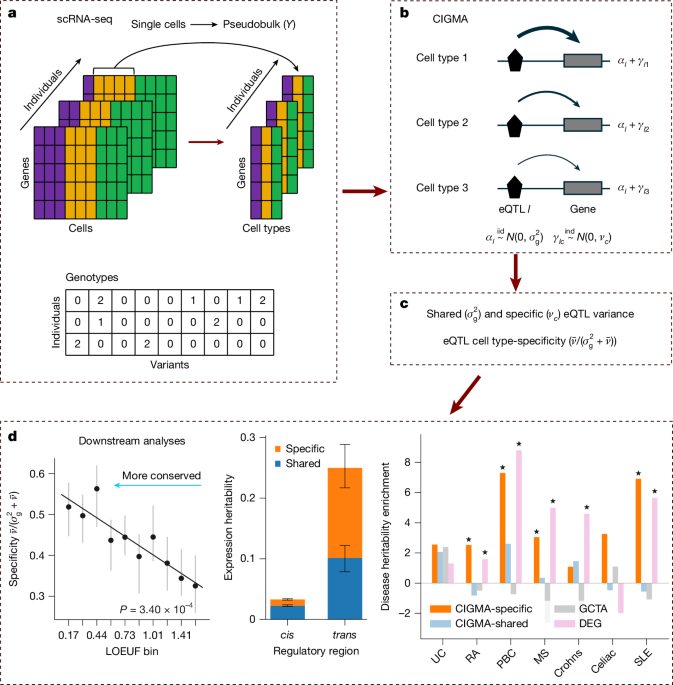
We propose an alternative approach based on partitioning variation in scRNA-seq data. Rather than identifying individual eQTLs, our model unbiasedly quantifies the overall contributions of cell-type-shared and cell-type-specific eQTLs. Using this approach, we established the importance of cell-type-specific eQTLs in the genetic architecture of complex traits and partly explained why known eQTLs are depleted in functionally relevant gene features.
We set out to characterize cell-type-specific eQTLs by combining recent population-scale scRNA-seq datasets, which greatly improve cell-type resolution over bulk tissues, with statistical genetic models that unbiasedly quantify genetic effects, similar to the genomic-relatedness-based restricted maximum-likelihood (GREML) model of complex trait heritability12.
Our approach, cell-type-informed genetic mixed-model analysis (CIGMA), is shown in Fig. 1 (Methods). For a given gene,