// NATURE NEWS — SPAZIO & SCIENZA
A binding-to-release strategy for targeted anticancer drug delivery
Nature
(2026) Cite this article
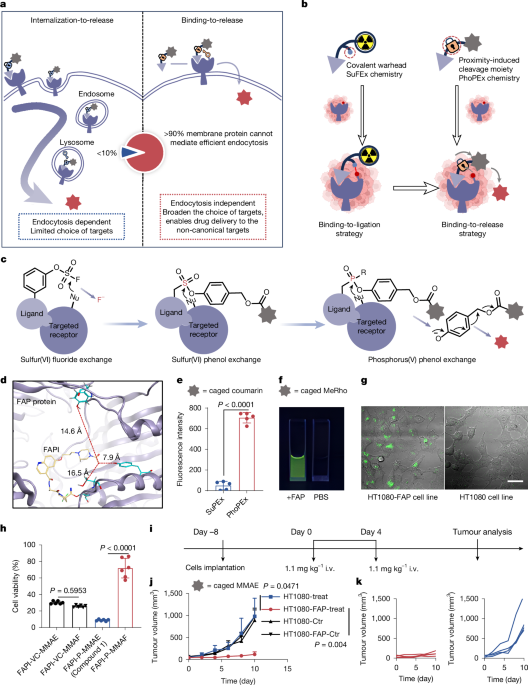
Drug conjugates, such as antibody–drug conjugates (ADCs) and small molecule–drug conjugates (SMDCs), are often dependent on efficient receptor-mediated endocytosis for payload release1,2,3—supported by about 10% of targets4,5,6,7. For poorly internalizing targets, drug conjugates dissociate and clear rapidly, limiting efficacy. To overcome the limitation in the internalization-to-release (ITR) pattern, we introduce a binding-to-release (BTR) strategy that decouples drug release from endocytosis by positioning an electrophile for direct cleavage by a proximal nucleophilic residue within the binding pocket. To realize this, we developed phosphorus(V)–phenol exchange (PhoPEx), a sulfur(VI) fluoride exchange-inspired chemistry enabling release of various payloads. This platform demonstrated high specificity from in vitro to clinical specimens, achieving precise detection of fibroblast activation protein (FAP) expression in patient-derived lymph nodes. In therapeutic settings, the FAP-BTR-SMDC achieved 5.9-fold higher monomethyl auristatin E exposure (AUC0–120 h) in tumours than internalization-dependent FAP-ITR-SMDC, matching FAP-ITR-ADC levels while minimizing off-target release. This led to improved ratios: the tumour-to-blood ratio was 14.7- and 3.6-fold higher than that of FAP-ITR-SMDC and FAP-ITR-ADC, respectively, and the tumour-to-liver ratio was 55.1- and 58.7-fold higher, respectively. This biodistribution increased the maximum tolerated dose and led to near-complete tumour regression in various tumour models. We further extended BTR to programmed cell death ligand 1 (PD-L1) and an mRNA-display-derived FAP peptide, suggesting potential broad applicability. This work establishes a framework that overcomes the internalization barrier, broadening the target scope for therapeutic and diagnostic conjugates.
Targeted drug conjugates, such as antibody–drug conjugates (ADCs), represent a transformative therapeutic modality in oncology1,2,3. Although their clinical success is undeniable—with the market projected to reach US$26 billion8,9,10,11—the field remains constrained by a fundamental limitation: a strong dependency on efficient receptor-mediated endocytosis and lysosomal trafficking for payload release12,13 (Fig. 1a, left). This endocytic prerequisite creates a dual bottleneck. First, it restricts the druggable target landscape to a small fraction of the human membrane proteome (about 180 of more than 2,000 proteins4,5,6,7) that undergo efficient internalization, funnelling development into intense competition on a handful of antigens such as HER2 and TROP211,14. Second, it subjects drug delivery to the cumulative inefficiency of the multi-step lysosomal trafficking pathway, resulting in only a fraction of the internalized conjugates successfully releasing their payload15,16. Although recent evidence suggests that extracellular payload release may also contribute to ADC efficacy in some settings, the dominant pattern of the field and optimization efforts remain centred on endocytosis13,17. Consequently, the vast majority of tumour-specific cell surface antigens with poor internalization efficiency remain an untapped ‘blue ocean’, representing a substantial opportunity for expanding the therapeutic reach of drug conjugates.
a, Schematic presentation of BTR compared with ITR strategy for drug delivery. b, Comparison of binding-to-ligation strategy and BTR strategy. c, Stepwise development of the PhoPEx reaction. d, Molecular docking of FAPI against FAP protein (PDB: 1z68), indicating the potential residue for PhoPEx reaction. e, Fluorescence intensity assay of FAPI-PhoPEx-coumarin and FAPI-SuPEx-coumarin were co-incubated with purified FAP protein (n = 5 independent samples). f, Representative photograph of the release of fluorescent molecules on FAP protein addition in vitro. FAPI-PhoPEx-MeRho (500 nM) and purified FAP (2 μM) were incubated in PBS (pH 7.4) at 37