// NATURE NEWS — SPAZIO & SCIENZA
Video reconstruction of variable VLBI observations with neural fields
Nature
(2026) Cite this article
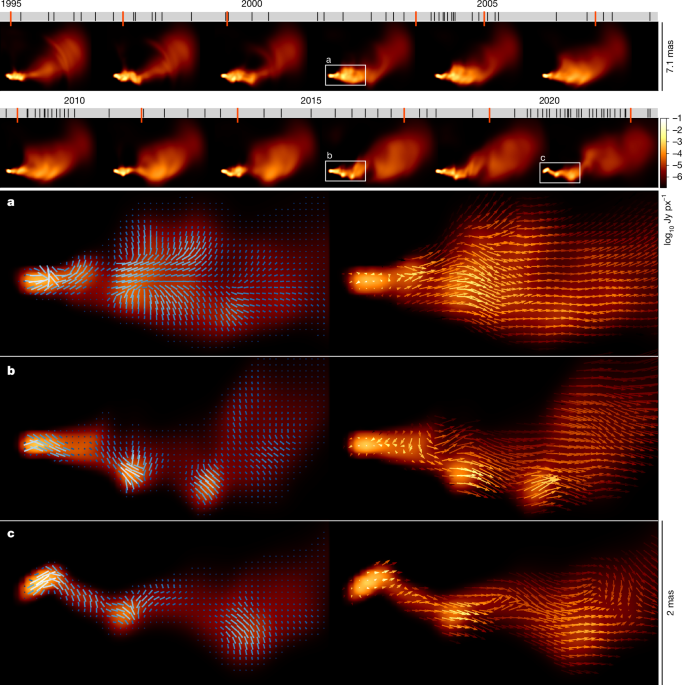
Supermassive black hole accretion and the ejection of collimated, relativistic jets of plasma are intrinsically dynamic processes shaped by large-scale magnetic fields1,2,3,4. Various algorithms have been developed to image these objects at different scales using radio interferometric observations5,6,7,8. However, there is a lack of imaging methods that can robustly resolve the temporal variability of the sources at high resolution. Here we present kine, a video reconstruction algorithm for very long baseline interferometry observations of variable sources. The kine algorithm uses a neural representation9 of the video to simultaneously process observations at different times, while learning and leveraging the spatio-temporal correlations present in the data. The algorithm reconstructs polarimetric time-continuous videos from single observations of fast-varying sources, such as horizon-scale observations of Sagittarius A* with the Event Horizon Telescope, or from repeated observations of slowly varying sources. In this work, we demonstrate the latter case, applying kine to multi-epoch Very Long Baseline Array observations of blazar 3C 345 (ref. 10). The time continuity of the video, combined with the resolution and dynamic range improvement achieved over traditional methods, enables the measurement of the local, instantaneous velocity of the plasma in the jet, in contrast to previous methods that track only discrete components. The proposed algorithm and methodology provide a transformative tool for kinematic jet analysis and can be applied to entire monitoring programs, providing a complete kinematic description of hundreds of sources, possibly leading to a reinterpretation of established models.
Supermassive black holes at the centre of active galactic nuclei drive the ejection of jets1,2, highly relativistic, collimated streams of plasma that propagate through the intergalactic medium11. Very long baseline interferometry (VLBI) is a primary tool to observe jets, enabling the detection of broad, unresolved features, called components, moving downstream at apparent superluminal speeds12,13,14,15. Superluminal components have been associated with travelling shock waves that compress the magnetized plasma16, whereas alternative models explain the components with plasma instabilities and geometrical effects17,18.
Traditional VLBI imaging relies on deconvolution techniques such as the widely adopted CLEAN5 algorithm. In recent years, alternative forward-modelling imaging approaches have been proposed6,7,8, which achieve improved angular resolution by incorporating prior assumptions about the image in a parametrized model of the sky brightness18.
We present a forward-modelling VLBI imaging method, kine, that recovers a full-polarimetric video of variable radio sources. kine reconstructs the video by jointly recovering all frames simultaneously, learning and enforcing the spatio-temporal correlations in the data through a neural representation of the video, which infers the extent of the correlations during the imaging process. This method outputs a continuous representation of the brightness density distribution, sampleable at any time coordinate. By imaging multiple datasets simultaneously, each frame is reconstructed using substantially more information than in traditional, single-epoch imaging, leading to improved angular resolution and dynamic range that can overcome limited (u, v)-coverage or lower signal-to-noise ratio (SNR) on individual observations.
The continuity and high-resolution of our video allow us to apply post-processing techniques, such as optical flow19,20, to recover the local instantaneous velocity field associated with the plasma. This is an advance over traditional kinematic analyses based on Gaussian model fitting21,22 or wavelet component decomposition23 because it resolves in space and time the projected velocity field describing the appare