// NATURE NEWS — SPAZIO & SCIENZA
Primate-specific regulation of the human glycosphingolipid gatekeeper UGCG
Nature
(2026) Cite this article
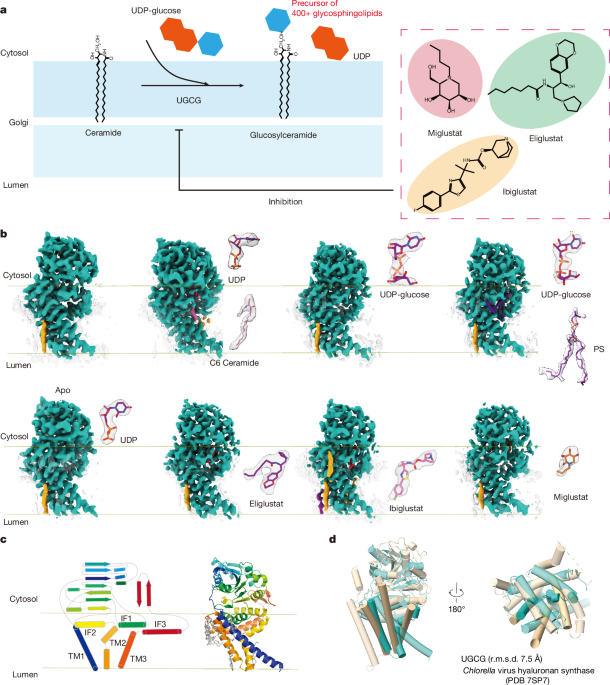
Glycosphingolipids are essential membrane components that organize lipid microdomains and orchestrate cellular signalling, differentiation and neuronal function1,2,3,4. In humans, these functions arise from a repertoire of several hundred glycosphingolipid species generated through stepwise glycan elaboration5,6. Entry into this network is controlled by a single committed reaction catalysed by UDP-glucose ceramide glucosyltransferase (UGCG), the gatekeeper that dictates the scale and composition of glycosphingolipid diversity. Despite its biological and therapeutic importance7,8, its mechanism and regulation have remained unknown. Here we report cryogenic electron microscopy structures of full-length human UGCG in eight functional states at 2.9–3.4 Å resolution. UGCG adopts a previously unrecognized triple-pass transmembrane architecture that anchors a GT-A core at the membrane interface and creates a bipartite active site engaging soluble and membrane-embedded substrates. Contrary to canonical GT-A enzymes, UGCG uses a metal-independent catalytic mechanism driven by an arginine network. We identify a primate-specific steric element that tunes lipid affinity and catalytic turnover, modulating glycosphingolipid entry. Structures with clinically used inhibitors reveal how this architecture governs their potency and selectivity. Together, these findings define the structural and evolutionary logic by which one enzyme controls glycosphingolipid diversity and provide a framework for precision modulation of membrane lipid homeostasis in disease.
This is a preview of subscription content, access via your institution
Access Nature and 54 other Nature Portfolio journals
Get Nature+, our best-value online-access subscription
Prices may be subject to local taxes which are calculated during checkout
The cryo-EM maps and atomic coordinates for the eight UGCG structures reported in this study have been deposited in the Electron Microscopy Data Bank and PDB, respectively, under the following accession codes: apo UGCG, EMD-80823 and PDB 26QF; UGCG bound to UDP-glucose, EMD-80832 and PDB 26QS; UGCG bound to UDP, EMD-80833 and PDB 26QT; UGCG bound to UDP-glucose and PS, EMD-80829 and PDB 26QM; UGCG bound to UDP and C6-ceramide, EMD-80824 and PDB 26QG; UGCG bound to miglustat, EMD-80827 and PDB 26QJ; UGCG bound to ibiglustat, EMD-80826 and PDB 26QI; and UGCG bound to eliglustat, EMD-80825 and PDB 26QH. The reference structure of Chlorella virus hyaluronan synthase used for structural comparison is available from the PDB under accession code 7SP7. Structural homology searches were performed against the PDB and AlphaFold Database. For molecular dynamics simulations, simulation input files, including initial system coordinate, topology and force-field files, equilibration configuration files and run scripts, as well as final output coordinate files, are available at Zenodo (https://doi.org/10.5281/zenodo.20809831)45. For sequence data sources: the amino acid sequences of UGCG analysed in this study were obtained from the NCBI protein database. The specific accession numbers for the species used in the phylogenetic analysis are as follows: Prototheria: Ornithorhynchus anatinus (platypus, XP_028909707.1), Tachyglossus aculeatus (echidna, XP_038626167.1); Metatheria: Monodelphis domestica (opossum, XP_001365801.1), Notamacropus eugenii (tammar wallaby, XP_072454167.1), Phascolarctos cinereus (koala, XP_020828114.1), Vombatus ursinus (wombat, XP_027695337.1), Sarcophilus harrisii (Tasmanian devil, XP_003761468.2); Afrotheria: Loxodonta africana (African elephant, XP_003407853.1), Trichechus manatus (manatee, XP_004372220.1), Orycteropus afer (aardvark, XP_007934906.1), Echinops telfairi (tenrec, XP_012862260.1); Xenarthra: Dasypus novemcinctus (armadillo, XP_058158524.1); Laurasiatheria: Erinaceus europaeus (hedgehog, XP_007529571.1), Myotis lucifugus (bat, XP_023609045.1), Equus caball