// NASA BREAKING NEWS — SPAZIO & SCIENZA
9 Things to Know About NASA’s Nancy Grace Roman Space Telescope
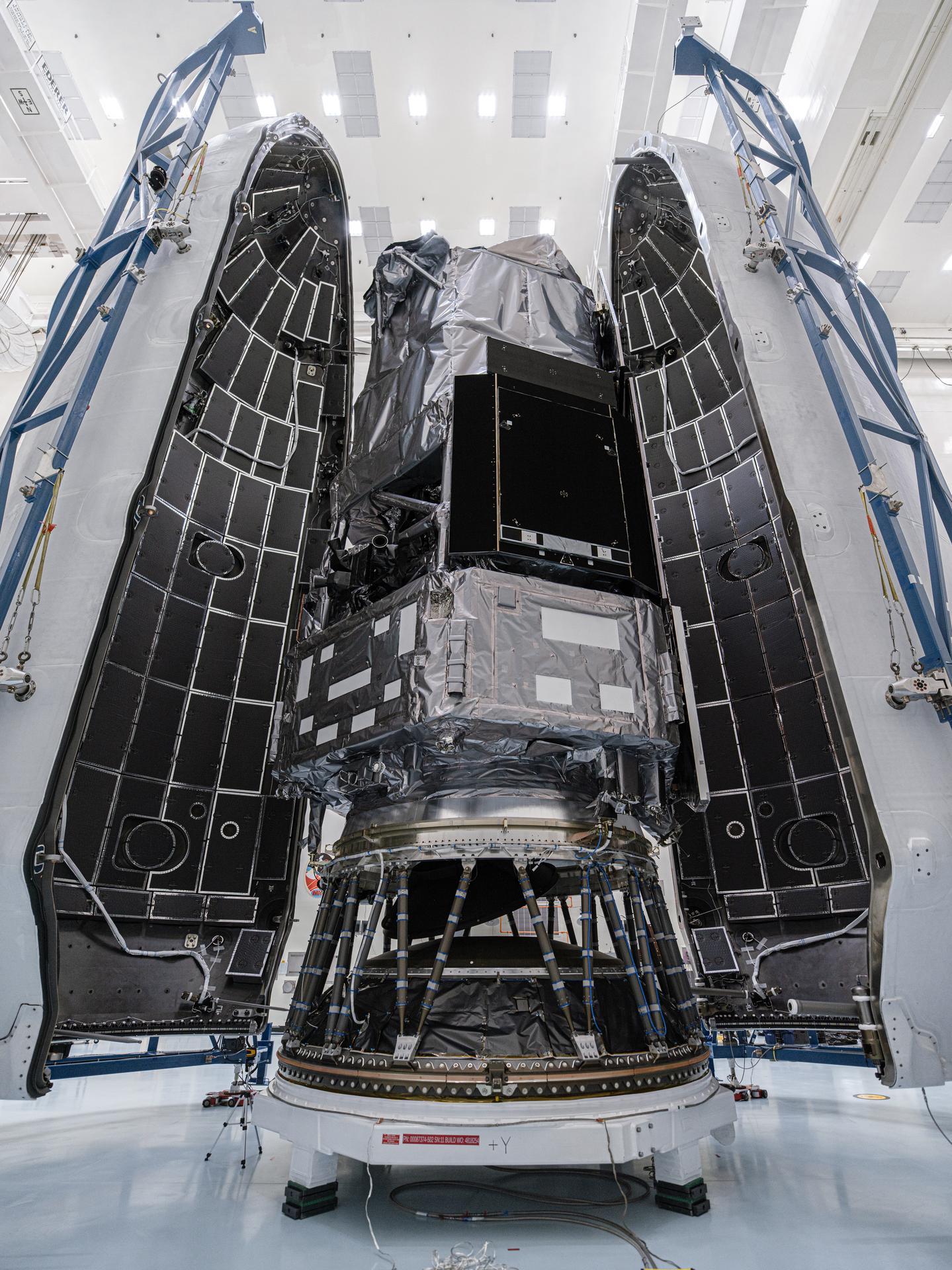
NASA’s Nancy Grace Roman Space Telescope is set to launch at 7:26 a.m. EDT on Sunday, Aug. 30. While you wait to watch the launch, brush up on some key facts about this wide-view mission.
Roman is named after Dr. Nancy Grace Roman (1925–2018), NASA’s first chief of astronomy. She championed space-based observatories that could study the universe above Earth’s hazy atmosphere while making their data broadly available to the scientific community. While she’s known as the “mother” of the Hubble Space Telescope, Roman played an even broader role as the driving force behind NASA’s entire Great Observatories program, which included Hubble along with the Chandra X-ray Observatory and the retired Compton Gamma Ray Observatory and Spitzer Space Telescope. Her vision and leadership helped establish NASA as a world-class scientific institution and laid the foundation for generations of space telescopes that continue to expand humanity’s understanding of the cosmos.
Roman will pair a large field of view with crisp infrared vision to scan vast, deep swaths of sky. This flagship mission is designed to help astronomers explore dark matter, dark energy, and planets outside our solar system, called exoplanets. Since each of Roman’s surveys will sample such a large volume of the cosmos, the mission will also offer practically limitless opportunities for astronomers to conduct a broad range of additional science. From objects in our outer solar system and exploding stars to growing black holes and galaxies by the billions, very little will be beyond Roman’s reach. Roman’s data will be made public as soon as it’s processed, allowing many teams to analyze it simultaneously.
Roman will orbit 1 million miles away at the second Sun-Earth Lagrange point (L2), the same location as NASA’s James Webb Space Telescope. At L2, gravity from the Sun and Earth works together with an object’s motion around the Sun to hold it roughly in place. This balance will give Roman a relatively steady orbit without using much fuel. Like Webb, Roman will trace out a large orbit around the actual L2 point — much larger than the Moon’s orbit around Earth — and the two will easily be kept far apart.
This summer, everyone was invited to submit their name to be added to a memory card attached to a plaque on the Roman spacecraft. More than 1.3 million people did so and will have their names carried all the way to L2.
Roman will have a primary mission lifetime of five years and is designed to support an additional five-year extended mission. Fuel is expected to be the mission’s life-limiting resource, and while NASA does not currently have an ability to service observatories at L2, Roman is designed to be refuelable.
The observatory’s Wide Field Instrument is a 300-megapixel infrared camera that will give Roman the same sharpness (angular resolution) as Hubble but with a field of view at least 100 times larger. Using this instrument, each Roman image will capture a patch of the sky about 1.5 times bigger than the apparent size of a full Moon. Roman’s Coronagraph Instrument is designed to demonstrate the most advanced technologies ever flown in space for directly imaging planets around other stars. It will block the glare from stars and make it possible for scientists to see the faint reflected light from planets in orbit around them, revealing giant worlds that are older, colder, and in closer orbits than the hot, young super-Jupiters direct imaging has mainly revealed so far.
Roman will work in tandem with many other NASA-led and international missions to provide the most complete view of our universe yet. Roman’s large panoramas will uncover interesting targets that Hubble could follow up on using infrared, visible, and ultraviolet light to offer a more comprehensive view. NASA’s James Webb Space Telescope can then use its larger mirror and more powerful vision to deliver even more detailed, ultra-sharp observations. And Roman can view regions around objects Hubble or We