// SPACE.COM — SPAZIO & SCIENZA
On Cloud 9: Have astronomers discovered the first starless galaxy?
"Most objects in the universe leave some trace of light. Cloud-9 does not. That silence is, in its own way, the most compelling result we could have obtained."
When you purchase through links on our site, we may earn an affiliate commission. Here’s how it works.
Scientists are closer than ever before to confirming that a galaxy known as "Cloud 9" is the first "starless" or "failed" galaxy ever discovered by humanity.
A starless galaxy is one with virtually no stars despite possessing a wealth of gas and dust that would normally serve as the building blocks of stars. The dominant element of a starless galaxy would be dark matter, the mysterious "stuff" that remains effectively invisible because it doesn't interact with light. Located 14 million light-years away near the spiral galaxy Messier 94 (M94), Cloud 9 is currently the best candidate for a starless galaxy humanity has discovered to date. It contains a vast cloud of hydrogen gas with an estimated mass of 1 million times that of the sun, and dark matter with around 5 million solar masses. Yet, the Hubble Space Telescope discovered in January this year that Cloud 9 emits virtually no starlight.
"But the most striking aspect of our research was the absolute emptiness of the image at the location of Cloud 9. When you look at an image reaching those depths and see nothing where a structure containing a million solar masses of gas should be, it is genuinely remarkable," team leader Ignacio Trujillo of the Instituto de Astrofísica de Canarias, Spain, told Space.com.
"Most objects in the universe leave some trace of light. Cloud 9 does not. That silence is, in its own way, the most compelling result we could have obtained."
Trujillo explained that despite having enough raw material to build a small galaxy, Cloud 9 seems to have never formed any significant stellar population. "That combination — gas but no stars, sitting in a relatively normal environment — makes it one of the most compelling candidates for what theorists call a 'dark' or starless galaxy," Trujillo added. "The concept has been theoretically predicted for decades, but observationally confirmed cases remain elusive. "The difficulty is obvious: if there are no stars, there is no visible light to detect, and the only way to find such objects is through their gas emission — typically neutral hydrogen observed at radio wavelengths — combined with extremely deep optical imaging to rule out the presence of even a faint stellar component."
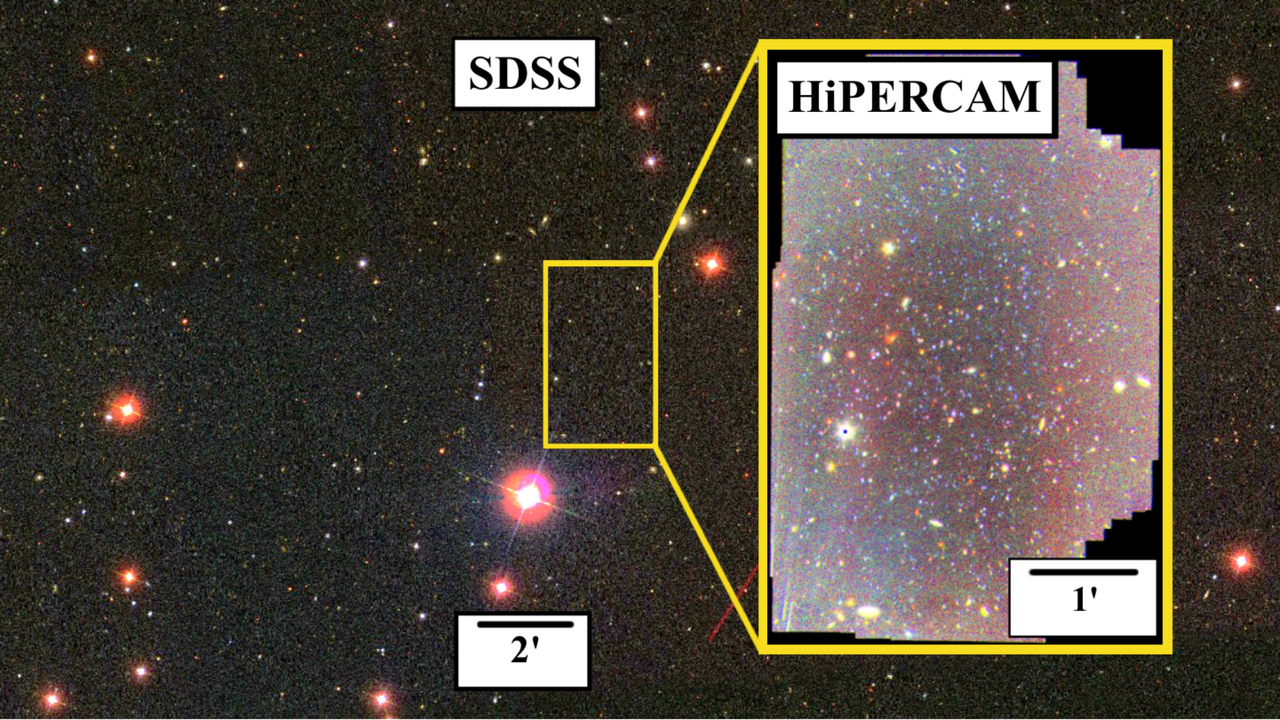
Trujillo and colleagues set about investigating Cloud 9 using the HiPERCAM camera on the Gran Telescopio Canarias, the world's largest optical telescope. This led to them obtaining the deepest images ever taken of the Cloud 9 region, approximately ten times deeper than any previous optical imaging of this object. "Honestly, the depth we achieved with HiPERCAM in just 2.36 hours of integration was striking," Trujillo said. What they saw left no questions about the nature of this galaxy.
"The result was clear: we detected absolutely no stellar emission within the region corresponding to the location of Cloud 9," Trujillo said. "Assuming an old, metal-poor stellar population — which would be the hardest kind to detect — we can set an upper limit on the total stellar mass of just 16,000 solar masses.
"Cloud-9 appears to be, within the limits of our observations, genuinely starless."