// ARS TECHNICA — HARDWARE & GADGET
Early land animals skipped the tadpole phase
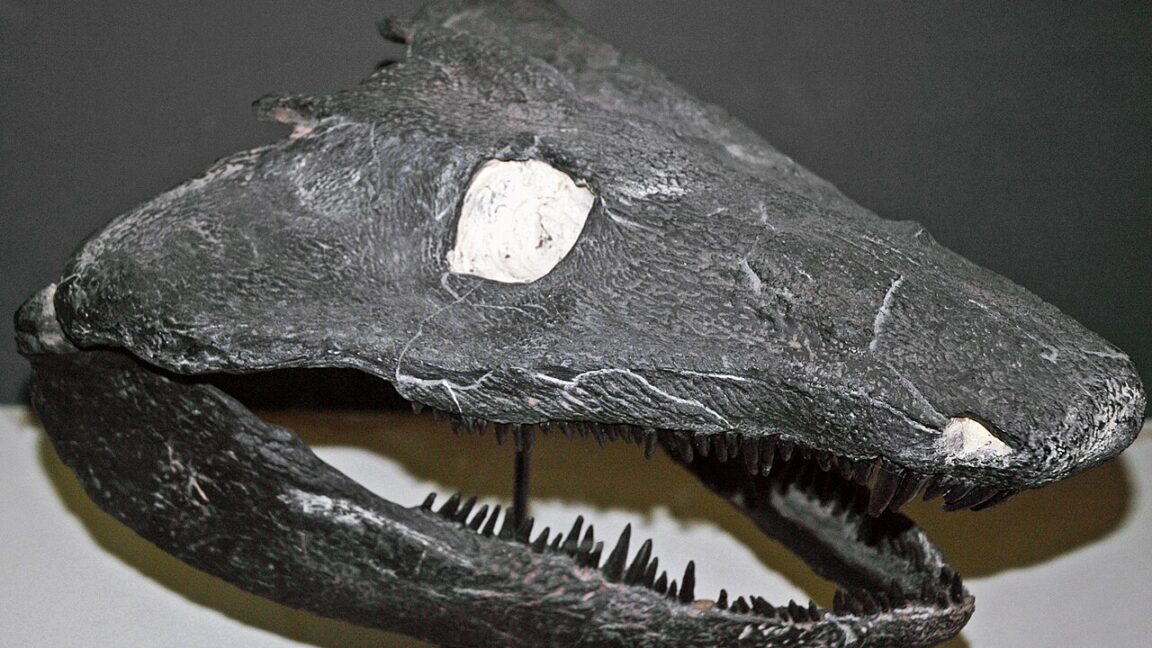
Current amphibian development may not have been typical of early land vertebrates.
For decades, biologists thought that early tetrapods, ancient vertebrates that started conquering the land over 300 million years ago, developed like modern amphibians—beginning their lives as purely aquatic tadpoles and then metamorphosing into terrestrial adults. “A lot of that comes from this old ‘scala naturae’ idea that you had fish that evolved into the next stage up, which were amphibians, and then amphibians evolved into the next stage up, which were reptiles that evolved into birds and mammals,” said Jason Pardo, a research associate at the Field Museum.
We’ve never had evidence that early tetrapods had an amphibian lifestyle; we have assumed it because it made intuitive sense. “It’s easier to make the transition from water to land if you’re already making that transition as part of your life cycle,” Pardo said. But now, a new Science study that Pardo co-authored with Arjan Mann (the Field Museum’s assistant curator of early tetrapods) shows our most basic assumptions about the first tetrapods that started living on land might be wrong.
The researchers’ study focused mainly on embolomers, an extinct group of large predators that lived roughly 300 million years ago. Embolomers looked like a cross between a crocodile and an eel, with large skulls full of sharp teeth, followed by long, eel-like bodies. It had short, stocky limbs adapted mainly for paddling in water, but also capable of powering brief, clumsy excursions on land. They are thought to be one of the first vertebrates that made a partial transition from an aquatic to a terrestrial lifestyle. These animals could reach over three meters in length, but to understand the very beginning of their life cycle, scientists focused on examining some of their centimeter-scale babies.
One of the most important specimens in the study was an embolomere fossil designated FMNH PR 1082, which has been sitting in the collections at the Field Museum for decades. “I think it’s been there for about 50 or 60 years. It was originally found by a collector,” Mann said. The fossil was initially classified as a different tetrapod species due to its very small size. But armed with modern imaging techniques like electron microscopy, Pardo and Mann realized the fossil was in fact a very young embolomere that died before it could even consume its first meal. “We were able to identify features that linked it to embolomers like the shape of the vertebrae, the radial spines on the tail, and the nice little fangs,” Mann said.
The team also realized that this young embolomere looked like a miniature adult. What’s more, the individual had an abdominal yolk, a portion of the egg’s yolk sac that an embryo internalizes into its body cavity just before hatching to use as an energy reserve. (According to the researchers, this internal yolk mass suggests the ancestral tetrapod egg was relatively large and nutrient-dense, like the ones laid by reptiles and birds, as opposed to the small eggs laid by amphibians and fish.) Despite having hatched recently, the specimen lacked the external gills that tadpoles should have, and there were signs of ossification in its bones—it was a youngling, but it was no tadpole.
The lack of a tadpole phase so early in life suggested there was no metamorphosis in this animal’s life cycle, which led Pardo and Mann to hypothesize the development of early tetrapods was direct, as it is in the reptiles or mammals that appeared much later.
Then they started looking at other fossils to make sure the FMNH PR 1082 was not some kind of outlier. It turned out it wasn’t.
To confirm this wasn’t an isolated case, the team looked at a second, even smaller embolomere hatchling that also showed no signs of external gills. Once this was confirmed, the team started checking fossil collections in other museums across America, looking for youngsters of other ancient lineages to see whether the missing tad