// HACKER NEWS — CYBERSECURITY
The efficient frontier of LLM inference
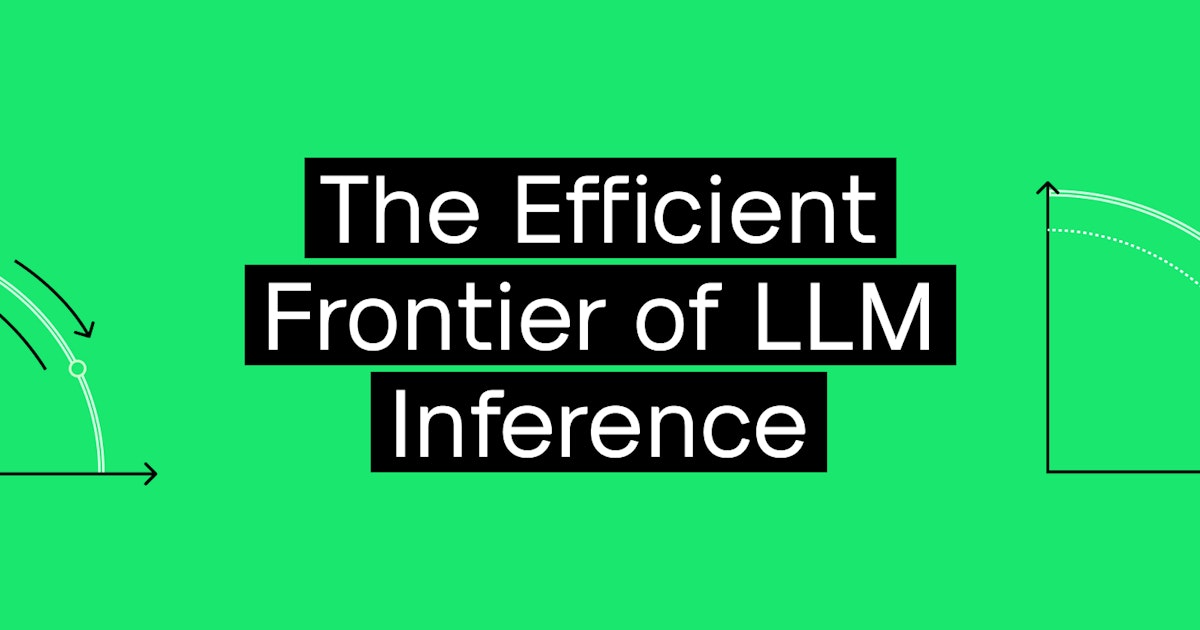
In the AI industry, we borrowed the term “efficient frontier” from economists. We use it to talk about managing tradeoffs, most often the tradeoff between cost and capabilities for models. A model is a “frontier model” if it offers the highest degree of intelligence at a given cost or size.
We also have efficient frontiers in inference engineering. Most often, this is expressed as a tradeoff between latency and throughput (which determines cost), though we can also exchange quality for throughput (via quantization, distillation, and pruning) or intelligence for speed (in the form of reasoning level).
There are two types of techniques available to inference engineers:
Techniques which make a tradeoff between two factors to move a deployment along an efficient frontier.
Techniques which push out the entire frontier for a given deployment, creating more overall efficiency which can be allocated to whatever outcome is most beneficial.
It’s useful to be able to target any point along an efficient frontier by making tradeoffs. Giving up per-user speed makes it possible to build high-throughput, low-cost pipelines for batch workloads. Sacrificing throughput to improve speed makes sense when latency-sensitive users have a high willingness to pay.
And of course, it’s incredibly useful to push out the entire frontier. Unlocking more efficiency creates gains that can be allocated to lower latency, higher throughput, or a combination of the two.
This article details which inference engineering techniques let you target a point on the frontier, and which techniques push the entire frontier out. For this article, we’ll assume we’re running an LLM like GLM-5.3 or Kimi K3 for agentic coding with KV cache reuse enabled and optimal KV-aware routing.
Hitting a certain target in production is often less about discovering some novel approach and more about finding the right set of configurations given the nature of the traffic.
In practice, the efficient frontier is very jagged. Rather than a smooth, continuous line between outcomes, small changes can have big impacts. These cutoff points are often unintuitive and must be discovered empirically through sweeps.