// NATURE NEWS — SPAZIO & SCIENZA
Self-driving cars make mistakes, and now users can see why
Hyochang Kim is at the Stanford Center at the Incheon Global Campus, Stanford University, Incheon 21985, South Korea.
Search author on:
PubMed
Google Scholar
Hyunmin Kang is in the Department of Psychology, Daegu University, Gyeongsan 38453, South Korea.
Search author on:
PubMed
Google Scholar
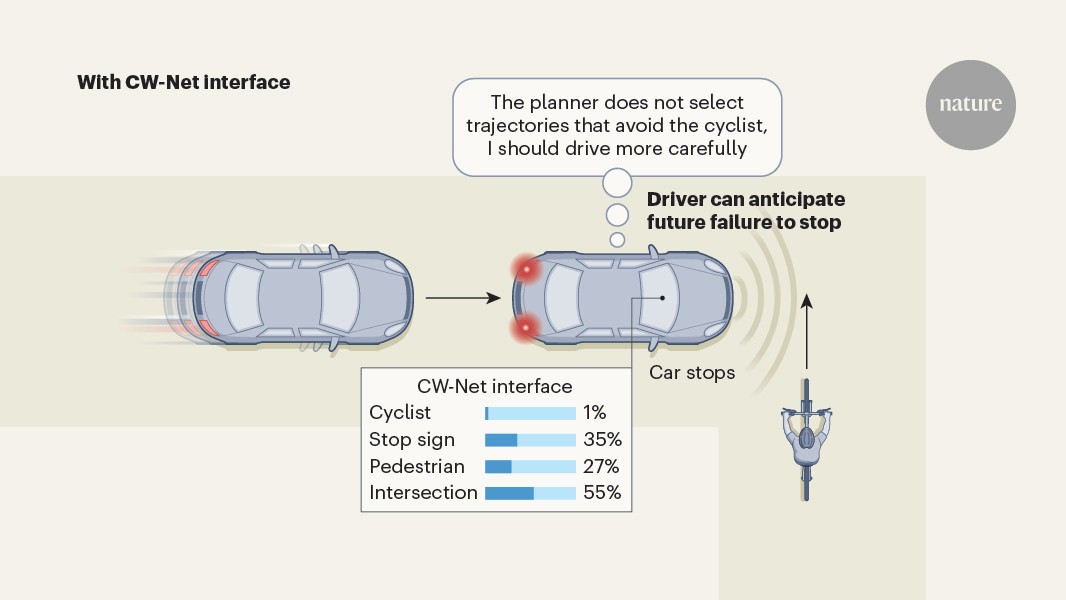
An autonomous vehicle brakes on a seemingly empty road. The driver cannot tell whether the car has detected a real hazard or is hallucinating and, unable to understand the system’s reasoning, they do not know whether to intervene. Writing in Nature, Kenny et al.1 report an algorithm called Concept-Wrapper Network (CW-Net) that tackles this ‘black box’ problem. CW-Net uses human-interpretable concepts to make the vehicle’s decisions transparent, and the authors show that this makes people better at predicting what the vehicle will do next — including in situations in which it has made a mistake.
Access Nature and 54 other Nature Portfolio journals
Get Nature+, our best-value online-access subscription
Prices may be subject to local taxes which are calculated during checkout
Koh, P. W. et al. in Proc. 37 Int. Conf. Mach. Learn. (eds Daumé, H. III & Singh, A.) 5338–5348 (PMLR, 2020).
Koo, J. et al. Int. J. Interact. Des. Manuf. 9, 269–275 (2015).