// HACKER NEWS — CYBERSECURITY
Reasons robotics is hard
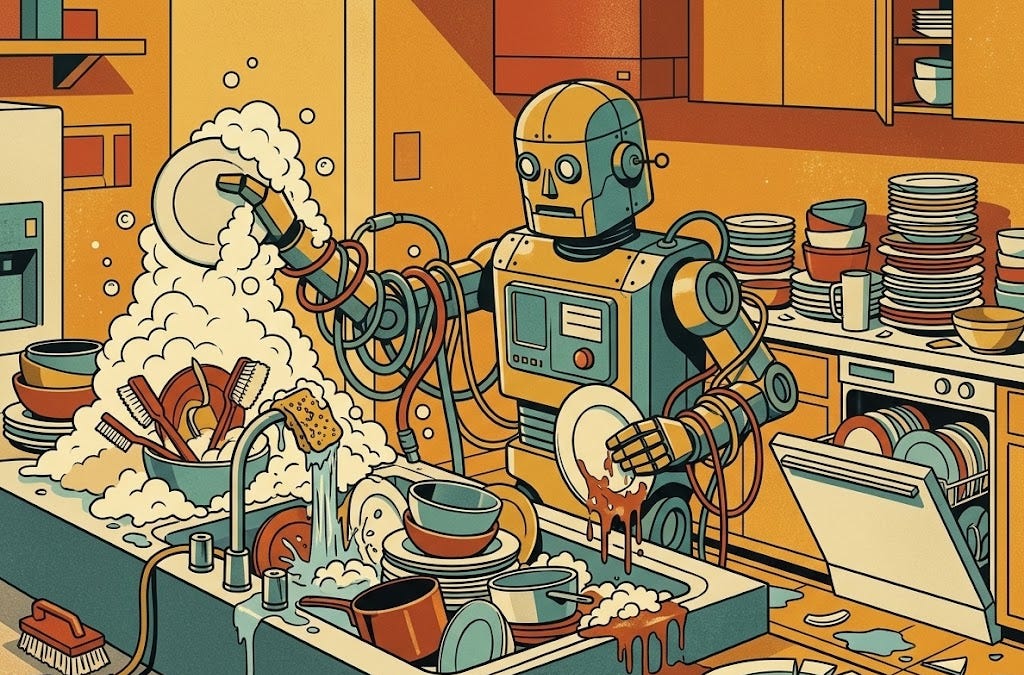
AI progress is racing along, but virtually all of the visible progress is in the realm of knowledge work, i.e. activities that can take place inside a computer.
In the San Francisco AI scene, there is a widespread belief that robots will soon enter the picture. In parallel with the race to develop broadly capable AI, there is an equally aggressive race to develop broadly capable robots – humanoid machines imbued with physical intelligence. Artificial workers that can cook and clean, fetch and carry… and do everything else, including building more of themselves, leading (in many forecasts) to economic growth best characterized as an “explosion”.
In other words, the thinking goes, AI in the data center will soon subsume all intellectual labor, and AI in humanoid bodies will soon subsume all physical labor. However, there is an important difference: while we can see progress in the intellectual realm, the physical side of AI is mostly confined to test facilities and demo videos. There is no robot equivalent to ChatGPT – nothing that you or I, or even most people in the AI community, can get our hands on.
So we’re stuck with demo videos. Unfortunately, they are a poor tool for assessing progress. We might be seeing the one successful task achieved in 100 attempts. The scenario might have been carefully arranged to avoid challenges the robot isn’t ready for. The video might be edited to make it look like the robot is acting with more speed and reliability than is actually the case. Here’s one very impressive demo… with a suspiciously large number of camera cuts.
(I have not yet had much chance to watch videos from the recent World Humanoid Robot Games. These are valuable for providing a public platform less amenable to cherry-picking. The handful of videos I’ve watched include some impressive feats, but don’t address many of the challenges I list below… and there are also a lot of spectacular failures.)
Demos draw attention to the things a robot can already do. The question then becomes: what’s missing? In today’s post, I’ll catalog the technical challenges that will have to be overcome along the road to broadly capable artificial workers. The next time you watch a robot doing something impressive, ask yourself: which of these capabilities has the robot demonstrated, and which challenges might the demo scenario be avoiding?
(Note that some challenges get easier if we consider wheeled robots rather than strictly humanoid robots. A wheeled robot can carry more weight, meaning that strength, endurance, and power for electronics are less of a challenge. And wheeled robots are less likely to fall over. But they can’t climb stairs1, step over clutter, or angle themselves to reach into a cupboard.)
The human hand is an engineering miracle – opposable thumbs, and all that. It has roughly two dozen “degrees of freedom” (distinct joints and/or directions in which each joint can bend), and approximately 17,000 tactile sensors. Our brains can control our hands with exquisite grace, using touch, sight, and even auditory cues to carry out all manner of delicate tasks, precisely and reliably.
Current robot “manipulators” are a pale imitation. Some existing robot hands can match the human standard on one or another physical attribute. For example, some have as many as 27 degrees of freedom. However, none come close to matching the overall package of flexibility, sensitivity, strength, reliability, and other physical attributes. It is the combination of factors that is especially difficult to match, even if the demos are getting more impressive. For instance, some companies have managed to cram thousands of tactile sensors into a robotic fingertip, but none have managed to make these tiny sensors able to stand up to heavy use2.
The control problem may be as challenging as the problem of physical construction. A competent robot must be able to find the right set of joint positions to grasp a complicated object; plan out the sequence of moti