// SPACE.COM — SPAZIO & SCIENZA
2 spacecraft will soon reach Mercury after 8 years in space. Here's what BepiColombo can do
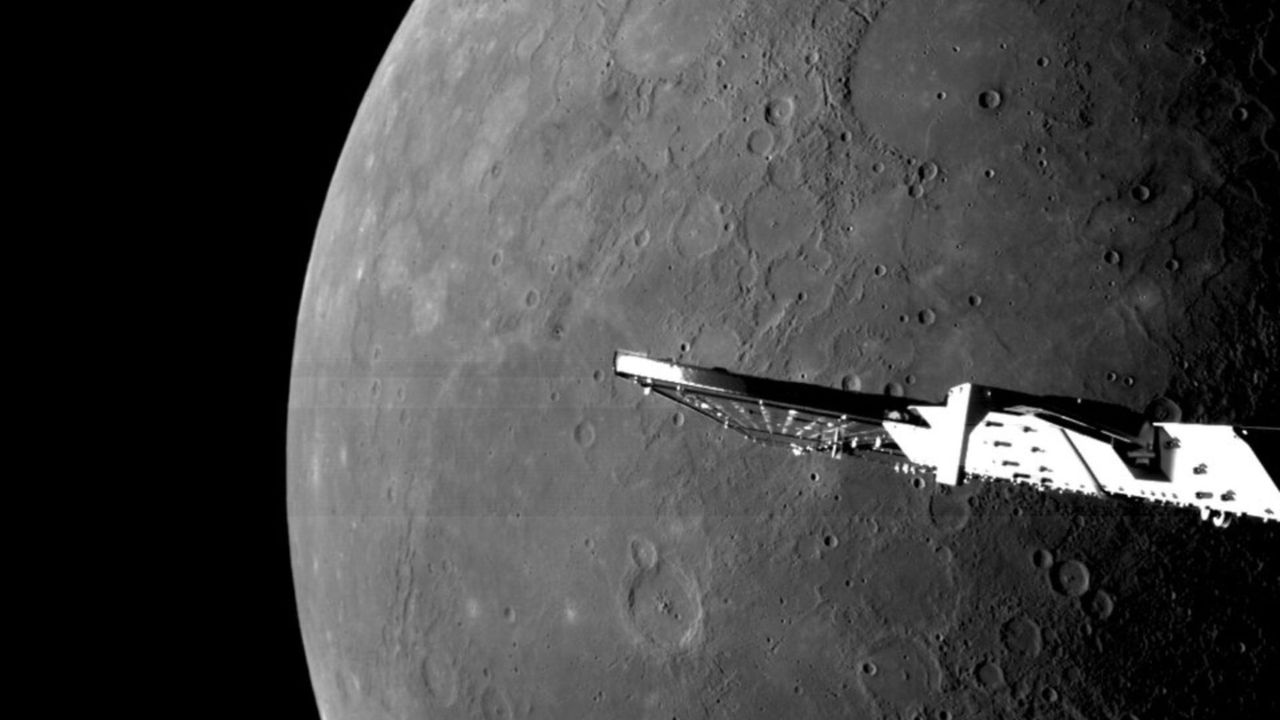
The tiny planet hides big mysteries that scientists can't wait to tackle.
When you purchase through links on our site, we may earn an affiliate commission. Here’s how it works.
Mercury, the tiniest and least-explored planet in the inner solar system, is hiding mysteries far larger than itself — and finally, scientists will soon be getting not one but two spacecraft designed to decode the strange world.
That's thanks to the BepiColombo mission, a joint project of the European Space Agency (ESA) and Japan Aerospace Exploration Agency (JAXA) that launched in October 2018. After a harrowing journey through the inner solar system, the mission is tackling a crucial maneuver on Thursday (Sept. 3): separating its science equipment from the transport that carried it all that way. By April 2027, scientists hope the mission's two instrument-heavy probes will be gathering a slew of observations that could help solve puzzles about Mercury — and maybe even the solar system we call home.
"I think being able to see new data come out about Mercury is going to be so fantastic," Rachel Klima, a planetary geologist at the Johns Hopkins University Applied Physics Laboratory, told Space.com. The planet, she says, is "just so weird and beautiful and interesting."
For now, Mercury holds the dubious honor of being the least-explored planet in the inner solar system, visited by only two missions to date. NASA's Mariner 10 spacecraft made a trio of zippy flybys in 1974 and 1975, giving scientists their first glimpses of the planet's cracked and cratered surface, as well as confirming the world has both a very tenuous atmosphere and a magnetic field.
"It really gave us our first close-up view of Mercury," Sean Solomon, a planetary scientist at Columbia University, told Space.com. "But it left a lot of pages blank."
And for decades, that was it. Scientists didn't return to Mercury until 2011, when NASA's MESSENGER spacecraft, with Solomon as its principal investigator, arrived at the tiny world. (Mercury has a radius of 1,516 miles, or 2,440 kilometers, meaning its width is just over a third of Earth's.) The spacecraft was packed with tools tailored to the job, such as spectrometers tuned to gamma-rays, X-rays and neutrons, and instruments to sniff out the atmosphere and measure the magnetic field, and it was there to stay. Four years of observations with MESSENGER showed scientists Mercury's complete surface for the first time, and by late in its mission, the spacecraft was passing just 15.5 miles (24.9 km) above the planet's surface.
But even MESSENGER wasn't sophisticated enough to crack Mercury's puzzles or unveil the strange planet's beginnings. "I think the jury's still out on exactly how Mercury got assembled," Solomon said.
MESSENGER opened up some smaller mysteries, too. It discovered bright, steep-sided pits that scientists dubbed "hollows." It found a suite of elements — that planetary scientists call "volatiles" for their tendency to slip free of rock — somehow more prevalent in Mercury's surface than Earth's. It calculated that the center of the planet's magnetic field is wildly offset from the planet's core. Plus, MESSENGER's tricky orbit also meant the spacecraft never saw the southern half of the planet as sharply as the northern half, leaving one side shadowed in doubt.