// NATURE NEWS — SPAZIO & SCIENZA
Buried underpants and a new definition of kissing win 2026 Ig Nobel prizes
Chris Simms is a science writer based in Somerset, UK.
Search author on:
PubMed
Google Scholar
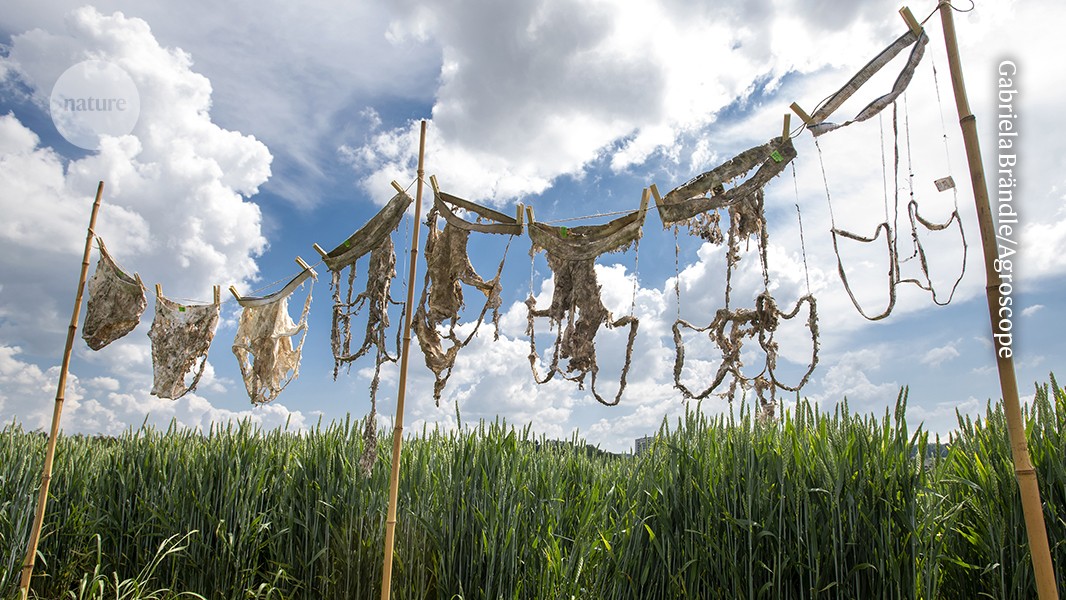
Researchers found that land use is a key factor in the decomposition of underwear, more so than other soil characteristics.Credit: Gabriela Brändle/Agroscope
The recognition and prestige of a Nobel prize for ground-breaking work comes with a gold medal and the equivalent of a million dollars. The parody version, an Ig Nobel prize, devised to celebrate research that makes people laugh, and then think, might not deliver on the cash front, but it does bring considerable renown.
This year’s Ig Nobel prizes were awarded on 3 September at a ceremony in Zurich, Switzerland. They include a biomechanics prize for creating a precise definition of kissing, which works across species and excludes the transfer of food during the act1, a physics award that aims to please with experiments to design a splash-free urinal2 and a soil-science award for investigating what happens if you bury and then dig up 1,000 pairs of underwear3 (see ‘The 2026 Ig Nobel prizewinners in full’).
“I hope that, as well as finding the research amusing, people will come away thinking a little differently about our place in the animal kingdom,” says Matilda Brindle, an evolutionary biologist at the University of Oxford, who was a co-author of the kissing study. “My jaw hit the floor when I got the phone call. It’s certainly one of my proudest life achievements.”
Brindle’s team steamily defined kissing as a “non-agonistic interaction involving directed, intraspecific, oral–oral contact with some movement of the lips/mouthparts and no food transfer”. According to this definition, polar bears, some birds and even ants kiss. What’s more, not only do other primates also snog each other, but the team also traced the behaviour back around 21.5 million years to the ancestor of all the large apes. This means that ancient Homo sapiens would probably have been smooching Neanderthals.
“We’ve shown that animals kiss and when it could have evolved in the primates; the obvious next step is understanding why. If this award helps spark more curiosity about this sort of question, then that’s a pretty wonderful outcome,” says Brindle.
Previous winners of Ig Nobel prizes have included researchers who studied the preferred pizza toppings of rainbow lizards in Togo4, the levitation of live frogs using magnets5 and research showing that London taxi drivers have particularly large hippocampi in their brains6.
In the prize’s early days — it was launched in 1991 by Marc Abrahams, editor of the satirical magazine Annals of Improbable Research — receiving an Ig Nobel prize was deemed insulting by some, but now many researchers see the awards as a great career boost.