// HACKER NEWS — CYBERSECURITY
OpenAI's GPT-6 Astra on ARC-AGI-3
ARC-AGI-3 is a benchmark for studying agentic intelligence through novel, abstract, turn-based environments. Agents must explore, infer goals, and build internal models of environments to effectively plan actions without explicit instructions. You can play ARC-AGI-3 yourself.
These environments only contain core knowledge priors and are difficulty-calibrated through controlled testing with human participants. Humans can solve 100% of the environments.
The goal of the ARC-AGI series is to measure the “residual gap” between current artificial intelligence and AGI. We define AGI as a system’s ability to acquire any skill a human can, as efficiently as a human can.
ARC-AGI-3 is the third generation of the ARC-AGI benchmark series. It tests agentic capabilities beyond ARC-AGI-1 and ARC-AGI-2. Each generation expands on the one before it - as frontier AI capabilities advance, our benchmarks must advance with them.
ARC-AGI-3 tests four components of agentic intelligence:
With our Standard harnessStandard harness enables a model to carry forward notes it chooses to keep with it throughout the environment., OpenAI’s Astra (max) scores 62.7% on ARC-AGI-3 Semi-Private for $26K. With the Provider Adapter harnessThe Provider Adapter harness preserves opaque reasoning state between requests and uses compaction for longer conversations, allowing the model to reuse prior work., Astra (high) scores 99.9% for $19K. Both are state-of-the-art scores. See the full leaderboard.
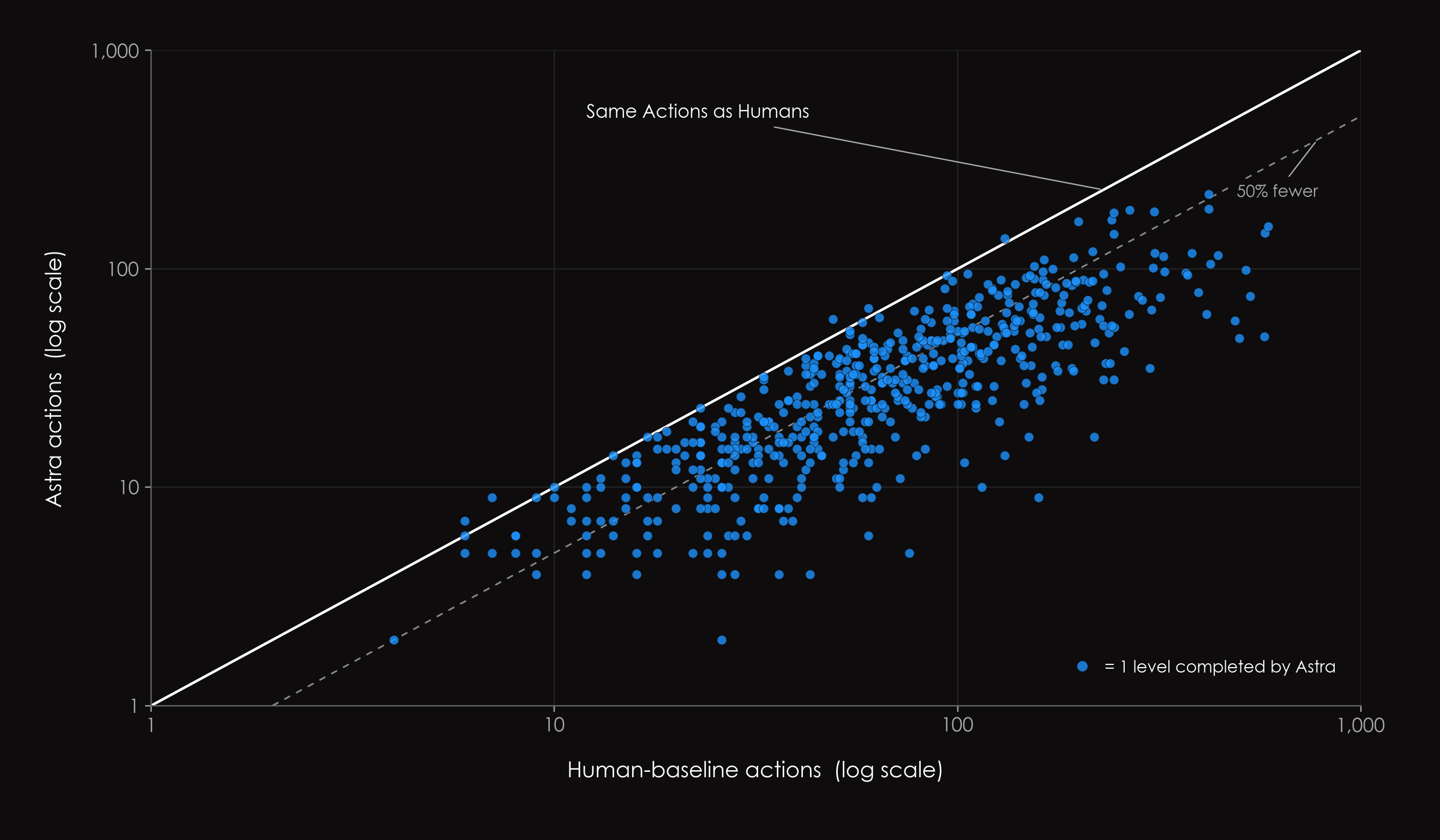
At max reasoning effort, Astra solves games more efficiently, requiring
fewer actions and therefore lowering total cost relative to the other
reasoning-effort levels.
For a cost comparison, during our controlled testing, human participants were paid $115 per 90-minute session, plus $5 per game completed. Participants attempted approximately nine games per session, roughly $12.78 per attempted game before bonuses.
Most of this fee pays for the participant’s time and willingness to take the test, rather than the energy their brain uses (a closer proxy to compare with AI). If we look at only the brain’s energy, and price it as electricity, the estimate drops to about 0.6 cents per session, or 0.067 cents per game attempted.1
Beyond the scores, Astra’s replays show how it turns unfamiliar game mechanics into useful working models. Three findings stood out: the compact algebraic notation it develops, its action efficiency compared with humans, and the custom tools it builds.