// SPACE.COM — SPAZIO & SCIENZA
How did the infant sun form? Scientists get surprising new insights from 4.6-billion-year-old space dust
"This transition, from a spherical cloud to a protoplanetary disk, is one of the most significant events in all of solar system history."
When you purchase through links on our site, we may earn an affiliate commission. Here’s how it works.
New research suggests that dust from meteorites contains a "fossil record" dating back to the formation of the sun. The research reveals that magnetism played a far greater role in the birth of the solar system than had previously been suspected.
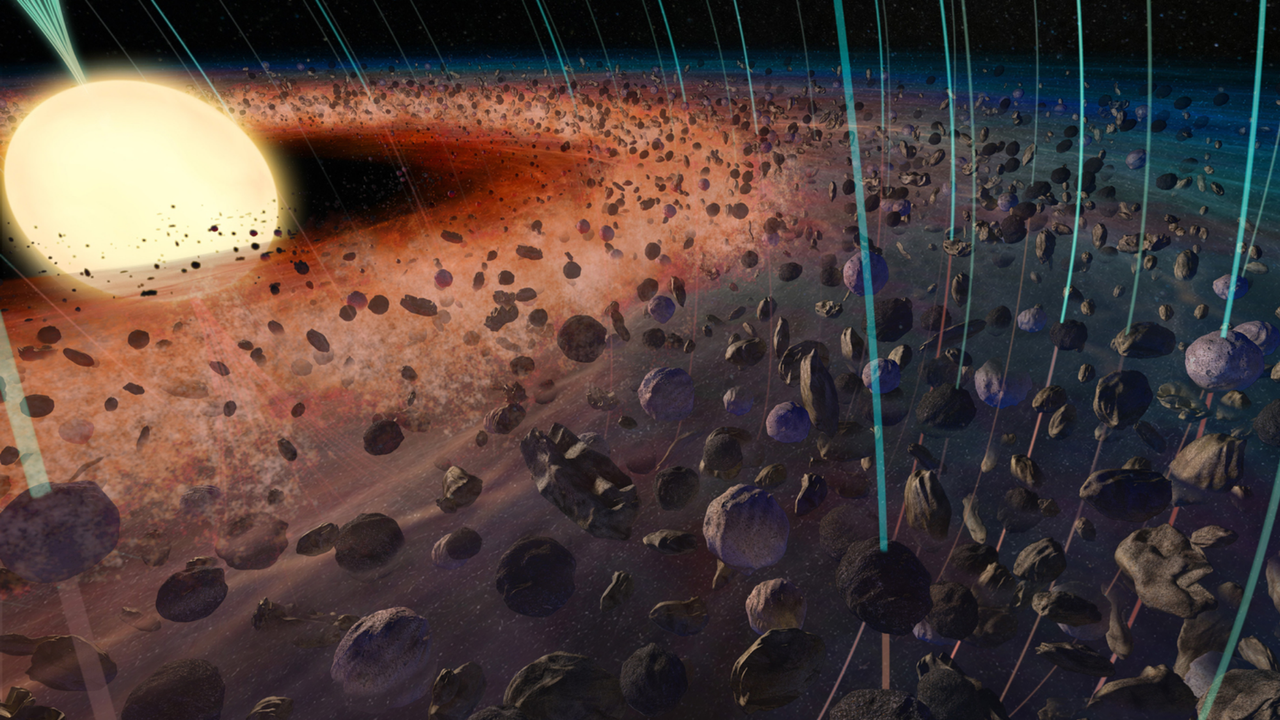
Around 4.6 billion years ago, the solar system was a cloud of gas and dust, known as a solar nebula. Over the next few million years, this cloud began to flatten, forming a donut-shaped ring or torus with a budding star gathering mass at its core. Eventually, planets would form within this so-called protoplanetary disk.
Scientists have always theorized that gravity was the main sculptor during this early era. But the new study suggests that gravity had major assistance from magnetism. The signature of this additional cosmic artist was found within grains of dust sealed in DOM 08006, a meteorite recovered from Antarctica in 2008.
The grains found by the team are calcium-aluminum-rich inclusions (CAIs), which are thought to have formed during the first 200,000 years of the solar system. That potentially makes them the oldest samples of solar system material ever seen.
"We know they are the oldest things we have of the early solar system," team leader Cauê Borlina of Purdue University said in a statement. "But CAIs are very complex and are not all the same, even within a 1-millimeter piece of the meteorite. So we have to carefully identify what types they are."
These CAIs indicated that there was a magnetic field in the proto-solar system even during its solar nebula phase. This magnetic field would have been stronger than Earth's magnetosphere and, as such, would have influenced the flattening of the solar nebula.
"This transition, from a spherical cloud to a protoplanetary disk, is one of the most significant events in all of solar system history," team member Benjamin Weiss, of the Massachusetts Institute of Technology (MIT), said in the same statement. "It has long been theorized that gravity caused this, but our measurements show magnetism likely played a role."
In the newly forming solar system, a magnetic field would have been generated when charged particles were sent spinning through the collapsing cloud of gas and dust that birthed the sun. This plasma would then have sustained that field.