// SPACE.COM — SPAZIO & SCIENZA
Venus is becoming a thinner crescent — and that's when it finally starts making sense
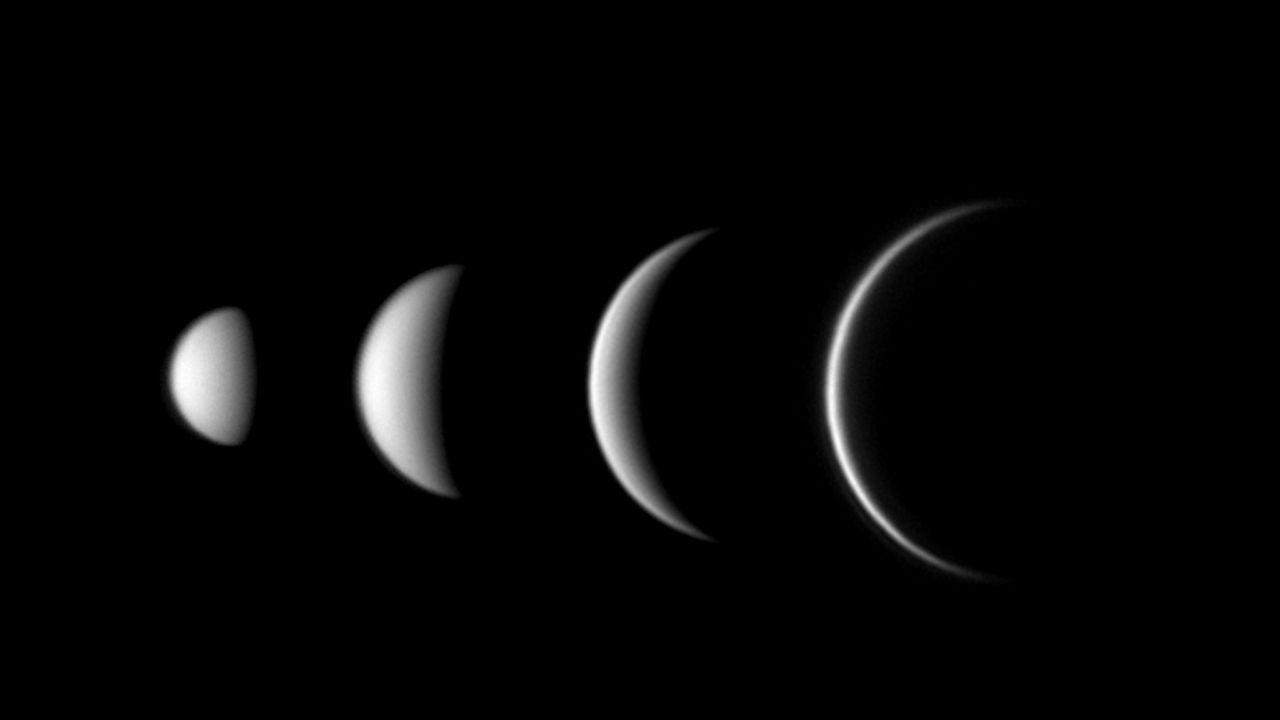
Venus is sinking into the sunset as it catches up with Earth — and a small telescope now reveals something the naked eye never can: another planet going through phases.
When you purchase through links on our site, we may earn an affiliate commission. Here’s how it works.
Venus is something of a frustration for stargazers. It's the brightest planet and the easiest to see, while the sight of it close to a crescent moon is one of the most achingly beautiful sights in the sky. Yet it gives almost nothing away.
Mars has its reddish color. Saturn rewards even a small telescope with its spectacular rings. Jupiter has moons, belts and an obvious disk. Venus, meanwhile, spends months blazing away in twilight looking exactly like what people who do not stargaze assume a star should look like — a brilliant white point. What we're seeing is sunlight reflected by its global cloud cover, which in turn makes it impossible to see in any detail.
But every now and then, it does something revealing by becoming a crescent. That is when Venus, an inner planet relative to Earth, finally makes sense.
Put a small telescope on Venus this week and its appearance is completely different from the dazzling dot seen with the naked eye. This week, its disk will dim from 36% to 32% lit as it shrinks toward a thinner crescent as September progresses. At the same time, its apparent disk is getting larger because Venus is moving closer to Earth.
Those two changes are connected. Venus reached its greatest eastern elongation, about 46 degrees from the sun, on Aug. 15. It's now swinging around the inside of its smaller, faster orbit of the sun towards inferior conjunction on Oct. 24, when it will pass roughly between Earth and the sun, and be lost in the sun's glare. Before that, it will reach its peak — greatest brilliancy — in the evening sky on Sept. 18, shining at magnitude -4.8 while just 26% lit. That's the sweet spot, when its increasing angular size and decreasing crescent combine at their brightest, as seen from Earth (though its modeled visual brightness peaks a few days later, around Sept.22). After that, it becomes an increasingly dim crescent.
Seeing Venus as a crescent makes the geometry beautifully obvious. We are no longer looking across the solar system towards the brightly illuminated side of Venus. We are increasingly looking at the planet from behind, towards its night side, with sunlight catching only one edge.
It is almost the same idea as a crescent moon — except Venus is another world tens of millions of miles away. As it passes roughly between Earth and the sun on Oct. 24, it will be 0.27 AU away — equivalent to 25 million miles (40 million kilometers). At its farthest, Venus can be 162 million miles (261 million kilometers) from Earth.
The phases of Venus were historically important. When Galileo observed Venus through a telescope in the early 17th century, seeing it display a broad range of phases helped demolish the traditional Ptolemaic model in which Venus was supposed to orbit Earth in a way that could not produce the full sequence he observed.