// HACKER NEWS — CYBERSECURITY
A Million Falcons Went Missing. Here’s How They Were Found
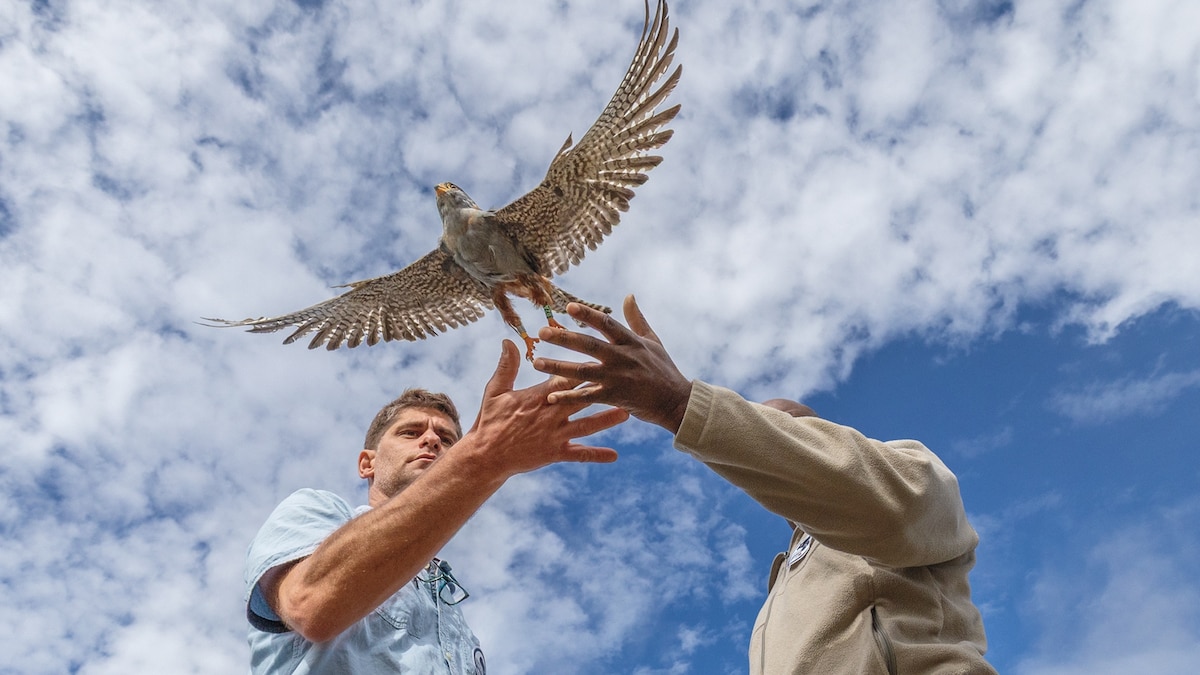
For years, the secret winter home of rare red-footed falcons remained a mystery. Then an ornithologist discovered the hidden world of “Falcopolis.”
Most birds of prey are loners. They might form huge flocks during migration, but for the rest of the year, they stick to themselves. The red-footed falcon is different. This kestrel-size bird frequently travels and roosts in large groups across Eastern Europe and Central Asia. It even nests in colonies, with hundreds of pairs of slate gray males and buffy-red females all living together in what Hungarian ornithologist Péter Palatitz calls “super-busy cities.” Within these avian metropolises, the falcons fight for nests, steal from each other, mate outside their partnerships, and leave eggs for others to raise. For scientists interested in how birds behave, “this system is a heaven,” says Palatitz, who has studied the falcons for 20 years.
These raptors don’t build their own cities. Instead, they occupy the abandoned nests of the rook, a relative of crows. But rooks have long been seen as agricultural pests and were so thoroughly persecuted in the 1980s and ’90s that their population crashed. The red-footed falcons, with nowhere to nest, plummeted to a quarter of their former numbers. In 2006, Palatitz launched a plan to reverse that decline by placing thousands of nest boxes throughout Hungary. The falcons responded enthusiastically. Over the next decade, their numbers doubled.
As the falcons rebounded, Palatitz took the opportunity to answer some long-standing questions about these little-studied creatures. For example, he knew that they winter in Africa but not their route or specific destination—key information for understanding how the species spends half its life. So, between 2009 and 2015, Palatitz and his team fitted 28 individuals with satellite transmitters. The devices revealed that the birds, which weigh just four to seven ounces, can cross the Mediterranean and the Sahara in a nonstop five-day flight. A week later, they end their 6,000-mile trek in southern Africa, where they stay for months.
But in resolving one mystery, Palatitz unearthed another. The tracking data hinted that in March, before returning north, the red-footed falcons all pass through the same small stretch of central Angola. Why? Some of the team thought this was a coincidence, but Palatitz argued that the birds were gathering at a huge roosting site. He bet a beer that he was right, and began making plans to visit Angola.
Traveling in Angola can be risky, as more than 14,000 acres of land are still contaminated with mines—a legacy of the country’s nearly three decades of civil war. For years, Palatitz couldn’t get permission to go outside the capital, Luanda. But in late 2018, he was introduced to José “Zeca” Agostinho, an Angolan who had spent decades doing de-mining work, including in Huambo Province, where the falcons seemed to be congregating. Agostinho lined up the right paperwork, and “our 10-year dreams came together in three months,” Palatitz says. By March 2019, the team was on the road to Huambo. And on their second day of searching, Palatitz won his beer.
The team came across a site where falcons streamed in from all directions, blackening the sky. Some darted around at eye level. Others wheeled overhead. They perched shoulder to shoulder on every available branch. As he watched them, Palatitz started crying. It was like being “in a new dimension,” he says, “like I’m not part of the Earth but I’m more part of the sky.”
Palatitz knew the falcons were sociable, but he had completely underestimated just how sociable they could be. In the summer, the birds are spread across thousands of miles from Hungary to Kazakhstan. But for six weeks in February and March, every last one passes through this tiny, 1.5-square-mile region of central Angola, which the team now calls “Falcopolis.”
True to their scientific name, Falco vespertinus—“falcon of the evening”—the birds begin to gather as sunlig