// KOTAKU — GAMING
My Crush On Star Fox 64 Explains Why Nintendo Keeps Remaking It
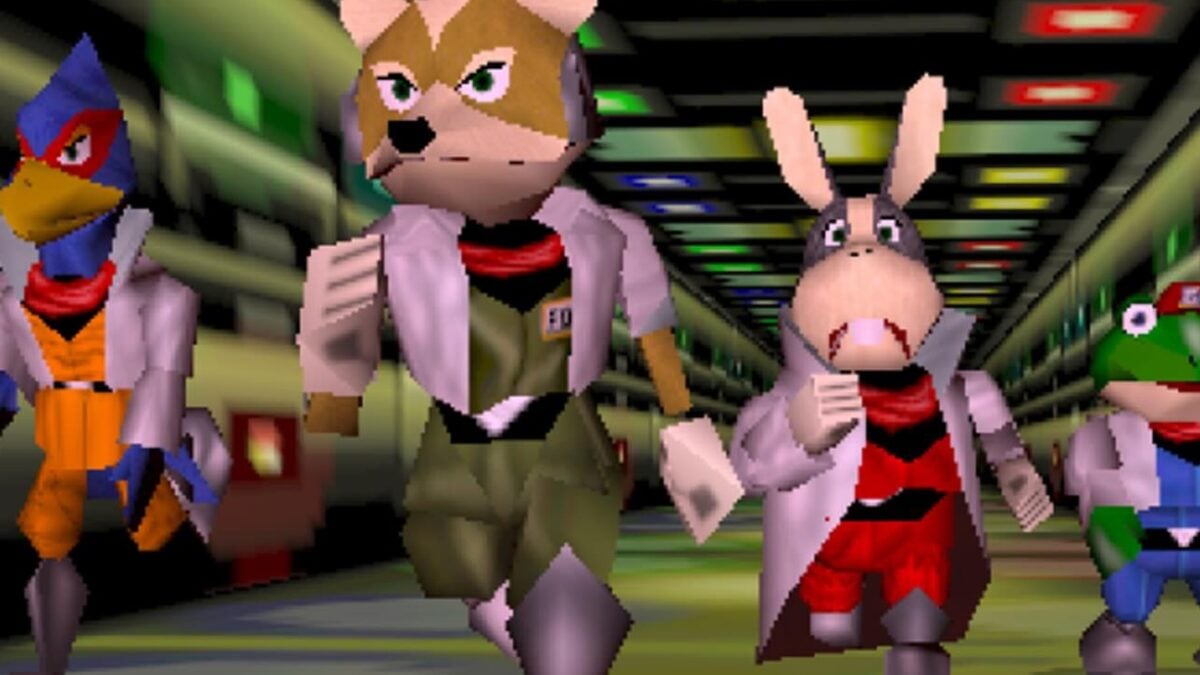
Totemic memories are often fleeting. The most memorable part of the opening cinematic of Star Fox 64 lasts less than thirty seconds.
Four walkin,’ talkin’ animals sprint down a seemingly interminable hangar corridor toward their fighter jets. A dog dressed as a general said that a planet is under attack and the gang is late to work. An exceptionally strong premise in military fiction. Nobody says a word because the alarm does all the talking, shrieking through the base as boots drum against the floor and our four pilots refuse to look anywhere but straight ahead.
The game offers exactly one additional detail about these people: their names. Slippy Toad. Peppy Hare. Falco Lombardi. Fox McCloud.
The first time I watched this scene, I knew which character I liked—sorry, like-liked.
I recognized Slippy Toad immediately: the girl in my biology class who borrowed a pencil. Somebody I knew pretty much nothing about but immediately knew that I needed to know more. This is surely one of the more humiliating features of being a person. Every so often your brain selects a favorite and becomes irrationally attached. We all had favorite Power Rangers and starter Pokémon. As an adult, I’ve insisted I have sophisticated reasons for loving certain artists, authors, or the basketball star Joel Embiid, but the truth isn’t so complex. Something catches my eye and inspires affection. The thick explanations come later. To love something is to commit yourself to paying closer attention.
Before the sprint to the Arwings was over, I loved Slippy Toad. He rented out the same part of my brain reserved for anyone else with that spark. A crush convinces you to begin secretly constructing a future around them. A crush transforms ordinary details into meaningful clues and chance encounters into cherished memories. Surely, before long, I’d be daydreaming about tonguing that frog under the bleachers.
But a favorite is only the beginning and Star Fox 64 extends far beyond the initial attraction. The game’s campaign, with its alternate routes that branch across the Lylat System, is built around repetition, sending players through entirely different levels depending on their performance. Reaching every planet, seeing every level or piece of content, requires multiple playthroughs. Earning medals demands revisiting twitchy challenges until they become second nature. The structure, if one wants to see the game completely, encourages return.
That return transforms the cast. It might be hard to imagine how these characters survive dozens of playthroughs. Slippy spends much of the campaign screaming for help, Falco bounces between bragging and insulting, and Peppy delivers tutorials like sage advice. At first these interactions register as broad sketches, but familiarity renders them more completely. The result is a kind of intimacy built from repeated encounters; seeing the same people often enough that they begin to feel human. We may not learn much in the way of additional facts about them, but familiarity allows us to perceive more within what was already there.
The structure of Star Fox 64 is built around this kind of knowing. One playthrough strands Slippy on Titania and sends Fox into the desert looking for him. Another playthrough defeats Spyborg on Sector X quickly enough to prevent Slippy’s crash landing entirely. Slippy occupies different places in your memory depending on where you go and how you perform. Learning what happens to him on every route is not entirely unlike checking the Instagram story of somebody you have a crush on. Neither activity has ever produced a healthy outcome, but each encounter supplies another angle from which to view the same person.
This is one of life’s great pleasures: the ecstasy of drawing closer to something through repeated encounters, and it is the joy of Star Fox 64. What begins as a simple hallway shooter, something reminiscent of an arcade cabinet featuring a gang of weirdos who escaped from the Hundred Acr