// KOTAKU — GAMING
Inside The Big Revamp Of Disney’s Millennium Falcon Ride
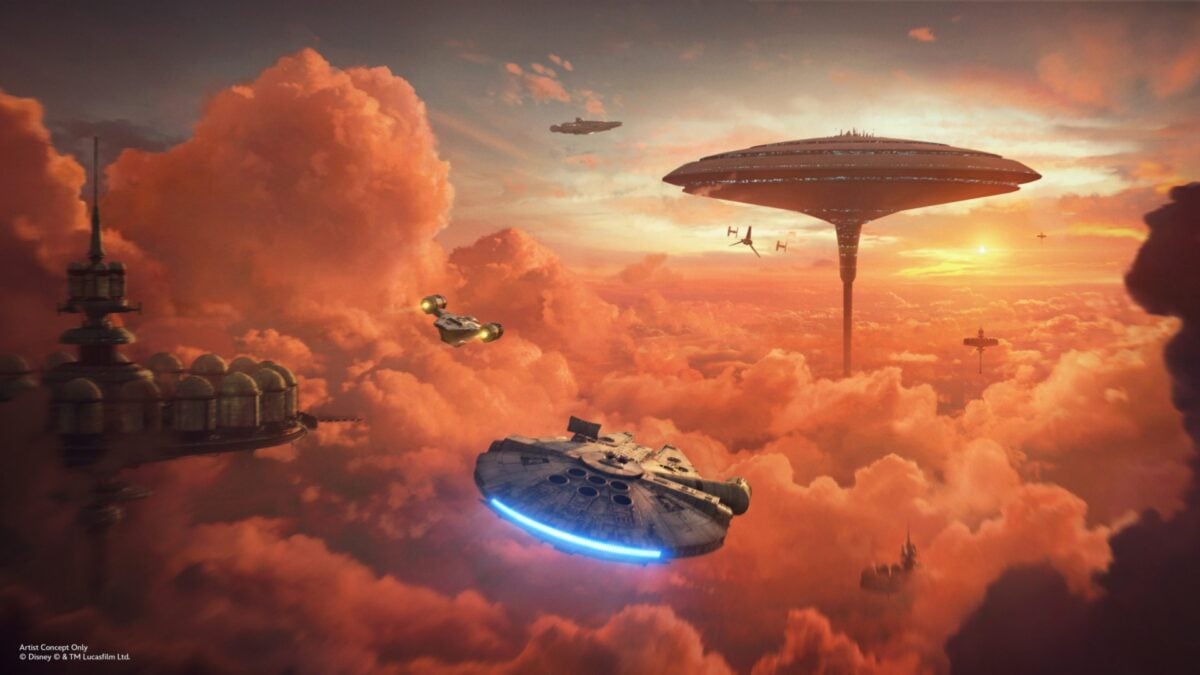
Video game and theme park design are two very different disciplines, but they have a lot in common. They share similar approaches to building worlds and turning narratives into interactive experiences, using environments to tell stories as much as dialogue, and both have embraced virtual reality in search of immersion—to similarly mixed results. Sometimes, though, a theme park ride is just straight-up a video game, albeit one you might physically move through; think the mini-games of Toy Story Midway Mania, or the lackluster Spider-Man ride at Disney California Adventure, or the many shooting-gallery dark rides that replace physical targets with screens.
The most elaborate and complex of those video game attractions is Millennium Falcon—Smugglers Run, a motion simulator found at the Star Wars outposts at Disneyland and Disney’s Hollywood Studios in Orlando. Launched in 2019 with Nvidia tech, Smugglers Run is a show experience built in Unreal Engine 4 and utilizing a screen that takes up your entire field of vision; it’s the most elaborate possible version of those arcade cabinets at Dave & Buster’s that make you feel like you’re sitting in a cockpit. Only this cockpit is a fastidiously detailed recreation of the Millennium Falcon, with its iconic lounge and everything, inside (or, more accurately, next to) a 114-foot life-sized replica of Han Solo’s ship.
Inside that cockpit, teams of six are split into three different jobs. Two pilots guide the Falcon on its mission, with one controlling it horizontally and the other vertically. (The pilot in the right seat also gets to punch it into hyperspace a few times, in perhaps the most physically exciting part of the entire attraction.) Behind them sit two gunners who fire guns and launch rockets at on-screen targets by tapping buttons as they light up on the Falcon’s walls; you can pick between manual and automatic control schemes, which just determines how many different buttons you can potentially push. And in the last row are the two engineers, who repair the ship on the fly by responding to various light-up prompts on the ship’s walls, and whose initial responsibilities were so limited that various little perks have been added in over the years. (Engineer is where you seat the grandparents whose only experience with video games was a few rounds of Space Invaders at a smoke-filled bar back in 1980.) All players are scored individually on their performances, and those are added up for an overall team score. There are tiers and ranks and everything, and it’s all stored by the Star Wars Datapad widget in the Play Disney app, if you really want it to be.
Disney heavily touted Smugglers Run’s game-like qualities when first promoting the attraction before its 2019 opening. At the time, Imagineers who worked on the ride talked about its modularity—how they could use the tech they developed with Epic Games and Nvidia to add new missions or tweak gameplay. Not much became of that in Galaxy Edge’s first several years; the engineer role was slightly retooled to become a little more involved in the action, but the original mission, in which the Falcon was loaned out to conman Hondo Ohnaka to smuggle coaxium in a win-win for both Ohnaka and the Resistance, remained the only one until the last week. As of May 22, 2026, guests can embark on a new adventure alongside the Mandalorian and Grogu, with three branching paths that will take them to different planets in the Star Wars universe. And along with the new mission comes Smugglers Run’s first big tech upgrade.
The new mission runs on Unreal Engine 5, which wasn’t released until 2022, three years after Smugglers Run opened. As Morgan McDowell, a technical project manager at Walt Disney Imagineering, tells me, the upgrade lets them improve the ride’s visuals and also expand its play options. “With Unreal Engine 5 we can add updated assets, so higher resolution graphics,” she says, inside a private meeting room attached to the Smugglers Run sh