// ARS TECHNICA — MOBILE & WEB
Planet orbits so close to its star that their magnetic fields connect
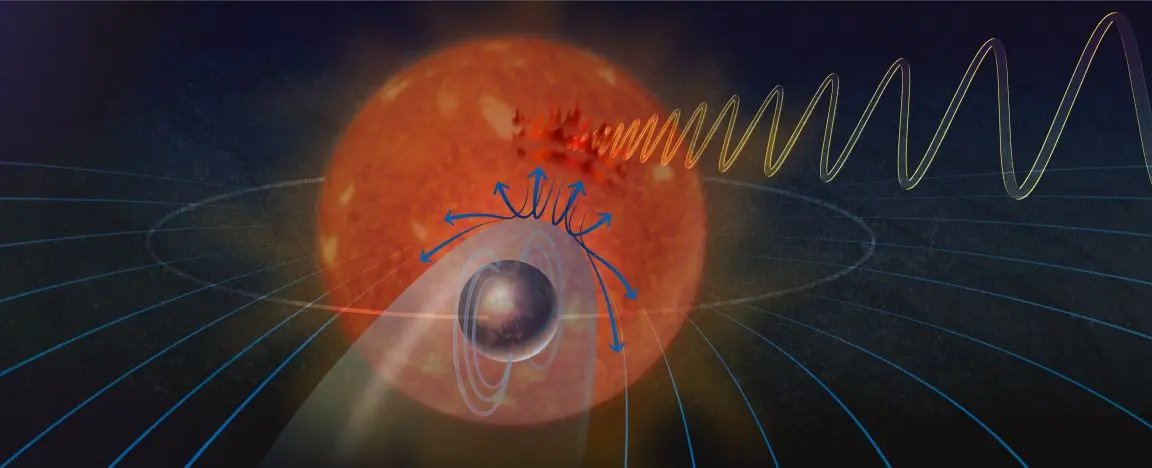
At the right point of the orbit and stellar cycle, the star’s chromosphere brightens.
For most of human history, our view of “close to the Sun” was defined by the orbit of Mercury, with its 88-day orbit and barren, baking surface. But from the moment we started discovering exoplanets, it became very clear that our own Solar System was anything but a guide to the rest of the galaxy. Planets with orbits only a few days long are strikingly common, with the proximity to the star creating things that seem bizarre from our perspective: metal vapor in the atmosphere, or atmospheres puffed out to ridiculously low densities.
Now, we can apparently add an additional oddity: overlapping magnetic fields. Researchers have found a star/planet combo that experiences periodic brightening, which they ascribe to the interactions between the magnetic fields of both bodies.
This is one of those cases where theory came before discovery. People had already proposed that a planet orbiting close to its host star could interact with it if its magnetic field were sufficiently strong. And, in a number of cases, researchers have found evidence that this is happening, with one case of an extremely young star emitting flares seemingly in response to the orbit of its innermost planet.
An international team of researchers has created the most comprehensive look at flaring in a star with a close-in planet. The star itself is called GJ 436, a red dwarf half the mass of the Sun that resides about 30 light-years from Earth. It has a single known exoplanet that is about four times as massive as Earth, and it completes an orbit every 2.6 days.
The researchers focused on the chromosphere, a thin layer near the exterior of the star that has emissions that are dominated by a relatively small number of ions and is known to be influenced by the star’s magnetic environment. The researchers used specific emissions from hydrogen and calcium ions as a marker for activity in the chromosphere.
We’ve been observing GJ 436 for years, so the team had a huge amount of archival data to search through. The team looked for periodic fluctuations in the emissions at the relevant wavelengths as a potential sign of a fluctuating magnetic influence. They found one, roughly the same period as the planet’s orbit, suggesting that the magnetic interactions were either limited to, or peaked at, one specific orbital configuration.
Why didn’t the signal line up precisely with the planet’s orbit? A model they produced helps explain this by also including factors like the star’s rotation, the uneven distribution of activity across the star’s surface, and the fact that the planet’s axis of rotation (and thus its magnetic field) probably isn’t precisely perpendicular to the plane of its orbit. With all of those factors considered, it’s possible to figure out how all of these details can produce a signal that lags the orbital period by a few hours.
There were some other oddities, though. One is that there are no signs of enhanced activity from various other elements that are thought to be present in the chromosphere of most stars. The researchers, however, note that the chromosphere itself has multiple layers and propose that the signal they’re seeing is originating in the lower chromosphere.
The second issue was that in some observations, there were no periodic signals at all. Because we have enough archival observation data, however, the researchers were able to track when the signal appeared and disappeared. And they were able to find a periodicity to that—one that lined up precisely with the star’s cyclic activity. (Think of our Sun’s solar cycle, and apply that to a different star.)