// SPACE.COM — SPAZIO & SCIENZA
James Webb Space Telescope catches 6 galaxies merging into one of the largest galaxies in the universe
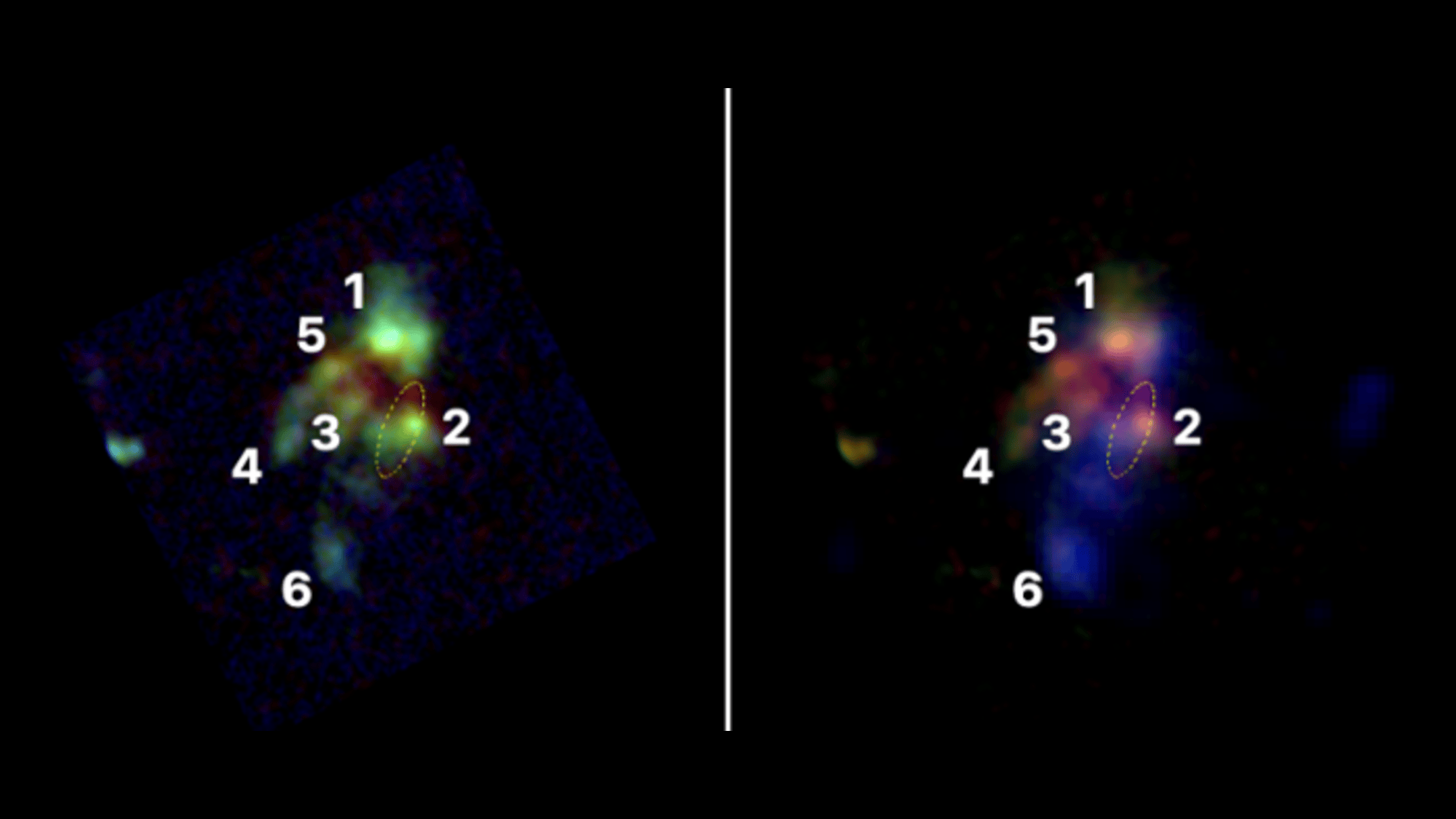
A supermassive black hole is also coming together at the heart of this galaxy maelstrom.
When you purchase through links on our site, we may earn an affiliate commission. Here’s how it works.
An intense demolition derby of at least six galaxies smashing into one another has been found lurking in the early universe by the James Webb Space Telescope. This merger is also expected to fuel the growth of a supermassive black hole and trigger the formation of what will eventually become one of the most massive galaxies in the cosmos.
"What makes this special is that we can follow both the build-up of a giant galaxy and the growth of the black hole at its center," Huub Röttgering, an astronomer at the Netherlands' Leiden Observatory, said in a statement.
The discovery came after a tip-off from radio astronomers who had noticed emissions that seemed to be coming from an undiscovered active black hole. When the James Webb Space Telescope (JWST) looked closer, it found a surprise.
"We didn't find a single galaxy, but an entire complex of at least six galaxies," said Aayush Saxena of the University of Oxford.
These six galaxies sit at a redshift of 4.0, which equates to a time about 12 billion years ago, just 1.8 billion years after the Big Bang.
Through the vision of the JWST's Near-Infrared Camera the six galaxies appear fuzzy, reminiscent of a faraway version of Stephan's Quintet, which is a collection of five galaxies, four of which form a compact group that are on course to merge to become a giant elliptical galaxy.
Similarly, the six galaxies spotted by the JWST, and collectively termed TGSSJ1530+1049, will undergo a series of rapid mergers to become what is known as a 'brightest cluster galaxy,' which is an enormous elliptical galaxy of the kind found at the center of galaxy clusters.
"We call structures like this protoclusters: the precursors of the vast collections of galaxies we see today," said Leiden's Roderik Overzier. "These are places where matter came together very early on. We think we are seeing a rare moment when several massive galaxies still exist separately, but are already in the process of forming one much larger galaxy."