// NATURE NEWS — SPAZIO & SCIENZA
Breaking timescales with generative sampling of conformational transitions
Nature
(2026) Cite this article
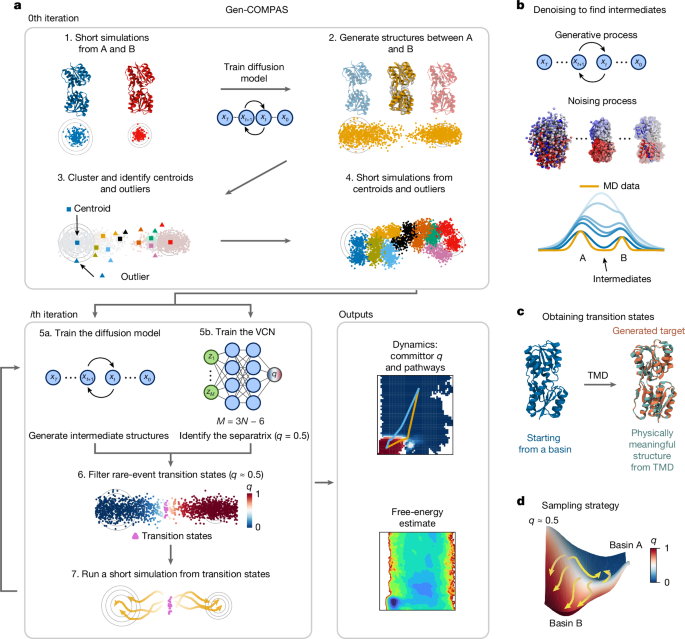
Molecular transitions, including protein folding, allostery and membrane transport, are central to biological functions, yet remain notoriously difficult to simulate. Their intrinsic rarity places them beyond the reach of standard molecular dynamics, whereas enhanced-sampling strategies are computationally demanding and often depend on arbitrarily chosen parameters and variables that bias outcomes1,2,3. Here we introduce Gen-COMPAS, a generative committor-guided path-sampling framework that reconstructs transition pathways without predefined collective variables and at acceptable computational cost. Gen-COMPAS couples a denoising diffusion probabilistic model, which produces structurally plausible intermediate targets, with committor-based filtering to identify transition states4,5. Short unbiased simulations from these intermediates yield transition-region ensembles at nanosecond-to-submicrosecond aggregate sampling scales for which conventional approaches require orders of magnitude more sampling. Applied to systems ranging from a miniprotein to a pentameric, ligand-gated ion channel, Gen-COMPAS recovers committors, transition states and free-energy landscapes from known end-point structures alone, without predefined reaction coordinates or prior mechanistic knowledge, thereby providing a computationally tractable route to mechanistic insight in biomolecular systems that have so far resisted conventional simulation approaches.
This is a preview of subscription content, access via your institution
Access Nature and 54 other Nature Portfolio journals
Get Nature+, our best-value online-access subscription
Prices may be subject to local taxes which are calculated during checkout
Input files of the systems analysed in this work are available at GitHub (https://github.com/Tangcyu/Gen-COMPAS/tree/main/examples). Source data are provided with this paper.
Gen-COMPAS is available as an installable open-source package at GitHub (https://github.com/Tangcyu/Gen-COMPAS). The repository provides installation instructions, a unified command-line interface for executing the complete workflow, ready-to-use configuration files and molecular-simulation inputs for representative systems in the examples directory. A graphical user interface is also provided to guide users through the available options and generate valid configuration files.
Dror, R. O., Dirks, R. M., Grossman, J. P., Xu, H. & Shaw, D. E. Biomolecular simulation: a computational microscope for molecular biology. Annu. Rev. Biophys. 41, 429–452 (2012).
Article
CAS
PubMed
Google Scholar