// NATURE NEWS — SPAZIO & SCIENZA
Neocortical long-range inhibition promotes cortical synchrony and sleep
Nature
(2026) Cite this article
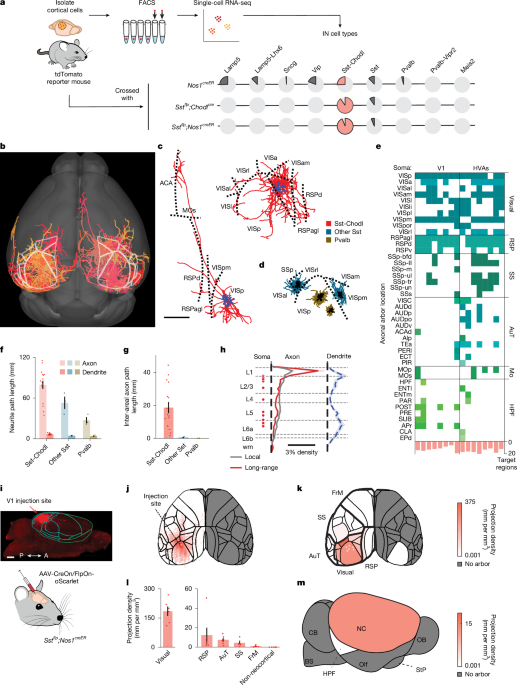
Sleep and wakefulness are associated with distinct cortical patterns of rhythmic activity1. During low-arousal states such as slow-wave sleep, synchronous low-frequency rhythms dominate activity across widespread cortical regions. Although inhibitory neurons are increasingly recognized as key regulators of cortical state2,3,4, the circuit mechanisms that coordinate synchronized activity across local and distant neocortical networks in vivo remain poorly understood. Here we show in mice that cells co-expressing somatostatin (Sst) and chondrolectin (Chodl)—which constitute a sparse and genetically distinct class of neocortical GABAergic inhibitory neurons—are selectively active during low-arousal states and mostly silent during periods of high arousal. In contrast to most neocortical inhibitory neurons, Sst-Chodl cells, despite being extremely sparse, exert widespread influence across the neocortex, through long-range axons that target multiple regions simultaneously. Selective activation of Sst-Chodl cells is sufficient to promote the multi-region cortical synchronization that is characteristic of low-arousal states and to induce sleep. Together, these findings show that long-range Sst-Chodl inhibitory neurons not only track behavioural state, but can also actively promote synchronized cortical activity and sleep behaviour, highlighting that cortical circuits have a key role in sleep regulation, alongside established subcortical mechanisms.
Sleep and rest are essential for mammalian physiology. Their disruption leads to widespread physiological and cognitive impairments and is linked to a wide range of disorders, including insomnia, sleep apnoea, narcolepsy, depression, attention deficit hyperactivity disorder and schizophrenia, and can even lead to death5. Transitions between alertness and low-arousal states, such as quiet wakefulness and sleep, occur on a timescale of seconds and are accompanied by pronounced changes in neocortical activity patterns (oscillatory activity or cortical states)1. Low-arousal states, including slow-wave sleep (SWS) and quiet immobility, are characterized by synchronous low-frequency cortical fluctuations and coordinated spiking activity, often referred to as synchronized cortical states. These alternate with desynchronized states associated with periods of high arousal and active behaviour, during which low-frequency cortical activity is suppressed1. GABAergic inhibitory neurons (INs) have been implicated as key regulators of arousal-dependent neocortical activity4. Although fast-spiking parvalbumin-expressing INs have been shown to promote desynchronized states—which dominate periods of alertness—by enhancing gamma-band activity2,3, much less is known about the identity and function of IN populations that regulate the synchronized cortical states of low-arousal periods.
The diversity of cortical INs has been recognized for nearly a century6, but assigning specific functions to individual classes of IN has proved challenging, in part because established IN classes are themselves highly heterogeneous7. For example, somatostatin (Sst)-expressing INs, which are often treated as a monolithic group, can be subdivided into more than ten subclasses with distinct morpho-electric and transcriptomic properties7. In this study, we focus on a transcriptionally homogeneous and evolutionarily conserved subtype of Sst-expressing INs characterized by co-expression of Sst, chondrolectin (Chodl), neuronal nitric oxide synthase (Nos1) and the neurokinin-1 receptor (Tacr1). These cells, hereafter referred to as Sst-Chodl cells, correspond to the Nos1 (or nNOS for immunoreactivity)-expressing cortical IN population described in previous studies7,8,9. Sst-Chodl cells are GABAergic INs that differ considerably from canonical, locally projecting neocortical interneurons in that they have long-range projection axons that can extend across millimetres in the m