// HACKER NEWS — CYBERSECURITY
Object storage is all you need
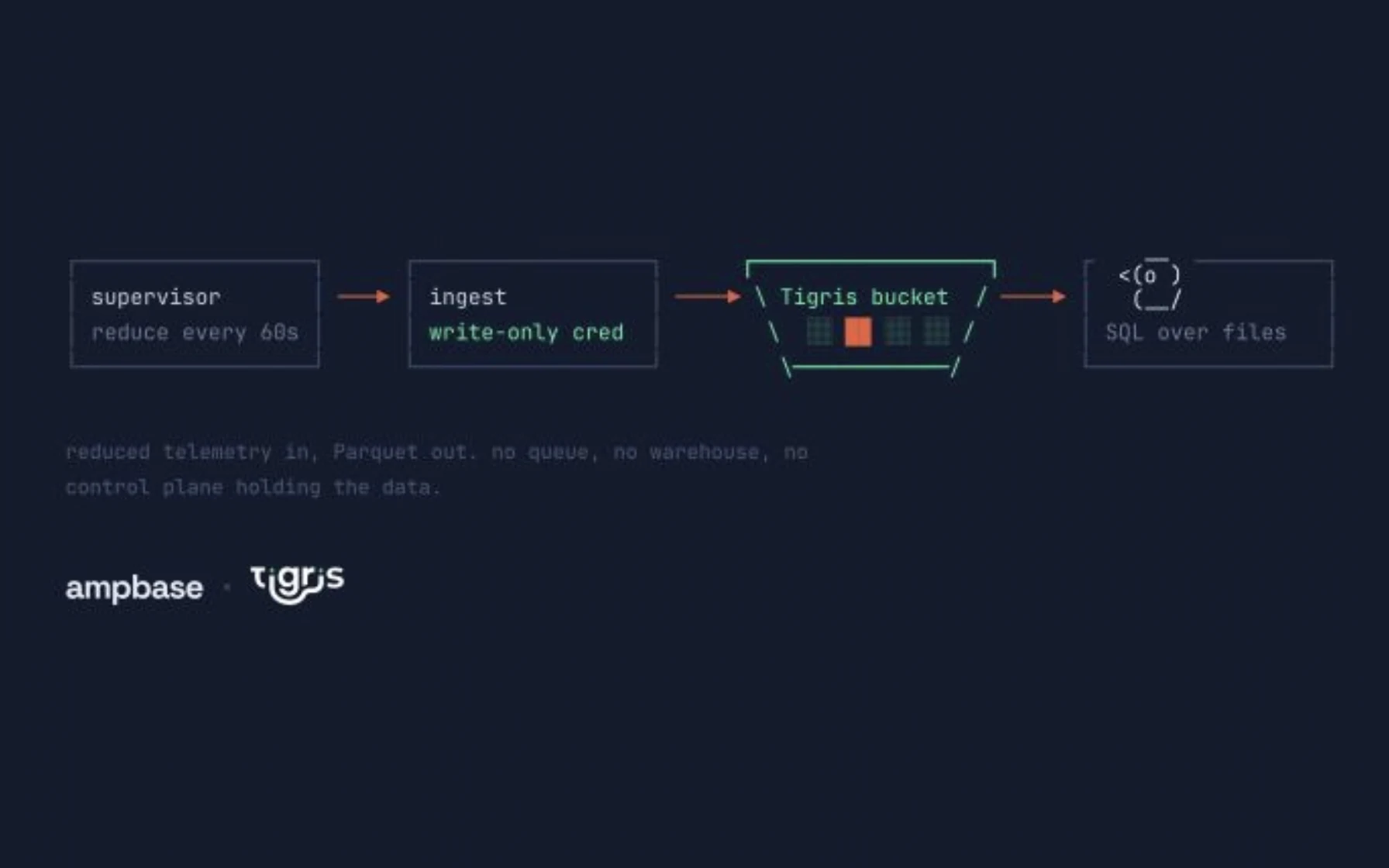
Tigris makes object storage using a database engine we built on top of
FoundationDB: a distributed key-value store. JP, the founder of Ampbase, uses a
control plane on Tigris with no database underneath it, and today he's going
over which database behaviors he had to build himself and what that cost.
Last time on
the Ampbase blog I talked
about all the database engines that we don't use and promised to follow up
explaining what we actually do. We don't use a relational database. We use
Tigris as the storage layer directly, and implement the few database behaviors
we actually need on top of the two primitives it gives us. Yeah, yeah, I know;
"we didn't need a database" is a catchy title that usually happens about eight
(8) months before the inevitable next post being "how we tucked our tail between
our legs and moved to Postgres".
In practice, when you reach for a database engine you're actually reaching for
four basic features: unique constraints, transactions, indices, and history
tables. In order to use Tigris' global object storage as a database, we had to
implement all of these primitives ourselves. Today I'm going to peel back the
curtain and show you how those primitives work so you can understand what
actually goes into your database engine of choice.
A global directory bucket holds the list of organizations, and every
organization gets a bucket of its own. Four of those keys are doing a job a
database would normally do for you, so they're labelled here and picked apart in
the next section:
We started out writing everything as JSON objects to each customer's bucket.
After a while we started adopting more and more features to our API with
protobuf options so
we can
define validation alongside the schema definition
among other things. Marshaling and unmarshaling all the JSON got more expensive
than we thought, so we switched to using Protocol Buffers directly. Our database
handles both formats so if records predate the protobuf migration, everything
loads as expected.
By using Protobuf, we eliminate the whole problem of managing a database layer:
migrations, connections, schemas. The only downside is that Protobuf field names
are forever, but to be fair it's about equally as painful to change column names
in Postgres, MySQL, or SQLite.
The naive way to create a bucket per customer would be to make a bucket per
customer, all in the same $bigcloud account and create a new account every time
you hit a quota limit. Or have one bucket with prefixes to get around the
per-account bucket limit, and rely on complexity in the IAM policy to enforce
isolation. All of this sounded rather dull, and Tigris has a
Partner Integration Program
for exactly this shape anyway. One call to it creates a Tigris organization for
that customer, its bucket, and a set of access keys scoped to it. We hold a
provider identity; each customer is an organization underneath it, with strong
isolation.
Isolation is baked into the infrastructure layer: no WHERE org_id = ? to
forget in your app code, because the credentials that reach one customer's data
cannot address anyone else's. As someone who has built a few platforms that
managed databases in the past, this is the part that most people mess up.
Beyond isolation, we need database-like behavior if object storage is truly
going to replace our database. But how do you get database-like behavior with
the simplicity of object storage? You leverage strong read-after-write
consistency, conditional writes, and other primitives as the backbone of
everything.
You can get all the important guarantees of a database from object storage.
Don't believe me, and say I will wrest your Postgres from your cold dead hands?
Please read on.