// NATURE NEWS — SPAZIO & SCIENZA
Cities and countryside are intimately linked — green initiatives must recognize that
Yansui Liu is vice-president of Henan University in Zhengzhou, China, and a professor of geographical sciences at the Institute of Geographic Sciences and Natural Resources Research, Chinese Academy of Sciences in Beijing, China.
Search author on:
PubMed
Google Scholar
Xinxin Huang is a lecturer in geography at the Faculty of Geographic Science and Engineering, Henan University in Zhengzhou, China, and an assistant researcher at the Institute of Geographic Sciences and Natural Resources Research, Chinese Academy of Sciences in Beijing, China.
Search author on:
PubMed
Google Scholar
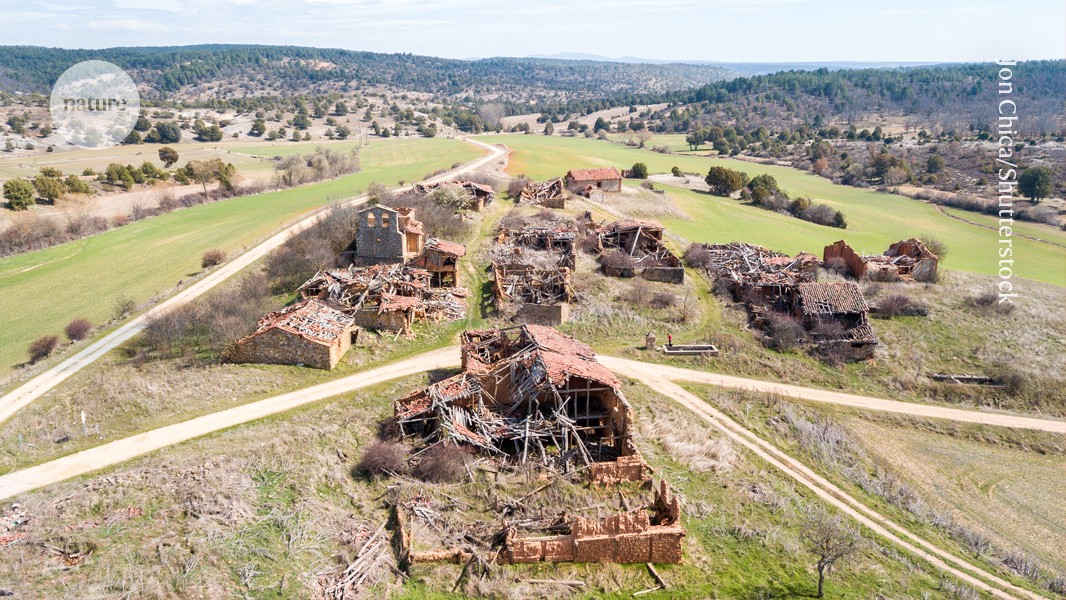
Vast expanses of rural Spain have become depopulated. Credit: Jon Chica/Shutterstock
Urbanization is usually judged by what is built, but it should also be evaluated according to what it hollows out. Around the world, increasing numbers of people are moving to cities — 67% of the global population is projected to live in urban areas by 20501. But this trend is about more than people relocating.
The rural regions that migrants leave behind are being steadily dismantled. Globally, up to 400 million hectares of land have been abandoned since the 1950s2 and up to half of the world’s rangelands (large expanses used as grazing land for livestock) are considered degraded3. Meanwhile, growing urban demand for food, water and biomass is intensifying the extraction of resources beyond city boundaries. The effects of these pressures are already evident in Europe’s emptying interiors, East Asia’s vanishing towns and Latin America’s swelling informal settlements.
These diverse cases expose a common policy oversight: a tendency to treat urban greening and nature-based solutions as an environmental cure-all. But cities depend on their hinterlands for survival — these areas provide food, deliver water and sequester carbon. Yet, the creation of urban green space doesn’t prevent working countryside from losing its human stewards, its fertile topsoil and the capacity to sustain ecosystem services.
Addressing this crisis requires managing urban and rural domains as a single entity. Here, we outline an approach that combines geospatial monitoring, landscape engineering and watershed planning to optimize ecological productivity and livelihoods in the countryside.
Rural decline is driven by three kinds of flow: demographic, land and ecosystem. Demographic flows begin when working-age populations migrate to cities to find better-paid jobs and more affluent lifestyles. With fewer workers left in rural areas, infrastructure and services diminish. Many remaining families are then forced to relocate, eroding both the tax base and local memory. Land flows refer to changes in land use driven by urban demand, whereas ecosystem flows describe transfers of water, biomass and ecosystem services from rural areas to cities.