// TOM'S HARDWARE US — HARDWARE & GADGET
Piecemakers bets edge AI devices will diverge from reliance on HBM — custom-designed memory fuses DRAM stack directly to the processor using hybrid bonding
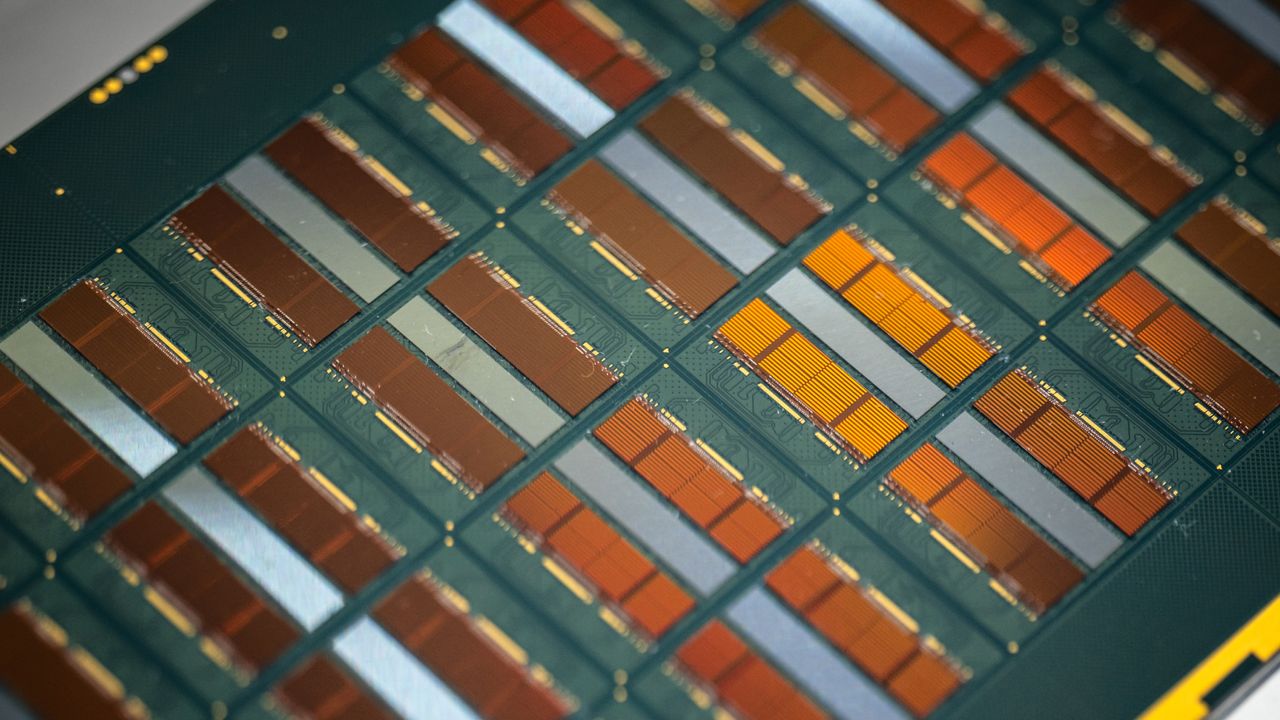
Design fees pay the bills with stacked DRAM shipping in 2027.
When you purchase through links on our site, we may earn an affiliate commission. Here’s how it works.
PieceMakers, a Nanya-backed DRAM designer, began trading on Taiwan’s Emerging Stock Board on September 16 at a NT$740 reference price, Cnyes reported ahead of the debut. PieceMakers is not an HBM company. Instead, it bets that inference memory diverges from training memory, President Lee Hsiao-wen told Cnyes, and that DRAM stacked directly on the processor with hybrid bonding can sit between Nvidia’s SRAM-only Groq LPU and HBM. As it stands, design fees, not chips, carry the company's profit, with AI custom-design work accounting for around 40% of the company's revenue in the first half of 2026. Piecemakers Chairman Joseph Ting told TechNews that its first volume customer program will not contribute to the company's financials until 2027 at the earliest.
At roughly 60.4 million shares outstanding, that price values the company at around NT$44.7 billion (around $1.4 billion). Taiwan's Emerging Board is the Taipei Exchange's pre-listing market, not a main-board IPO, so shares trade through market makers ahead of any formal listing application. The stock ended its first session at NT$915, 23.6% above the NT$740 reference price, after opening at NT$1,035 and trading as high as NT$1,205.
Nanya Technology is the largest holder of Piecemakers, at 33.96%, after selling 715,000 shares at NT$740 to seed the float, a disposal it disclosed in a Sept. 9 exchange filing reported by Knews.
PieceMakers was founded in January 2006 in Hsinchu, Taiwan, led by chairman Joseph Ting and president Lee Hsiao-wen. Historically, the company has designed standard SDR/DDR DRAM and known-good-die (KGD) parts through representatives in China, Japan, France, Turkey, and Israel. Now, the company seeks to shift from direct product sales to custom design services, paid as non-recurring engineering (NRE) fees, and then to IP licensing, royalties, and turnkey production from 2027, the company said at its Sept. 7 briefing, UDN reported.
Revenue from the AI custom design unit has risen from around 4% in 2024 to almost 40% in the first half of 2026. The products behind that increase are HBLL (High Bandwidth, Low Latency RAM), a 2D die rated at 144 GB/s that was taped out in 2016 for Intel’s HPC line and published at ISSCC in 2017, and HiBaLL, the 3D-stacked version rated at more than 1 TB/s, the company claims.
The company described its customers to Cnyes as developers of cloud AI inference accelerators, international semiconductor players, and North American customers, with some programs in design and verification, and none named. Qualcomm CEO Cristiano Amon’s Computex keynote backdrop in June listed PieceMakers among Taiwan ecosystem partners, although neither company has defined the relationship. The takeaway is that the profit is in design fees and not chips. The margin curve matches a pre-royalty Non-Recurring Engineering (NRE) business, rather than a traditional memory vendor.
Nanya’s AI-memory strategy is custom and edge rather than HBM3E. PieceMakers is the first half of a strategy laid out in 2024. On Aug. 7, 2025, Nanya announced a joint venture with Etron Technology, a Hsinchu-based chip designer, capitalized at NT$500 million, with 80/20 ownership. The venture was envisioned to design custom high-bandwidth memory for edge AI devices rather than for data center accelerators. Nanya president Pei-Ing Lee said earlier in 2025 that the company would not compete in HBM3 or HBM3E, TrendForce reported.
Both halves of the strategy rely on Formosa Advanced Technologies, the Formosa Plastics Group’s test and assembly affiliate, for packaging. It is building the through-silicon-via (TSV) and die-stacking processes that both need. The surge in DRAM pricing has made commodity memory Nanya’s real business, which leaves PieceMakers a cheap side bet that has become a windfall. Nanya took advantage o