// NATURE NEWS — SPAZIO & SCIENZA
Mutational constraints on RSV F and its neutralization by antibodies
Nature
(2026) Cite this article
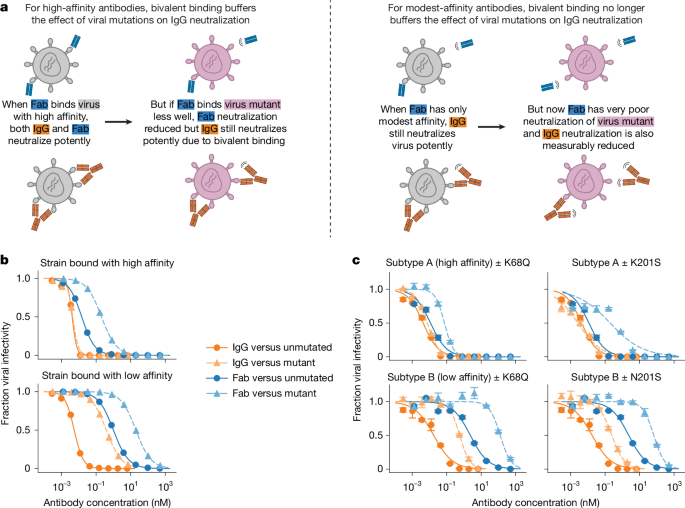
New antibodies targeting the F protein of respiratory syncytial virus (RSV) have substantially reduced infant hospitalizations1. However, viral resistance is a concern: one antibody failed clinical trials because of a resistant strain2, and sporadic resistance mutations to the most widely used antibody (nirsevimab) have been identified3,4,5,6. Here we define how RSV F mutations affect antibody neutralization. We first provide a biophysical model of how the buffering of bivalent IgG binding combines with the lower Fab potency of nirsevimab to subtype B to make resistance to this antibody more common in subtype B than A strains. We then perform pseudovirus deep mutational scanning to safely measure how nearly all mutations to F affect its cell entry function and neutralization by IgG and Fab forms of nirsevimab, clesrovimab and several other key antibodies. We use these measurements to enable real-time surveillance of RSV sequences for antibody resistance, and show that resistant strains have arisen sporadically but are at present rare. Overall, our work shows how Fab potency and epitope specificity combine to determine how viral mutations affect antibody neutralization, enables monitoring for natural RSV strains resistant to antibodies of public-health importance, and can help guide development of future antibodies with resilience to viral escape.
Respiratory syncytial virus (RSV) is a leading cause of infant hospitalization in the USA and infant mortality globally7,8. Two monoclonal antibodies, nirsevimab and clesrovimab, were recently licensed and recommended to prevent severe RSV disease in infants9. Nirsevimab has demonstrated roughly 75–80% effectiveness against RSV-associated hospitalizations of infants10 and (along with maternal vaccination) has reduced infant hospitalizations in countries where it is widely used1. More antibodies are under development including for low-income and middle-income countries where RSV is a main cause of infant mortality11,12.
Nirsevimab and clesrovimab target the prefusion conformation of the RSV fusion protein (F)13,14, binding the apex antigenic region Ø and the lateral-face antigenic region IV, respectively. Although F is less variable than the surface proteins of influenza and SARS-CoV-2, it still evolves sufficiently fast to pose challenges for monoclonal antibodies15,16. Regeneron’s anti-F antibody suptavumab failed a phase 3 clinical trial from 2015 to 2017 because it was escaped by mutations in circulating RSV-B strains2. Whereas nirsevimab has been in use in the USA for 3 years and retained high effectiveness, sporadic resistant strains have been identified, particularly in breakthrough infections3,4,5,6,16,17,18,19,20. Therefore, surveillance of RSV sequences for potential escape mutations is an important public-health priority4,6,20,21. However, surveillance is hindered by incomplete knowledge of how F mutations affect key antibodies, as previous studies have identified only a limited set of resistance mutations by passaging laboratory-adapted RSV in the presence of antibody5,14,22 or looking for mutations in antibody-binding footprints4,5,6,17,20.
Here we provide a complete quantitative understanding of how RSV mutations affect antibodies by combining a biophysical model of bivalent IgG neutralization with deep mutational scanning measurements of how all amino acid mutations affect F’s cell entry function and neutralization by the IgG and Fab forms of key antibodies. Our work explains why nirsevimab resistance mutations are more common in one of the two RSV subtypes, defines the potential for escape from existing and candidate clinical antibodies, and informs a sequence-surveillance platform to rapidly identify antibody-resistant natural RSV strains.
Surveillance of individuals who received prophylaxis and experimental studies performed for resistance analysis for Food and Drug Administration (FDA) licensure have f