// NATURE NEWS — SPAZIO & SCIENZA
Evolution and heterogeneity of lethal metastatic bladder cancer subtypes
Nature
(2026) Cite this article
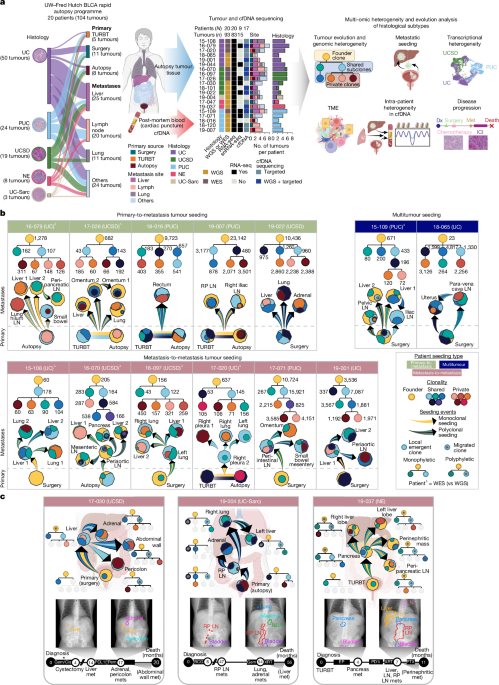
Histological variation is a prognostic feature of metastatic urothelial cancer1,2,3, but its evolutionary trajectory remains poorly defined. We developed a metastatic bladder cancer rapid autopsy programme enriched in histological subtypes4 to profile individuals with terminal disease. Here by reconstructing the evolutionary histories of patient tumours, we show that metastasis-to-metastasis seeding is the dominant pattern of cancer spread and that increased polyclonal migration predicts poor prognosis. The burden, heterogeneity and timing of genomic alterations differ markedly among histological subtypes. Plasmacytoid and neuroendocrine variants develop early driver alterations associated with shorter survival. Mutational signature analyses and experimental models demonstrated that plasmacytoid tumours uniquely use the Fanconi anaemia pathway to mitigate chemotherapy-induced genomic scarring. Single-nucleus profiling revealed mixed cell states in histological subtypes and an association between transcriptional heterogeneity and patient survival. Characterization of the tumour microenvironment uncovered distinct immune states across subtypes, with plasmacytoid tumours exhibiting immune-inflamed profiles, whereas squamous tumours are predominantly immunosuppressive. Last, we demonstrate that post-mortem cell-free DNA captures genomic and transcriptional heterogeneity of the subtypes, which provides a potential strategy for noninvasive assessment of tumour identity and aggressiveness. Our results provide new insights into how tumour heterogeneity shapes the evolutionary history of disease progression in bladder cancer histological subtypes.
Metastatic bladder cancer (BLCA) is a common and highly lethal disease that remains a major clinical challenge owing to its marked histological and molecular heterogeneity5,6,7,8. Approximately one in four patients with metastatic BLCA have tumours with subtype histological features such as squamous, plasmacytoid, neuroendocrine (NE) or sarcomatoid differentiation1,2. These histological subtypes often have distinct disease trajectories compared with conventional urothelial carcinoma (UC)1,2,3,9. However, it is not well understood how genomic, transcriptomic and microenvironmental heterogeneity evolve in these tumours and shape their distinct natural histories and responses to therapy10,11,12,13,14,15. Charting the evolutionary history of metastatic tumours in patients can uncover the emergence of treatment-resistant clones and identify optimal points for intervention. However, so far, a comprehensive characterization of tumour evolution and molecular heterogeneity in histological subtypes has been limited, particularly in the metastatic setting.
The University of Washington and Fred Hutchinson Cancer Center (UW–Fred Hutch) metastatic BLCA rapid autopsy programme was designed to enrich for histological subtypes of carcinomas arising in the urothelium. This resource was developed to investigate intra-patient and inter-patient tumoural heterogeneity and to retrace the evolutionary trajectories of metastatic BLCA16,17,18. Here using whole-genome sequencing (WGS) of primary and multiple metastatic tumours from each patient, we reconstruct tumour clonal phylogeny and metastatic seeding, which reveal insights into the nature of metastatic spread and drivers of aggressive histological subtypes and therapy resistance. We analyse bulk RNA sequencing (RNA-seq) and single-nucleus RNA sequencing (snRNA-seq) data to uncover transcriptional heterogeneity and molecular hallmarks that underlie histological subtypes, their tumour microenvironments (TMEs) and disease progression. Finally, we evaluate the potential of post-mortem cell-free DNA (cfDNA) to capture the genomic and transcriptional heterogeneity of metastases and to enable a minimally invasive approach to identify driver genomic alterations and distinguish aggressive metastatic BLCA subt