// HACKER NEWS — CYBERSECURITY
Deodands put a price on objects that caused death
In 1829, hundreds of spinners and weavers had gathered at the Norfolk Arms Hotel when the floor collapsed under them. In the tumble, the crowd fell two stories, all the way into the cellar. Thirty people died.
After the incident, a jury convened for an inquest. They assessed the value of splintered timbers that had been the floor: 5 shillings, to be divided amongst the family of the victims. A pretty paltry sum, even by the standards of the day—but that was the nature of the law.
The jury was working from a legal concept that was over eight centuries old: the deodand, an obscure survival of medieval law. As William Pietz writes in “Death of the Deodand: Accursed Objects and the Money Value of Human Life,”
The term itself comes from the Latin phrase deo dandum, which means “that which must be given to God.” It is an example of the idea that evil objects are sacred, that they are charged with divine power, and that they therefore belong to God. In English law prior to 1846, any moveable material object—more specifically, any piece of personal chattel property—that directly caused the death of an adult human being became deodand and, as an accursed thing, was held to be forfeit to God (whose earthly representative in such cases was the royal sovereign).
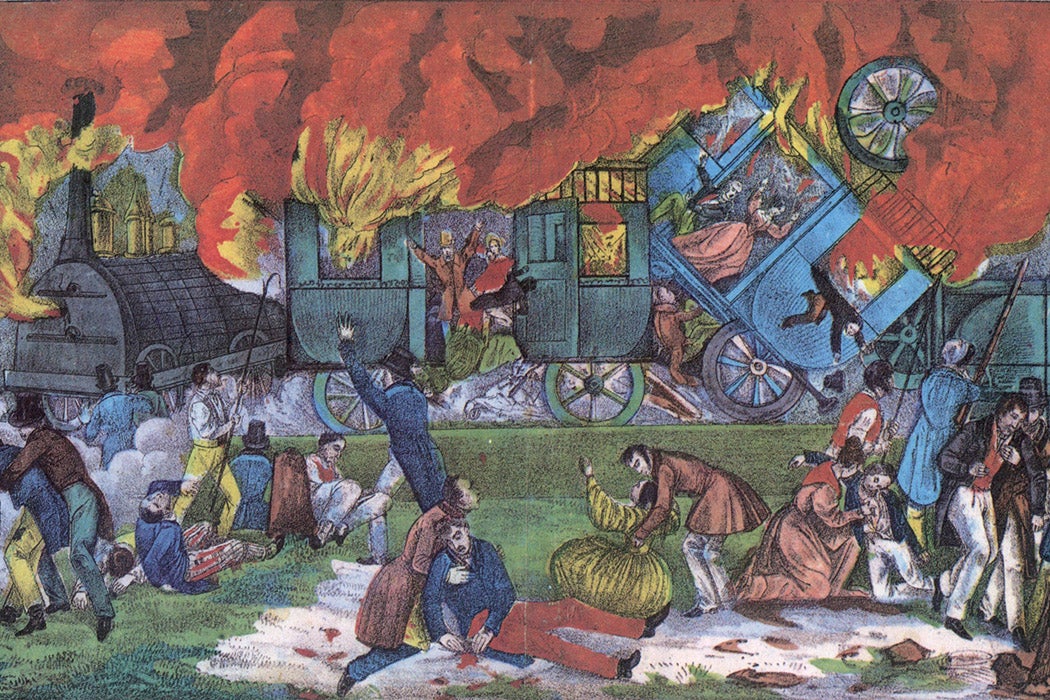
By the time of the horrible accident in 1829, the deodand was on its way out. But it would have a surprising last act, making its mark on some of the key legal battles of the Industrial Revolution.
First, an explanation of the concept: When an object killed a person, the owner of that object was on the hook for the value of the thing in question. That money was due to the king, and theoretically was to be used for charitable purposes. In practice, it was usually collected by the local coroner, and often (though not always) given to the family of the deceased.
In theory, a deodand was a moving object that caused someone’s death. But in the course of eight hundred years, there can be a lot of variation, and when it comes to deodands, it’s much easier to identify the exception than the rule. For instance, say a cask of ginger rolls through a trapdoor and lands on a poor laborer below. Definitely a deodand. Now, imagine a church bell falls on someone and kills them. That should count, right? No: because deodands can only be chattel property, whereas a church bell, being part of a fixture on the landscape, comes under real estate.
Then there’s the motion issue. If you fell off a ladder, that ladder would become a deodand, even though you were the one in motion. It’s not about blame, either: based on the case history, it seems that you could be doing a drunken jig on the top step, and the ladder could still be declared a deodand.
Another problem is how much of the object counts as a deodand. In some cases, for instance, where someone was run over by a cart, only the cart wheel would be assessed as a deodand. But when one Bedfordshire man slipped and fell on the pole of a cart “so that it entered his fundament,” the whole cart, including the load and the horses pulling it, was seized.
The reason for all this variation might be that the assessment was left to the discretion of the jury. Just imagine all the factors—invisible in the record—that could have swayed the jury’s findings: local opinion, gossip, public sympathy or blame, and the desire for revenge… It was an imperfect but accessible means of exacting justice—punishing the negligent, sparing the merely unlucky, providing for the bereaved.