// NATURE NEWS — SPAZIO & SCIENZA
Daily briefing: Asgards — the microorganisms that might have begat us all
Search author on:
PubMed
Google Scholar
Hello Nature readers, would you like to get this Briefing in your inbox free every day? Sign up here.
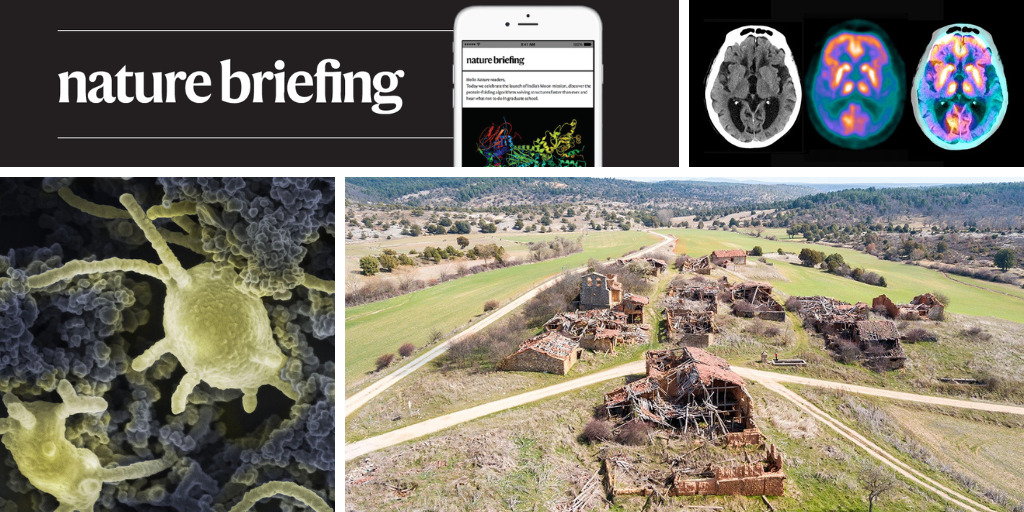
Mapping microproteins in the brain might help to understand, and treat, Alzheimer’s disease.Credit: Zephyr/SPL
More than 1,000 previously overlooked ‘microproteins’ have been found in samples of human brain tissue from people with and without Alzheimer’s disease. Dozens of the microproteins showed altered expression in people with Alzheimer’s disease, a finding that could pave the way for uncovering new mechanisms of ageing and neurodegeneration.
Immune cells that fight stomach bugs can migrate from the gut to the brain, where they establish a lasting ‘memory’ of previous infection, according to a study in mice. After an infection, gut-trained T cells journey to the meninges, a protective membrane that shields the brain. Once there, the cells become residents that can respond to later infections. The findings could shed light on how gut infections might affect neurological disorders, and could help to develop therapies that harness the relationship between the gut and the central nervous system.
Advanced-imaging researcher Ning Xu used diffractive super-resolution microscopy to capture this video of the abnormal beating of airway cilia in a child with primary ciliary dyskinesia, a rare genetic disorder affecting respiratory function. "To understand this disease, you need to watch the cilia through dozens of beat cycles, not just a still image,” says Xu. Xu’s image won the 2026 Small World in Motion Competition. (Ning Xu/Nikon Small World)
Microorganisms from which all complex life might be descended — the Asgard archaea — were discovered in 2015 from DNA in sediments plucked from the bottom of the North Atlantic. Since then, researchers have been painstakingly culturing these exotic organisms and finding lots of surprises along the way.
“Urbanization is usually judged by what is built, but it should also be evaluated according to what it hollows out,” argue geographers Yansui Liu and Xinxin Huang. As people increasingly move to the city, those who remain in rural areas can start to lose their infrastructure and services — eroding these areas’ ability to fulfil essential roles, such as food production. “The onset of the urban age should not be misconstrued as a post-rural era,” the authors write. “The resilience of modern cities remains contingent on the integrity of the countryside.”
Driverless cars can offer unusual seating arrangements and tempt passengers to recline or even to lie down — something seatbelts and airbags weren’t designed for. The rise of autonomous vehicles is encouraging the design of new types of crash-test dummies. And it might finally convince regulators to tackle outdated safety standards, says automotive safety engineer Becky Mueller. “It’s a good time to make sweeping changes.”
Groups of interacting AI agents — in this case, copies of OpenAI’s GPT-5.5 model — tend to evolve odd language patterns that spread like wildfire through the group, suggest recent experiments. (Science | 9 min read)