// NATURE NEWS — SPAZIO & SCIENZA
Losing your way of life to climate change matters — and we need a way to measure it
Manasi Kumar is a clinical psychologist and a professor of population health at the Institute for Excellence in Health Equity, New York University Grossman School of Medicine, New York City, New York, USA.
Search author on:
PubMed
Google Scholar
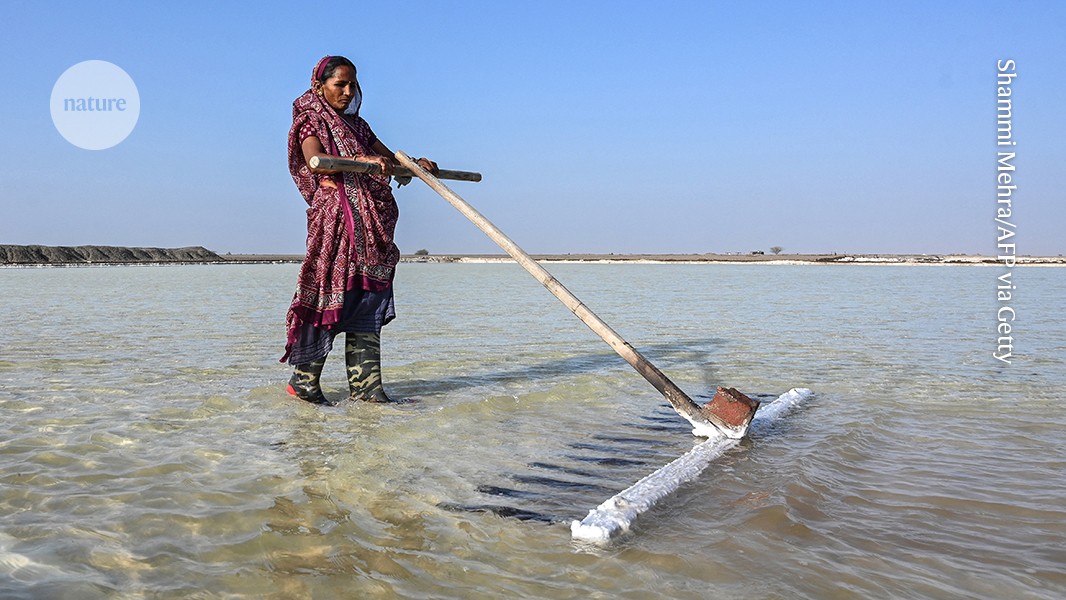
Salt harvesters in Gujarat, India, often have to work through extreme heatwaves.
The first time I began to understand climate loss as a mental-health issue was not while reading a report or attending a summit. It was while listening to people describe what they feared losing.
While working with coastal communities in Kenya, I heard concerns that initially sounded economic: declining fish catches, disrupted marine ecosystems and shrinking livelihoods. But the conversations quickly turned deeper. Community members spoke of mounting anxiety, growing substance use in unemployed young men and rises in gender-based violence, sex tourism and adolescent pregnancies as poverty intensified.
People also worried about the erosion of traditions tied to the sea: knowledge passed between generations; community rituals and identities rooted in fishing livelihoods. What they feared losing was not only income, but also stability, belonging and hope for the future.
The rise of eco-anxiety: scientists wake up to the mental-health toll of climate change
Over the years, as a clinical psychologist and public-health researcher, I have heard concerns about climate change that extend far beyond homes, crops and livelihoods. People speak about losing their sense of belonging. They worry that their children will grow up disconnected from the places that have defined their families for generations. They talk about grief for disappearing landscapes, anxiety about an uncertain future and the exhaustion that comes from living through repeated crises.
As governments prepare for a round of negotiations at COP31, the 31st United Nations Climate Change Conference, in Antalya, Turkey, in November — and as I and others participate in Climate Week NYC 2026 in New York City this week — discussions about climate-related loss and damage are needed urgently. Communities are already experiencing irreversible harm: permanent displacement, destruction of ecosystems, loss of cultural heritage and repeated disasters that are eroding resilience. The devastating flood in Nepal last month is one glaring example.
Mental health sits at the centre of those losses, yet remains mostly invisible in the systems designed to address them. When climate policy acknowledges mental health, it is usually through adaptation, focusing on helping people to cope with ongoing changes. These policies can encompass preparedness, psychological first aid, resilience programmes and stronger health systems. Investments in these areas are essential, but they address only part of the problem.