// HACKER NEWS — CYBERSECURITY
What California is learning from solar panels built over irrigation canals
This story is part of Flipping the Switch, KQED’s series about California’s transition to clean energy and what it means for you. What works? What doesn’t? And how much does it cost?
Driving from Los Angeles to San Francisco, Jordan Harris saw the concrete canals that transport water across the state slowly evaporating under the scorching West Coast sun.
Harris said he spent a lot of his life in France, where he noticed how trees lined the canals and protected their precious water from the wind and sun. “And so I started thinking, could we do something similar in California?”
California’s extensive network of canals and aqueducts is the lifeblood of the state, providing clean water to populous cities and expansive farms that wouldn’t otherwise have it. While the state has long struggled with evaporation, researchers at UC Davis estimate that California’s total water supply could shrink by up to 25% by 2050, the equivalent of two Lake Shastas. They attribute the decline, in part, to hotter temperatures caused by climate change.
In an effort to limit warming poised to dry out the state, California pledged to shift to 100% clean electricity by 2045.
The state currently generates 62% of its electricity from renewable and zero-carbon sources, with the largest percentage of that coming from solar. But meeting California’s energy demand will require an unprecedented expansion of solar and storage capacity.
Thinking back to the baking concrete canals, Harris pitched an “obvious” solution to his friend Robin Raj: Why not build solar panels on top of California’s 4,000 miles of open canals that transport water across the state? The panels would produce clean energy while limiting evaporation by shading the canal — a win-win.
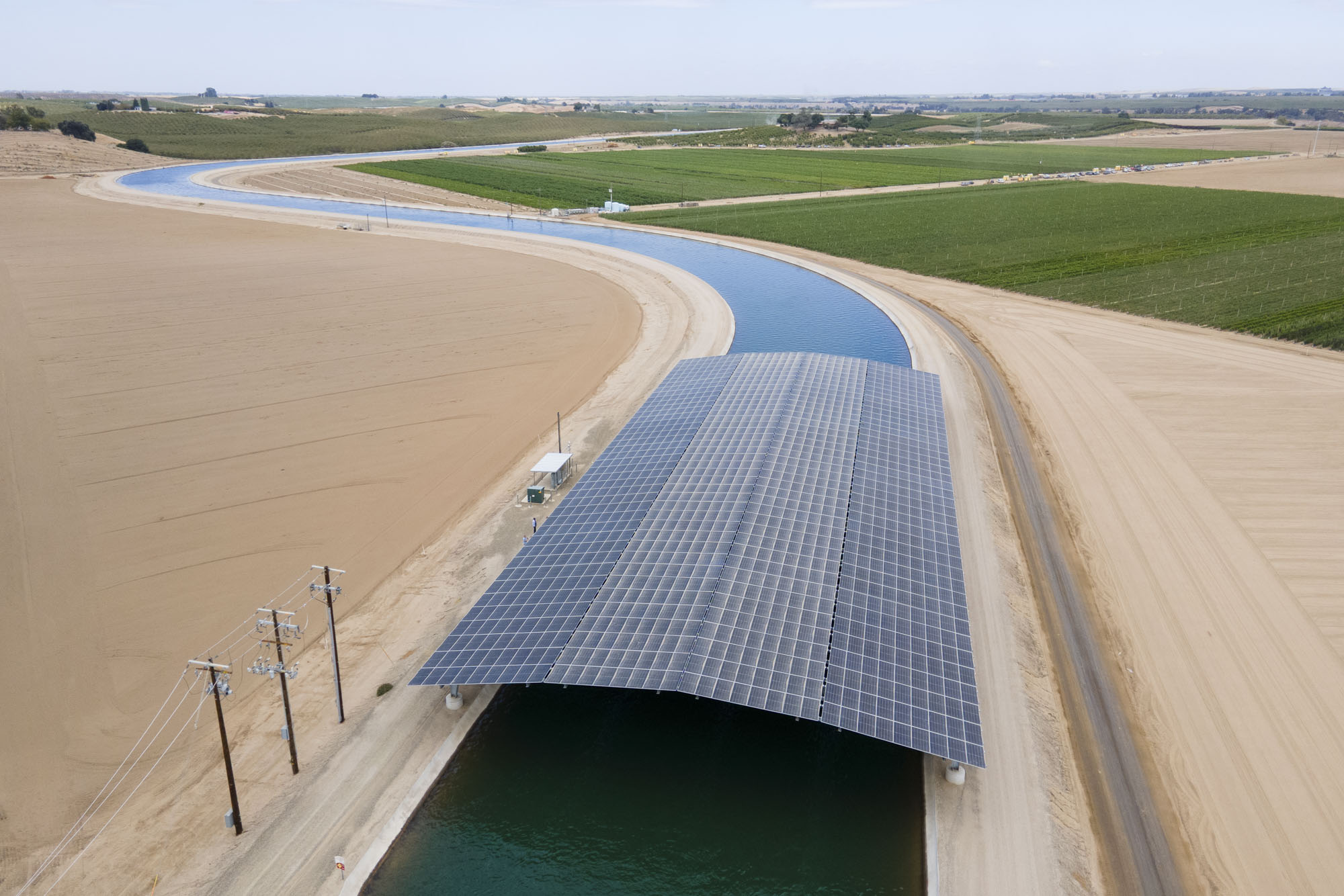
The duo went on to start Solar Aquagrid, an advocacy firm dedicated to reimagining aging canals, and partnered with the Turlock Irrigation District, UC Merced and the California Department of Water Resources to cover small sections of Turlock’s canals with solar panels. The new “solar canal” provides shade to limit evaporation and generates power all in one neat package. They call it Project Nexus, and it operates at the intersection of the state’s need for clean water and energy.
Project Nexus tests not one, but three different solar canal models. A wide-span canopy rises over one of Turlock’s 115-foot canals, resembling the top of a barn. A more classic set of slanting solar panels sits atop a 20-foot canal. And accordion-like retractable panels are positioned low across the narrow canal, ready to roll up at a moment’s notice.
Raj affectionately called the wide-span canopy his “singular field of dream.”