// NASA BREAKING NEWS — SPAZIO & SCIENZA
Risk of Hydrazine Use Following Freeze–Thaw Exposure
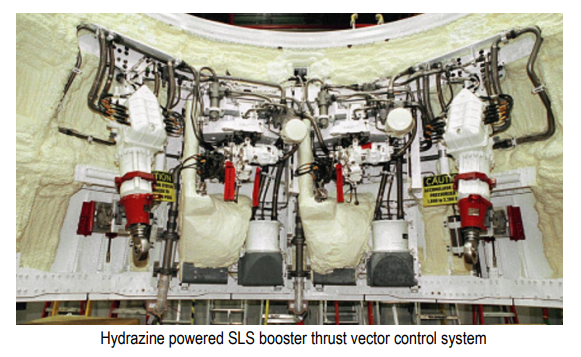
For more information, contact Jonathan E. Jones, Langley Research Center, jonathan.e.jones@nasa.gov
The purpose of this Technical Bulletin is to communicate the risks associated with freeze–thaw cycles in hydrazine monopropellant systems and to provide general recommendations for mitigating damage, operational hazards, and loss of system reliability in propulsion and auxiliary hydrazine systems.
BackgroundHydrazine (N2H4) freezes near 1.6°C, and its phase transition is known to introduce risks to flight hardware. Multiple NASA programs have historically encountered hydrazine freeze related issues:
• Space Shuttle APU hydrazine lines were vulnerable to freeze induced contraction followed by thaw induced over expansion, capable of bursting plumbing. Shuttle flight rules permitted no more than two freeze–thaw cycles before considering the system degraded or failed.1
• Voyager propulsion systems faced mission threatening scenarios as hydrazine temperatures approached the freezing/slush formation range (0.1–1.6°C). Detailed thermal modeling was required to prevent freezing of lines, blockage, and thruster malfunction.2
• Hydrazine thermodynamic properties confirm significant changes in density and pressure across phase transitions, emphasizing the sensitivity of propellant lines to freeze–thaw stress.3
These combined lessons form the basis for risk identification and mitigation.
Problem SummaryFreeze–thaw exposure of hydrazine systems presents the following critical risks:
• Structural Damage Hydrazine contraction during freezing allows additional propellant into confined lines, producing “superpacked” conditions that cause line or fitting rupture upon thaw.2
• Valve, Seal, and Diaphragm Compromise Elastomeric components and precision valve seats may experience cracking, distortion, or loss of sealing capability due to differential thermal expansion. Voyager thermal assessments highlighted susceptibility of long stainless steel runs to asymmetric temperature profiles.2