// NATURE NEWS — SPAZIO & SCIENZA
The anthropogenic fingerprint on emerging infectious diseases
Nature
(2026) Cite this article
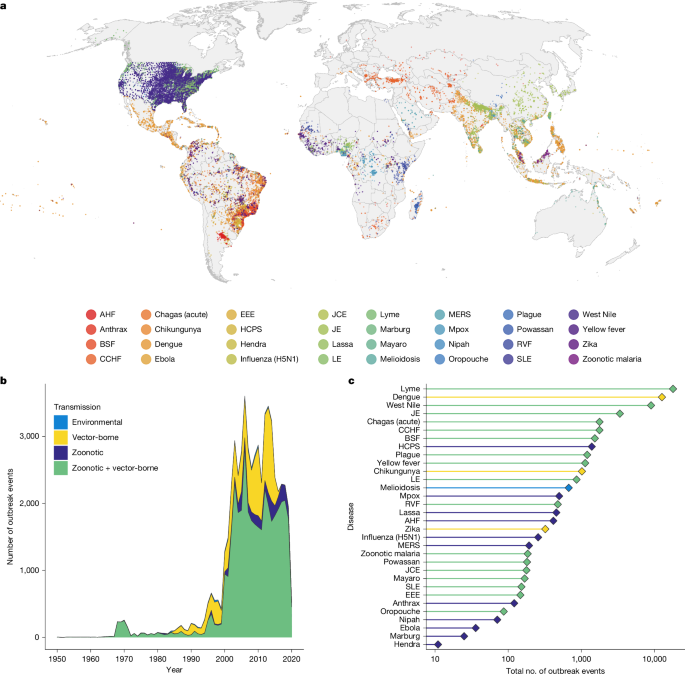
Emerging infectious diseases are a hallmark of the Anthropocene1,2. Human-driven ecosystem changes and human–wildlife–livestock contact can drive the emergence of zoonotic and vector-borne diseases3,4,5, but how much these processes shape landscapes of outbreak risk is poorly understood, beyond a few well-studied systems6,7,8. Here we consolidate 58,319 outbreak event records for 32 diseases and systematically test how 16 hypothesized social and environmental drivers impact outbreak geographies, while accounting for detection and reporting biases. We show that outbreak risks are typically highest in mosaic landscapes where people and livestock live alongside forests and fragmented ecosystems. These combined factors, along with long-term declines in precipitation, share strong impacts across several vector-borne diseases (for example, dengue, Lyme disease and zoonotic arboviruses). By contrast, directly transmitted zoonoses (for example, Ebola and mpox) share few common drivers, and the impacts of most other anthropogenic pressures (for example, deforestation, climate warming and agricultural intensification) vary widely between diseases. Most consistently, the observed geography of outbreaks is shaped by healthcare access: reporting declines by a median of 32% (range across diseases: 1.2–96.7%) for each additional hour’s travel time from a health facility. Our findings underscore that infectious disease spillover and emergence are multi-causal, and that no one-size-fits-all strategy can prevent epidemics and pandemics. Ecosystem-based public health interventions9 should always follow system-specific evidence, and be paired with greater investment in health systems and One Health pathogen surveillance.
In recent decades, emerging infectious diseases transmitted by wildlife (zoonoses; for example, COVID-19, Ebola virus disease, influenza and mpox) or arthropod vectors (for example, dengue fever, Lyme disease and Zika virus disease) have had catastrophic social, economic and ecological impacts. This trend is widely considered the result of an ongoing state shift in the biosphere10,11, where human-driven environmental changes are both increasing animal susceptibility to infection, and creating more opportunities for animal-to-human transmission (zoonotic spillover2), leading to more outbreaks of both familiar and new pathogens. The rising tide of emerging infections has brought global attention to ecological and social interventions that could mitigate the upstream drivers of disease emergence9. Recent attention has often focused on curbing wildlife trade or deforestation12,13,14,15, but other important options include reducing greenhouse gas emissions to limit climate change, ecosystem restoration initiatives, human and livestock vaccination, improved access to point-of-care diagnostics and clinical care, the development of ‘One Health’ disease surveillance systems and workforces, and stricter biosecurity practices16,17. These interventions are grounded in public health and ecological first principles, but there is limited scientific consensus on their potential benefits and relative priority, in large part owing to insufficient evidence about the universality of many drivers of disease transmission and emergence.
Meta-analyses and literature syntheses have shown predictable anthropogenic effects on community diversity, pathogen diversity and infection dynamics in wildlife hosts and arthropod vectors18,19,20,21,22. These studies suggest that ecosystem degradation and biodiversity loss tend to increase wildlife disease prevalence4,18, but that the net impacts of habitat fragmentation, agriculture, urbanization, deforestation and climate change may be unpredictable and context-specific19,23,24. This uncertainty reflects a mixture of scientific evidence gaps and true heterogeneity across systems, driven by differences in pathogen life cycles, host and vector ecology, an