// NATURE NEWS — SPAZIO & SCIENZA
Sequence-encoded hexagonal lattices in multichannel peptide nanofibrils
Nature
volume 657, pages 935–943 (2026) Cite this article
Structural complexity in biological matter arises from molecular information that encodes supramolecular assembly across length scales1,2,3. Here we show that minimal nine-residue peptides can encode discrete lateral interaction motifs that direct supramolecular organization. These motifs generate hexagonal pores and hierarchically tile into multichannel nanofibrils with defined topology. Sequence-encoded amphiphilicity combines a cross-β-dimer, an inversion point and a trimeric junction to create complementary interfaces that couple lateral growth to axial stacking, yielding honeycomb lattices with continuous approximately 5-nm solvent-accessible nanochannels. Cryo-electron microscopy resolves the supramolecular architecture and shows that lattice symmetry and pore geometry are preserved across variants. Systematic perturbations establish sequence–structure rules linking residue position to supramolecular symmetry, lattice propagation and channel topology. Molecular dynamics simulations and vibrational spectroscopy show that the channels remain water accessible and show sequence-tunable hydration. These findings establish that a minimal, sequence-encoded interaction hierarchy can programme long-range supramolecular order, providing a general framework for how short peptides can encode complex, symmetry-defined architectures4,5,6,7,8,9,10,11,12.
Biological materials derive functional complexity from molecular information that encodes their three-dimensional structure and hierarchical organization across length scales. Polypeptides offer a rich chemical design space13,14,15, and β-sheet-rich amyloid fibrils represent one of their most prevalent supramolecular states, with roles ranging from hormone storage to pathological aggregation16,17,18. Recent advances in cryo-electron microscopy (cryo-EM) have revealed these assemblies at high resolution, resolving their atomic structures in the hydrated state17,18, and disclosing the packing and polymorphism of cross-β-motifs.
Most peptide assemblies elongate as one-dimensional fibrils whose lateral interfaces are polymorphic and therefore difficult to design, preventing controlled tiling into higher-dimensional lattices (Extended Data Fig. 1a). Programmable hierarchical growth has been achieved in coiled-coil proteins19,20,21,22,23,24,25,26 and collagen-mimetic systems through large pre-organized interfaces27,28, whereas peptide nanochannels formed from cyclic scaffolds rely on covalent backbone pre-organization29,30,31,32,33,34. By contrast, controlled two- or three-dimensional lattice formation from minimal linear β-sheet peptides is rare5,6,7,8,9,10,11,12. Consequently, a geometry-guided framework for programmable multichannel architectures from short linear β-sheet sequences has remained elusive.
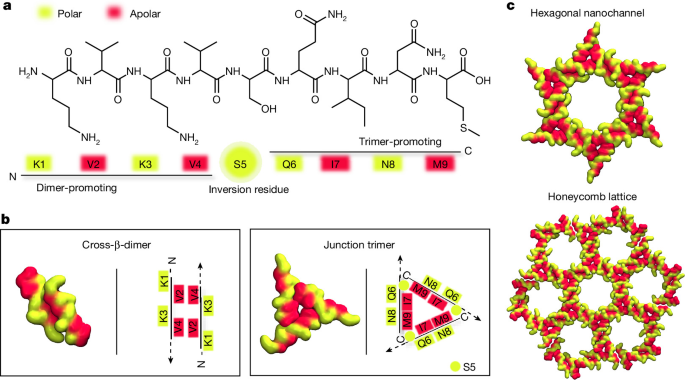
Here we show that amphiphilic nonapeptides encode discrete interaction motifs that direct the formation of hexagonal pores, which hierarchically tile into laterally expandable multichannel nanofibrils: a cross-β-dimer that mediates lateral and axial growth, a trimeric junction that encodes lateral connectivity and symmetry, and a central inversion residue that orients the two motifs (Fig. 1a) to create complementary interfaces that couple lateral organization to axial stacking. Cryo-EM, sequence perturbation, molecular dynamics simulations and vibrational spectroscopy reveal how these motifs couple axial stacking, lateral tiling and sequence-dependent channel hydration. Together, these results show that minimal sequence-encoded interaction motifs can programme supramolecular symmetry and hierarchical lattice growth, enabling multichannel peptide nanofibrils from short linear sequences.
a, Modular design of the DILT peptide family showing the cross-β-dimer-forming interface, the inversion residue and the trimeric-junction-forming interface that together encode complementary axial and lateral interface