// NATURE NEWS — SPAZIO & SCIENZA
Reference genomes and fossils revise bat family phylogeny and biogeography
Nature
(2026) Cite this article
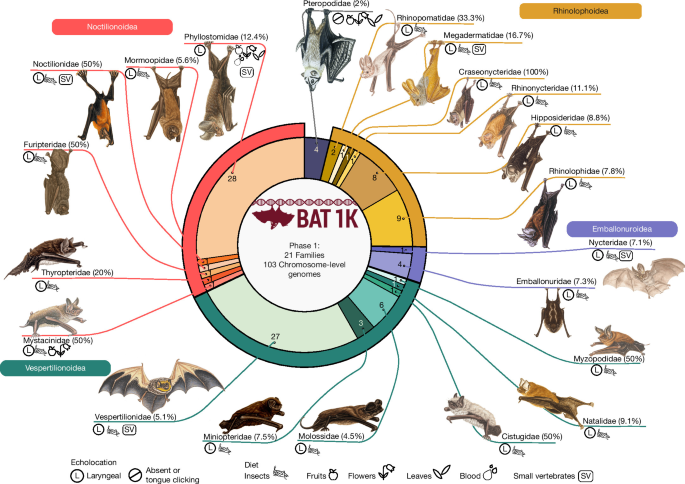
Bats are extraordinary among mammals, having uniquely evolved powered flight and laryngeal echolocation, along with disease resistance, extended healthspans and the ability to hibernate1. However, the evolutionary history of bats and the understanding of these adaptations remain unresolved. We analysed chromosome-level, long-read genome assemblies from 103 bat species, including 42 new assemblies, representing all 21 bat families. This dataset, expanded in scope and assembly quality, yielded a new bat phylogeny. We placed Myzopodidae as the earliest branch within Vespertilionoidea, and resolved yangochiropteran relationships, identifying Emballonuroidea and Vespertilionoidea as sister groups. Our analysis revealed a mosaic evolutionary history across bats and explained why previous phylogenetic studies were misled. Chromosomal ancestral-state reconstructions supported 26 ancestral bat chromosomes. We integrated a morphological dataset of 699 characters for 65 species, including 44 pre-Quaternary fossils and representatives of most living bat families, with neutrally evolving genomic sites. Fossilized birth–death and dispersal–extinction cladogenesis analyses showed that bats, and thus powered flight, probably originated in Europe in the late Palaeocene, refuting African and North American origins. Placement of the fossil †Vielasia in the oldest ‘Eochiroptera’ clade indicates that laryngeal echolocation predates crown-bat diversification. Total evidence dating, including the fossil taxa, significantly reduced unrepresented basal branch lengths compared with molecular-only divergence estimates. By integrating comprehensive genomic and morphological datasets, analysed using innovative methods, we resolve long-standing controversies in bat biology and provide new insights into the evolutionary history and trait diversification of bats.
With over 1,500 species, bats account for more than one fifth of all living mammal species2. They are distributed globally, are predominantly nocturnal and adapted to diverse foraging niches, ranging from insectivorous, sanguivorous, carnivorous, piscivorous, frugivorous and nectarivorous species1. Some species are exceptionally long-lived compared with other mammals of similar body size, capable of living 8–10 times longer than expected, showing few signs of ageing or cancer3. Several species host a diversity of viruses without overt disease symptoms and show unique immune adaptations4,5. Despite having the smallest mammalian genomes (approximately 2 Gb), they harbour a diverse endogenous genomic virosphere4,6 and many have active DNA transposons, which is exceptionally rare among mammals7.
The acquisition and evolution of these unique traits have been the centre of heated debates, particularly in relation to the evolution of flight and echolocation. This is probably due to the difficulties in reconstructing bat evolutionary history8,9,10. Challenges have stemmed from: homoplastic and convergent molecular and morphological characters11,12; conflicting phylogenetic signals13; a paucity of chromosome-level bat genome assemblies1,14; rapid speciation events resulting in incomplete lineage sorting and introgression15; the dearth of phylogenetic methods required to handle this complexity; and a limited and fragmented fossil record16.
Indeed, the fossil record has provided important but incomplete insights into the early bat evolution. The oldest bat fossils, dating to the early Eocene (approximately 56–52 million years ago (Ma)), have been recovered from multiple biogeographical regions, including Asia, North America, Europe and Australia, and in some cases consist of well-preserved skeletons from Lagerstätten deposits16,17,18. These fossils indicate that powered flight and echolocation had evolved by this time16,17,18. However, beyond this narrow temporal window, the bat fossil record is sparse and highly fragmented, dominated by isolated