// NATURE NEWS — SPAZIO & SCIENZA
TRAM promotes Toll-like-receptor-free myddosome signal transduction
Nature
(2026) Cite this article
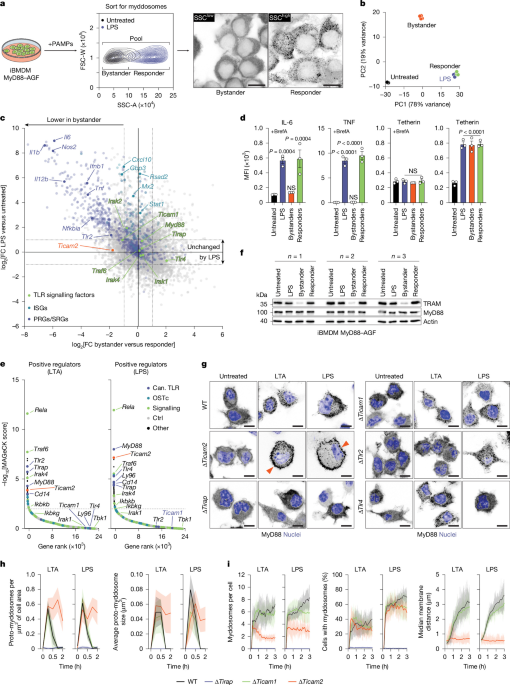
In the Toll-like receptor (TLR) signal transduction pathways, activated receptors are present for mere minutes within the initial, membrane-proximal signalling complexes called proto-myddosomes1. Proto-myddosomes are rapidly released from TLRs to self-assemble (that is, mature) into enzyme-rich, cytosolic supramolecular organizing centres called myddosomes2,3,4. Myddosomes induce hours-long inflammatory gene expression5,6,7,8,9,10. The mechanism controlling proto-myddosome release and its effect on signal transduction are undefined. Here we identify factors that regulate the maturation process of proto-myddosomes into receptor-free cytosolic myddosomes11. Through a genetic screen in macrophages, we identify TRAM, which was previously described to control MyD88-independent TLR signalling, as a regulator of myddosome assembly. Using biochemistry, live-cell imaging and activity reconstitution with recombinant proteins, we show that the plasma-membrane-associated adapter TIRAP seeds proto-myddosomes12,13, after which TRAM dissociates MyD88 from the TLR–TIRAP complex to enable myddosome maturation and downstream signal transduction14,15,16,17,18,19. In the absence of TRAM, MyD88 cannot dissociate from the TLR–TIRAP complex, resulting in abnormal and unstable MyD88 interactions with downstream signalling enzymes. These findings enabled us to identify TRAM-dependent long-lasting myddosome activities as the determinant of two TLR pathway hallmarks: hours-long NF-κB activation20,21,22,23,24 and secondary response gene expression25,26,27. Chemical dissociation of cytosolic myddosomes disrupted existing inflammatory activities of TLR-stimulated cells in vitro and in vivo. Collectively, this work establishes TRAM as a regulator of myddosome maturation and signalling, providing the molecular basis for receptor-free signal transduction.
TLRs are transmembrane proteins that detect microbial products and endogenous ligands, collectively referred to as pathogen- and damage-associated molecular patterns (PAMPs and DAMPs, respectively; typically bacterial cell wall components, nucleic acids or host-derived molecules that indicate tissue injury)28,29. Thus, TLRs are considered gate keepers of inflammation and adaptive immunity30,31. Recent work on the endogenous TLR signalling pathways revealed an unusual activity1. Rather than assembling myddosomes around the cytosolic tail of TLRs, as would be expected from classic views of receptor-mediated signal transduction, activated TLRs seed the assembly of small clusters of MyD88 referred to as proto-myddosomes. Proto-myddosomes are subsequently released from the TLR into the cytosol, where they grow in size and mature by incorporating inflammation-inducing signalling proteins that act at all stages of the TLR pathway. These insights raise the question of how proto-myddosomes are released from TLRs, and whether the receptor-free state of myddosomes is important. Here we identify regulators of this unorthodox mechanism of signal transduction.
We established a flow-cytometry-based assay to separate myddosome-containing cells from cells lacking myddosomes (referred to as bystanders). This assay is based on the concept that the large number of μm-sized myddosomes within individual cells would change the side scatter (SSC) properties, when assessed using flow cytometry32. To test this idea, we used immortalized bone-marrow-derived macrophages (iBMDMs) that contain a biallelic knock-in of an AGF (Apex2-mEGFP-Flag) tag at the endogenous locus encoding the myddosome component MyD88 (ref. 1). MyD88–AGF iBMDMs treated with bacterial lipopolysaccharide (LPS), a TLR4 ligand, exhibited a shift from homogenous SSClow properties to the majority of cells being SSChigh (Fig. 1a). Imaging of cells after sorting confirmed phenotypic separation, with SSChigh cells (referred to as responders) containing clusters of MyD88–AGF (that is, myddosomes). SSClow bystan