// NATURE NEWS — SPAZIO & SCIENZA
Lsp2 links mTORC1 to TOP mRNA translation and lifespan in Drosophila
Nature
(2026) Cite this article
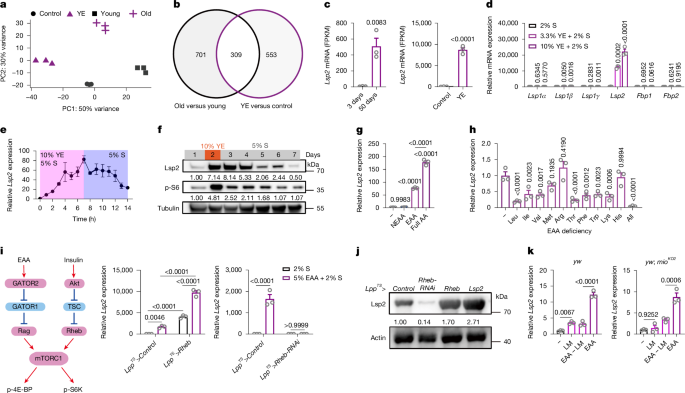
Mechanistic target of rapamycin complex 1 (mTORC1) senses nutrient availability to orchestrate metabolic processes that are crucial for physiological homeostasis and ageing1. mTORC1 preferentially regulates the translation of 5′-terminal oligopyrimidine (TOP) motif-containing mRNAs (which encode mainly ribosomal proteins) through the 4E-BP translational repressor2; however, this function of mTORC1 is resistant to rapamycin inhibition3. TOP mRNAs are exceptionally abundant, and thus impose a major translational burden on cells, but how their translation is physiologically tuned and linked with lifespan remains unclear. Here we show that Lsp2, which was previously known to be a storage protein4, is also an adipose effector and feedback activator of mTORC1 that modulates lifespan in Drosophila. Expression of Lsp2 is induced by essential amino acids through mTORC1 and is gated by additional signals of nutrient sufficiency. Genetic ablation of Lsp2 robustly extends lifespan without impairing key life history traits such as reproduction. Translatomic profiling shows that loss of Lsp2 selectively reduces global TOP mRNA translation in a 4E-BP-dependent manner, thereby extending lifespan through a mechanism distinct from the effects of rapamycin. Evolutionarily, TOP motifs co-emerged with 4E-BP and are present in nearly all Drosophila ribosomal protein mRNAs. Moreover, we show that the role of TOP motifs in translational control extends to Drosophila. Collectively, our findings reveal a nutrient-induced physiological factor that amplifies mTORC1 output in TOP mRNA translation and regulates organismal longevity.
This is a preview of subscription content, access via your institution
Access Nature and 54 other Nature Portfolio journals
Get Nature+, our best-value online-access subscription
Prices may be subject to local taxes which are calculated during checkout
All relevant datasets generated in this work are publicly available. Regular RNA sequencing data have been deposited in the Gene Expression Omnibus (GEO) under the accession number GSE295794. Translatomic data are available through the GEO under the accession number GSE297586. The proteomic data have been deposited to the ProteomeXchange Consortium (https://proteomecentral.proteomexchange.org) via the iProX partner repository with the identifier PXD063648. Other publicly available databases and datasets that were used in this work: the D. melanogaster protein database (https://www.uniprot.org/taxonomy/7227), the D. melanogaster (BDGP6.46) reference genome (https://www.ensembl.org/Drosophila_melanogaster), FlyAtlas 2 (https://flyatlas.gla.ac.uk/FlyAtlas2/), the KEGG database (https://www.genome.jp/kegg/) and a total of 49 CAGE-seq datasets for 7 species (complete accession numbers are provided in Supplementary Data 8), including the following datasets used for TOP mRNA prediction in Drosophila: SRR27927240, SRR27927241, SRR27927242, SRR488271, SRR488279 and SRR488280 (refs. 72,73). Source data are provided with this paper.
Original code for TOP mRNA, mRNA sequencing, monosome sequencing and polysome sequencing data analyses is publicly available via Zenodo at https://doi.org/10.5281/zenodo.21473950 (ref. 74).
Liu, G. Y. & Sabatini, D. M. mTOR at the nexus of nutrition, growth, ageing and disease. Nat. Rev. Mol. Cell Biol. 21, 183–203 https://doi.org/10.1038/s41580-019-0199-y (2020).
Article
PubMed
PubMed Central
CAS
Google Scholar