// NATURE NEWS — SPAZIO & SCIENZA
The mutational dynamics of the Arabidopsis centromeres
Nature
(2026) Cite this article
Centromeres are essential for faithful chromosome segregation during cell division. Yet despite their conserved function, many centromeres contain highly variable but internally remarkably homogenized tandem-repeat arrays1,2,3,4,5 whose evolutionary dynamics remain poorly understood. Here, using replicated genome assemblies of mutation accumulation lines, we define the centromere-specific mutation spectrum in Arabidopsis thaliana. We find that kilobase-sized insertion–deletion mutations (indels) occur frequently and consistently preserve tandem-repeat arrays by adding or removing only complete repeat units. Point mutations accumulate at an almost tenfold higher rate than elsewhere in the genome, probably driven by non-allelic gene conversion between closely linked repeat units. These findings suggest a central role for homology-directed DNA repair in centromere evolution, further supported by the accumulation of more frequent and longer tandem-repeat-preserving indels in Arabidopsis lines that are deficient in the anti-recombinase helicase RTEL1. Forward-in-time simulations parameterized with the observed mutation spectrum show that kilobase-sized indels and point mutations alone are sufficient to generate the megabase-sized homogenized repeat blocks characteristic of natural centromeres. Together, our results show that centromere evolution is driven by a distinct mutational spectrum shaped by homology-directed DNA repair, providing a quantitative framework for understanding how mutational processes generate and maintain the large-scale architecture of centromeric DNA.
Centromeres are essential for faithful chromosome segregation during cell division. Despite their conserved function, centromeric DNA often consists of highly homogenized, megabase-scale tandem-repeat arrays that vary markedly within and between species1,2,3,4,5. The mutational processes driving this rapid sequence turnover remain poorly understood.
The individual units of centromeric repeat arrays are typically short6,7 (100–200 bp) and highly similar, but not identical, in sequence. Often, specific combinations of different repeat units are repeated multiple times, forming higher-order repeat (HOR) regions. Closely linked and highly similar HOR regions can further expand into homogenized blocks that span several megabases, producing the characteristic large-scale patterns of sequence similarity that are commonly observed when visualizing sequence similarities across entire centromeres1,5,6.
The functional core of a centromere typically consists of such homogenized blocks, whereas the peripheries tend to be more heterogeneous and contain more transposable element (TE) insertions and structural rearrangements1,5. Although this general organization is usually conserved, the number, size and arrangement of the homogenized blocks vary greatly even between individuals of the same species. This variation has led to the hypothesis that megabase-scale mutations or long-range recombination events give rise to the characteristic structures of centromeric satellite arrays7.
In A. thaliana, the five centromeres are composed of tandem-repeat arrays derived from a 178-bp repeat monomer (CEN178)5. Long-read assemblies have reconstructed the centromeric tandem arrays in both the reference accession Col-0 and large populations of diverse Arabidopsis accessions5,8,9,10. The extreme sequence divergence observed in natural centromeres supports the hypothesis that these regions evolve through distinct mutational dynamics based on homology-directed DNA repair1,11, with gene conversion and unequal crossovers long proposed to have dominant roles in tandem-repeat evolution and homogenization2,12,13,14,15,16,17,18.
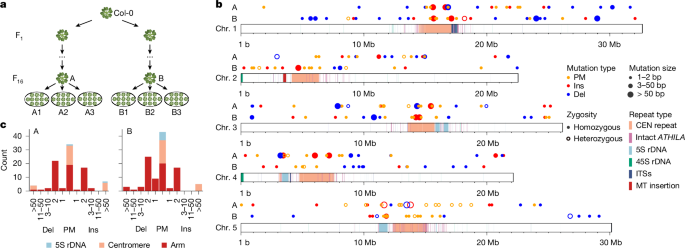
To better understand these mutational processes, we analysed A. thaliana mutation accumulation (MA) lines, which were propagated through repeated single-seed descent over multiple generations to allow mutation