// NATURE NEWS — SPAZIO & SCIENZA
Brain lipids are organized into zones — and reorganized during pregnancy
Evan Macosko is in the Stanley Center for Psychiatric Research at the Broad Institute of MIT and Harvard, Cambridge, Massachusetts 02142, USA.
Search author on:
PubMed
Google Scholar
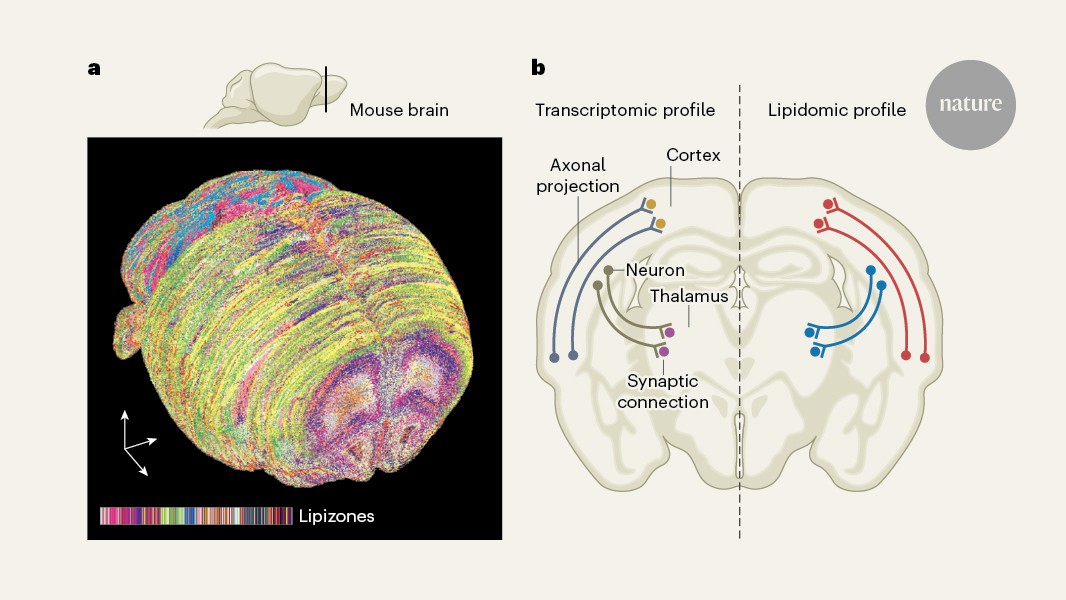
When the pioneering German–British neurochemist Johann Thudichum generated the first catalogue of brain lipids more than a century ago, one molecular fraction baffled him so much that he named it sphingosine, after the enigmatic ancient Sphinx1. A century and a half later, the brain’s fats have retained much of that mystery. Comprising half of its dry weight, lipids are perhaps the brain’s most defining compositional feature. Their most famous role is forming the insulating myelin wrapping that enables efficient electrical conduction along neuronal projections called axons. But beyond this, a broader conceptual understanding of brain lipids is still in its infancy. How the vast diversity of brain lipids is spatially organized, and why the brain requires such immense biochemical variety, remains a big puzzle — one that Bassini et al.2 begin to address in their paper in Nature.
Access Nature and 54 other Nature Portfolio journals
Get Nature+, our best-value online-access subscription
Prices may be subject to local taxes which are calculated during checkout
Thudichum, J. L. W. A Treatise on the Chemical Constitution of the Brain (Bailliere Tindall, 1884).
Bassini, L. F. et al. Nature https://doi.org/10.1038/s41586-026-11050-0 (2026).
Article
PubMed
Google Scholar
Article
PubMed
Google Scholar