// NATURE NEWS — SPAZIO & SCIENZA
Gravitational forces inside Earth drag some decades out — and make others fly by
Dominique Jault is at the Institute of Earth Sciences (ISTerre), University of Grenoble Alpes, CNRS, Grenoble 38058, France.
Search author on:
PubMed
Google Scholar
Paolo Personnettaz is at the Institute of Earth Sciences (ISTerre), University of Grenoble Alpes, CNRS, Grenoble 38058, France.
Search author on:
PubMed
Google Scholar
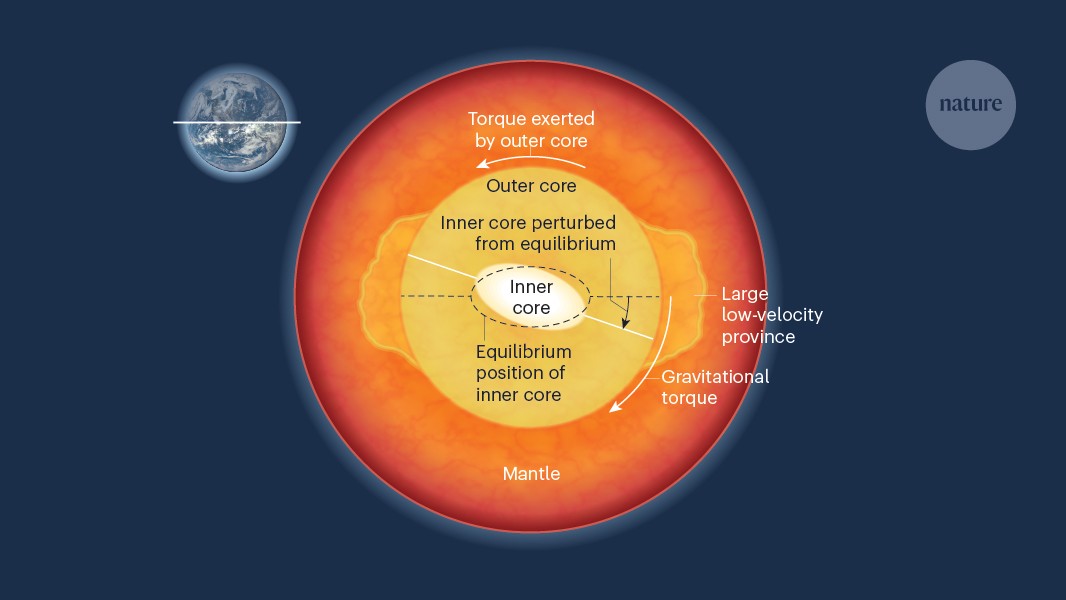
The rate at which Earth spins, and therefore the length of the day, fluctuates on scales ranging from hours to millennia. Decadal variations that alter day length by a few milliseconds are caused by the transfer of angular momentum between the planet’s core and the solid mantle that surrounds it. Several mechanisms for this transfer have been proposed but now, writing in Nature, Zhang and Dumberry1 report that these multidecadal variations can be traced to gravitational coupling between the inner core — a solid ball of iron that floats in the liquid outer core — and the mantle. This result was obtained by linking seismological measurements that reveal how the inner core rotates with a model of the core’s flow derived from measurements of Earth’s magnetic field.
Access Nature and 54 other Nature Portfolio journals
Get Nature+, our best-value online-access subscription
Prices may be subject to local taxes which are calculated during checkout
Zhang, H. & Dumberry, M. Nature https://doi.org/10.1038/s41586-026-10999-2 (2026).
Istas, M., Gillet, N., Finlay, C. C., Hammer, M. D. & Huder, L. Geophys. J. Int. 233, 1890–1915 (2023).