// ARS TECHNICA — SPAZIO & SCIENZA
Former NASA chief sounds alarm on China's lunar "exploration" plans
“Beijing’s intended strategy is to dominate the high ground of the twenty-first century.”
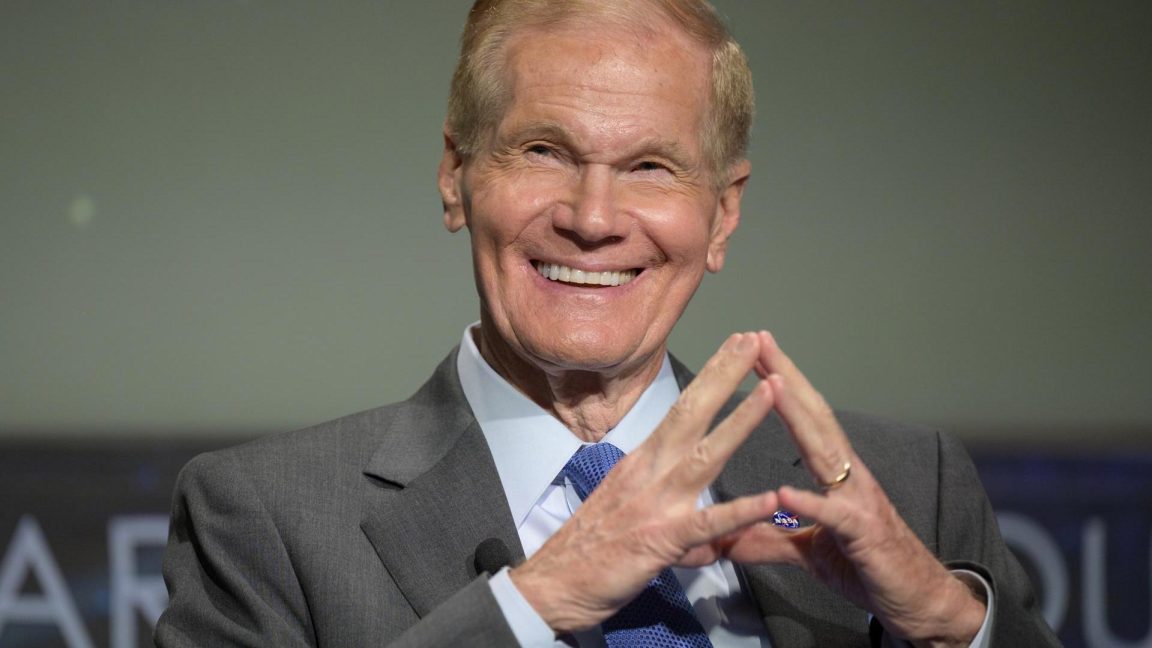
In a forthcoming memoir, former US politician and NASA Administrator Bill Nelson offers a blistering assessment of China, saying the United States must do all it can to retain its leadership in space exploration.
“Beijing’s intended strategy is to dominate the high ground of the twenty-first century,” writes Nelson in Space Odyssey, a book to be published by Harper Horizon in January 2027.
A former Congressman and Senator from Florida, Nelson served as a mission specialist on a space shuttle flight in 1986 and later as NASA administrator from May 2021 to January 2025 under President Biden. The book largely focuses on his space policy work in Congress and his tenure as NASA’s leader.
Nelson recounts how in early 2023, NASA assisted the US military when a Chinese spy balloon began traversing the United States. With its experience in using balloons to map the stratosphere and model atmospheric currents, NASA provided information on how to shoot the balloon down without endangering anyone on the ground.
He argues that the balloon saga offered further affirmation that the United States was enmeshed in a high-stakes competition with China for the high ground.
“What many Americans first registered as a balloon violating our airspace was really a warning that the next great rivalry will not be fought on land or sea but the skies above us and even beyond our atmosphere,” he writes. “The episode was also a window into the new space race that is swiftly approaching its most urgent phase, with the stakes even higher than the Cold War contest.”
Nelson has long been wary of China as a threat to the United States, noting his concerns about technology theft from the West. Unlike his predecessor under a Democratic president—former astronaut Charlie Bolden, who served as NASA leader under President Obama—Nelson supported the Wolf Amendment, which strictly limits cooperation between NASA and China’s space program.
The reason, Nelson says, is that China’s space program is militarized and highly secretive.
“China is not a partner to be trusted,” he writes. “Partnership requires trust, and trust is founded on transparency. With China, despite repeated efforts to build verifiable, rules-based cooperation and set commonsense guard rails for engagement, there has never been much of either.”