// PC GAMER — GAMING
Turtle Beach Command Series KB7 TKL review
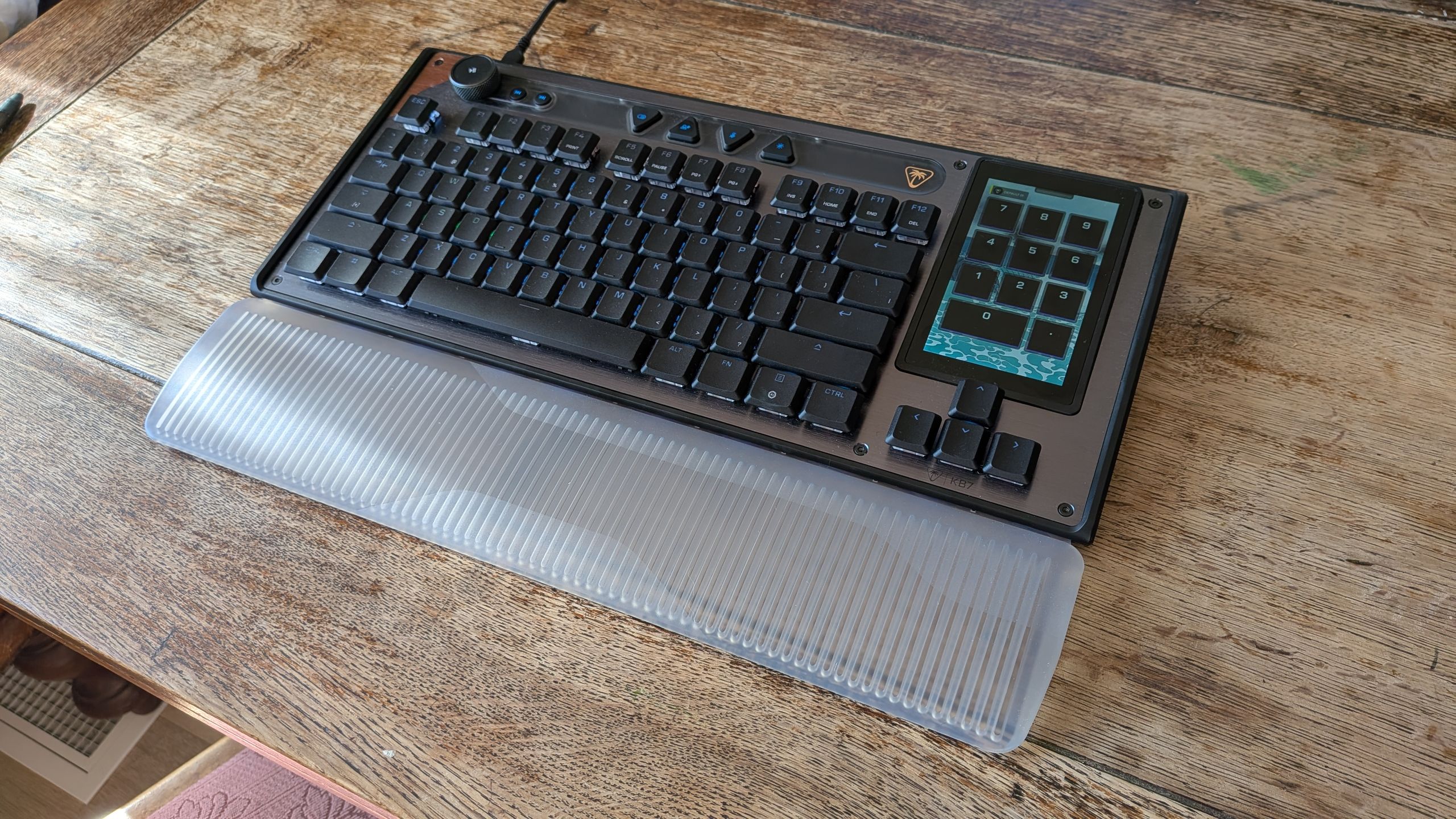
A feature-full Hall effect keyboard for competitive fanatics and content creators alike, but it also has a lot to offer for the rest of us.
PC Gamer's got your back
Our experienced team dedicates many hours to every review, to really get to the heart of what matters most to you. Find out more about how we evaluate games and hardware.
As we know, Turtle Beach loves to put a big ol' screen on its peripherals and this decadent Hall effect keyboard is probably the apotheosis of "big screen on otherwise screen-less thing" design. It's a big 4.3-inch color touchscreen affair that does little more than what can already be achieved on the monitor directly in front of you. But it can definitely do it quicker.
More on that screen later but yes, it does confer an added level of prestige to this slab, which is no slouch in the looks department. Weighing in at just under a kilo without a palm rest, it has a weapon-like and stylish aluminium veneer body and, it almost goes without saying, RGB that's customisable on a key-by-key basis. The gun metal grey veneer gives it a slightly gritty quality, but tastefully so: it's a hardcore keyboard, but it's not overtly a hardcore gaming keyboard unless, of course, you have the Counter-Strike touchscreen template blaring on that display.
The elephant in the room is that the Command Series KB7 has Hall effect switches. If you pay attention to modern gamepad design you're probably accustomed to assuming that Hall effect equals better. Where keyboards are concerned, the truth is a touch more complicated. Mechanical keyboards trigger inputs physically whereas Hall effect keyboards do so digitally. Ultimately, it means Hall effect switches can be triggered more quickly and in rapid succession. They are, in other words, super low-latency keyboards.
Hall Effect switches with Rapid Trigger and adjustable actuation
There's every chance you've never noticed any meaningful latency in your (likely wired) gaming keyboard. With 8K polling, the response time on these keys is a blinding 0.125ms, but that's been achievable on mechanical slabs for a while. But among other less showy benefits, Hall effect keyboards offer a huge amount of customisation when it comes to actuation: one can adjust this metric—which basically measures how sensitive a key is to the user's press—on a key-by-key basis.
Using the Turtle Beach Swarm 2 app, actuation can also be tweaked globally on a scale of 0.1ms to 3.2ms: Drag it all the way up to 0.1ms and you'll probably start to ssssound liiike a hissssssing sssnake during moment-to-moment typing. Lower actuation can lead to accidental inputs, but where there's a will there's a way, and if you want ultra-sensitivity I'm sure you'll adapt. If you're the kind of person who slams A and D when strafing in a first-person shooter, a lower actuation may make sense. The freedom to tinker is what Hall effect keyboards are really all about, and doing so here is a breeze—especially with five onboard profiles to muck around with.
The screen seems a bit superfluous and showy at first, but over time its flexibility blossoms. Using the Turtle Swarm software I can load a bunch of pre-made templates into the onboard memory. These templates come in the form of three-by-four grids of buttons—like the missing numpad—including shortcuts for OBS, Discord, Counter-Strike, Teams, Zoom, League of Legends, Streamlab, and Photoshop.
I did miss onboard shortcuts—with useful glyphs—for Steam, which would seem to make more sense than dedicated buttons for Microsoft's Gamebar. I had to make do with creating macros which I could then assign to the touchscreen, though there's no way to customise the icon of said macros, so if I create too many there's no simple visual identifier to distinguish them: they just show as New Macro. Meanwhile, there are dozens of pre-fab macros in the Swarm 2 app that you can use, ranging from obvious choices like Apex Legends and Dota 2 through to BioShock 2 (but not 1) for some r