// HACKER NEWS — CYBERSECURITY
Coulomb's law remains tricky to test at home
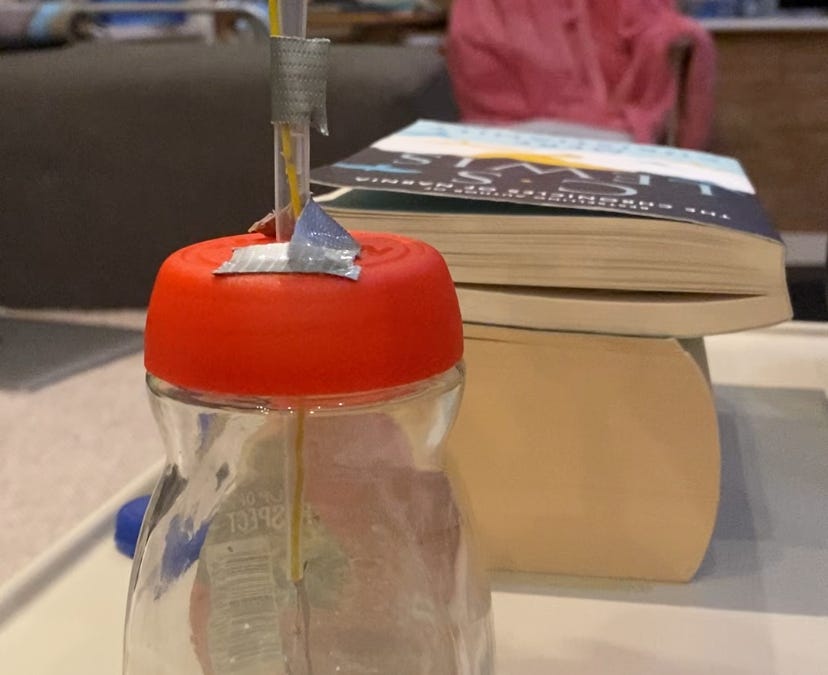
One problem that I've had in physics is remembering physical laws. I want to be able to use physical law in the same way that I can fry an egg, string together a sentence, or add up numbers. I think the world 'fluency', comes to mind. Imagine manipulating the physical world as fluently as one can communicate ideas - 'oh my chicken gets overcooked, that’s fine, I know how to solve the heat equation so I just need to reduce the temperature by X and make my chicken a bit more spherical next time!'.
Sure, I could just look up Coulomb's law or Maxwell's equations, or ask an LLM, but I'm always amazed that the Greeks managed to learn so much about the world with much less tools. And I kinda want to be able to do the same. One time my friend Cyrus and I we were sitting on the beach in Brighton and then challenged each other to try to compute the radius of the Earth from first principles using the angle of the horizon. I think these types of challenges are both fun and revealing.
There is piece of advice in one of Shankar's texts that stuck with me whilst I was chilling by the pool in Malaysia, from his textbook 'On Fundamental Physics II'. Shankar writes that to get deep understanding of physics, one should think hard about how physical law could actually be tested and measured with real life instrumentation. Lest, we might get lost in 'factors of 2pi' just doing symbolic manipulations like the Cambridge Masters theoretical physics student I was.
I've always had trouble trying to remember something like Coulombs law, so I had a bit of a think about how I could feel it and test it with my own hands. After all, Coulomb's law deals with point charges. And those are abstract ideas, it's not straightforward to just magic up a piece of electric charge. One starting point might be to use something like a pen and rub it against your hair, but
Coulombs law is meant to tell us the force between two charged particles. If we have two charged particles q1 and q2, then observations like two charged balloons tells us that there should be a force between the two charged particles. Coulomb's law quantifies this force.
It states that if the distance between the charged particles is x, then the force between them should be
Ok but let's think critically about this equation to see if there are any new insights to become of it. How could one have come to a reasonable conclusion that this is indeed the law of force between charges? Presumably, the law is a function of distance between the charges, and the charge on both. So we have the force being a function of the following
To help us slim down what this function might be, we might ask what happens when one of the bodies are not charged. If one isn't charged, then intuition says that there should be no forces in between the two things. This means that the charges should enter the equation as multiplicative factors. This would imply then that the force law looks like below, where a and b are some constants
But then by symmetry, we require a and b to be the same. So the force should look like
But it's not at all obvious to me why the exponent a is 1 in nature. I think if I tried to write about a physical rabbit hole is out of scope but I will keep thinking about it.