// HACKER NEWS — CYBERSECURITY
A Million Agents Is a Distributed System Problem
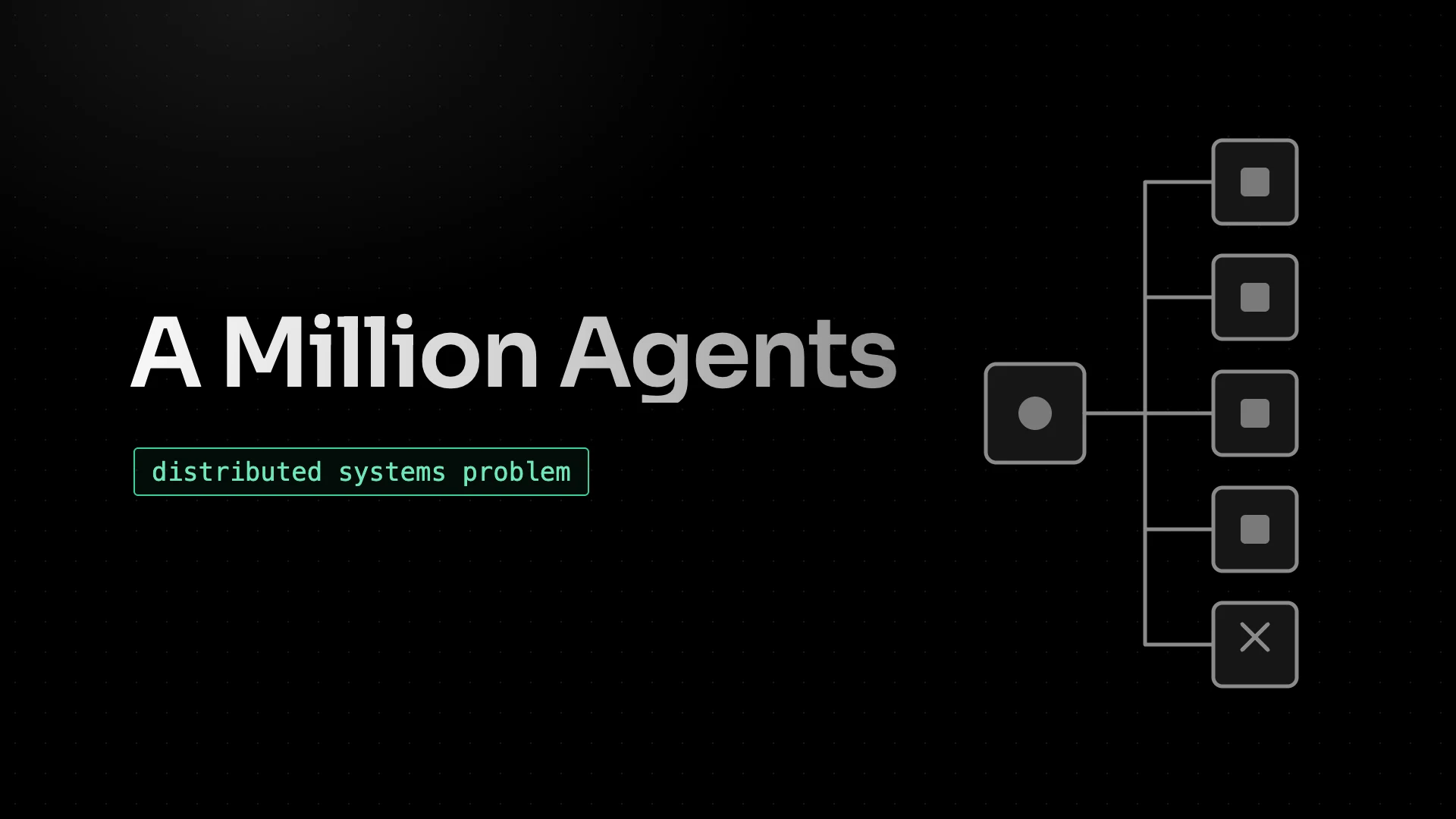
I think about agents the way I think about people. One agent is a worker. A thousand agents is an organization, and an organization of machines is a distributed system.
People keep telling me agents can run forever. Technically that's true. You can call a model in a loop until your credit card declines. But the agent still runs on finite stuff: tokens, context, compute, memory, tools, money. Something always runs out.
Humans aren't that different. We work for a while and get tired. Our working memory is tiny. We forget things. So we write the important parts down, sleep, and come back the next morning with a clear head and the same identity.
Machines have the same constraint in a different shape. A box runs out of CPU. A pod runs out of memory. Nobody fixes that by assuming every process should live forever. We schedule work over the resources we have.
I don't see why intelligence gets a pass. An agent can work for a while, write down what matters, clear its context, and let itself or another agent pick up from there. We run our own coding agents on VPSes at InsForge, and they get killed, restarted, and run out of context all the time. The failures that actually hurt are the ones where the plan lived only inside the agent's context window.
This stopped being an analogy a while ago. There's a whole research line building it.
AIOS, an "LLM Agent Operating System" out of Rutgers, opens with the problem in one sentence:
"Allowing unrestricted access to LLM or tool resources can lead to inefficient or even potentially harmful resource allocation and utilization for agents."
Their answer is a kernel. Every agent request gets broken into system calls (an LLM call, a memory read, a storage write, a tool use), a scheduler decides whose call runs next using the classics, First-In-First-Out and Round Robin, and a context manager snapshots an agent mid-task so it can be interrupted and resumed. They report up to 2.1× faster execution when serving agents built on existing frameworks.
Scheduling, context switching, memory management, storage, access control. That's an operating system. The processes just happen to think.