// NASA BREAKING NEWS — SPAZIO & SCIENZA
2026-2027 DWU: High School Engineering Challenge
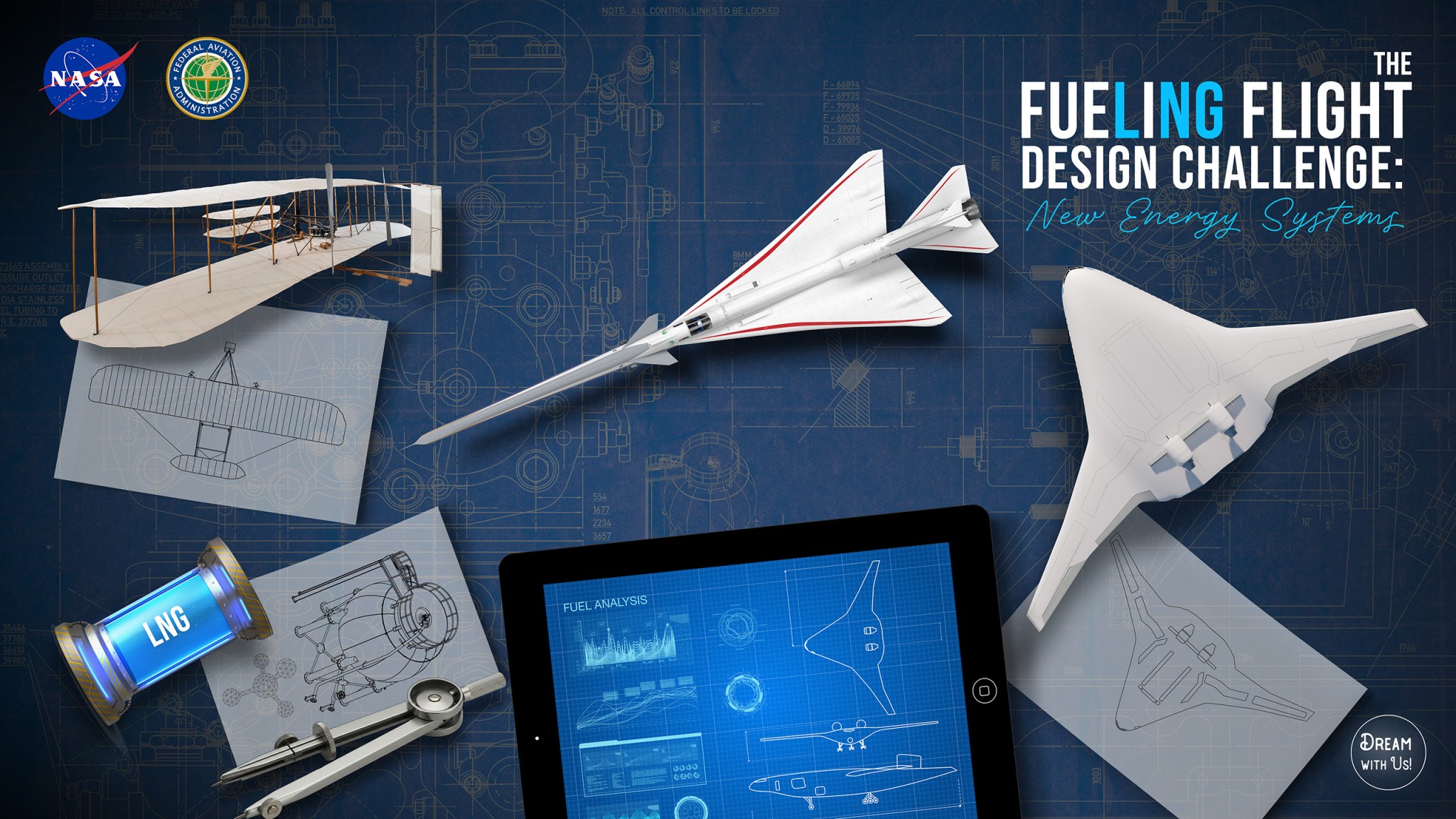
The 2026-2027 challenge theme is, “Fueling Flight Design Challenge: New Energy Systems.”
As more and more aircraft are a part of the US’ National Airspace System (NAS), NASA and partners at the FAA, at universities, and in the aviation industry are searching for ways to increase safety, make flight more affordable, find new fuels for aircraft, and reduce the amount of time passengers and cargo spend in the air. This year’s Dream with Us Challenge focuses on new aircraft fuels and how even the addition of one new fuel will change both the aircraft they are used in and the airports where aircraft take off and land.
The “Fueling Flight Design Challenge: New Energy Systems” challenge is open to middle and high school students, with a different task for middle school teams and high school teams. Teams for both categories will focus on the addition of an emerging aircraft fuel source, liquefied natural gas (LNG) into our aviation environment. This will require teams to learn more about LNG, how it might be used in aviation, the benefits of an additional fuel source, and what kind of changes would need to be made to aircraft and to airports to adapt to these new changes.
Since the early days of aviation, commercial aircraft have relied on traditional designs and infrastructure. Aircraft have been a similar “tube-and-wing” design, with limitations that were made because of the materials aircraft were made with, along with the technology to build these aircraft. With the increasing availability of new technologies and new materials, aircraft no longer need to follow the same basic design. In addition, new research about fuel types, increasing demand for more flights and more fuel has resulted in many different options that include types of fuel, increasing electrification, and more. That also means airports are going to need to adjust. Changes in airport infrastructure will be needed to add multiple fuel types, different gateway configurations to allow for new aircraft types, and perhaps even different areas for different aircraft. What will this all look like? That partially depends on researchers and designers in the future since these are challenges the aeronautics community is starting to face now and will continue to do in the future.
Globally each year, over 62 million metric tons of air cargo are transported, which is more than 33% of global trade by value. This equates to about $8.3 trillion annually. With these large numbers, even a small increase in efficiency can have a large economic impact.
A major air freight company has announced that they are looking to replace some of their fleet with a new aircraft and are interested in new designs to increase efficiency and that will utilize a different type of fuel. Your team has been tasked by your aircraft company to develop a new concept cargo aircraft to present to the air freight company. Your team has been directed to focus on a design that will use liquefied natural gas, or LNG. Since LNG must be stored differently than traditional jet fuel, the aircraft design needs to adapt. These changes, however, may lead to innovative designs that are more aerodynamically efficient.
The air freight company has provided the following requirements.
Teams will be provided with performance information for the jet engine.
The high school module is for students in grades 9 – 12. Students in grades 6 – 8 will use the middle school module. See the Dream with Us main webpage for details. Note: for teams that have both middle and high school students, those teams will compete in the high school challenge.
The high school challenge is open to all participants in grades 9 – 12 who are attending public, private, parochial, and home schools in the United States of America and children of U.S. military members stationed overseas.