// ARS TECHNICA — MOBILE & WEB
What butterfly wings have in common with barbershop poles
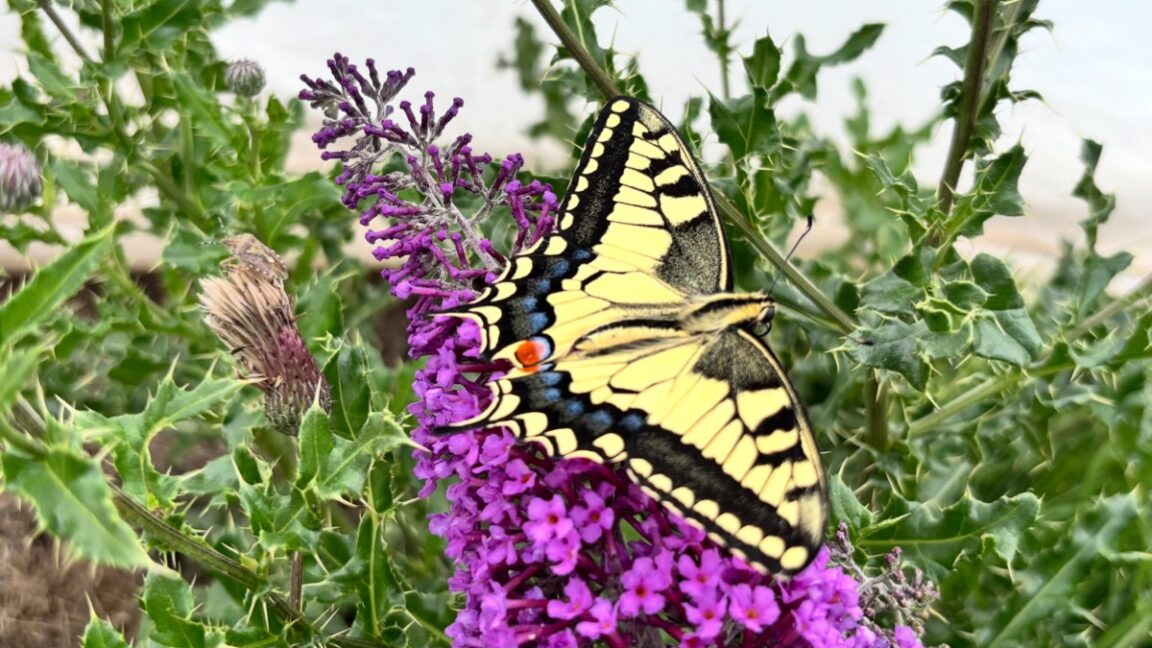
Wing patterns, flight dynamics create “motion dazzle” effect, make it harder to gauge speed, direction.
Old-fashioned striped barbershop poles turn in place on a vertical axis, but humans typically perceive the stripes moving upward rather than turning with the pole. It’s a well-known visual illusion arising from processing biases in human vision. According to a new paper published in the journal Nature, a similar effect could explain how butterflies often evade predatory birds: Their flight patterns and wing patterns combine to make it hard for predators to accurately gauge speed and direction.
“The stripes and spots on many butterflies’ wings interfere with the way visual systems try to guess the direction and speed of moving things, boosting false motion cues while hiding the butterfly’s true heading,” said co-author George Hancock of the University of Exeter in Cornwall. “The illusions interfere with the predator’s most basic visual targeting system and disrupt the final ‘ballistic attack’ in the tens of milliseconds when it commits to grabbing its prey, with no time to change course. As a result, birds and other predators will often simply miss.”
Butterfly wings have long fascinated scientists, ever since the first documentation of the growth of said wings back in 1938. By 2021, researchers at MIT had captured on video the unique structural growth of butterfly wings—continuously, as a butterfly develops inside its chrysalis—for the very first time. Butterfly wings are an example of structural color in nature: the bright iridescent colors don’t come from pigment molecules but from what physicists call photonic crystals. The scales of chitin (a polysaccharide common to insects) are arranged like roof tiles. Essentially, they form a diffraction grating, except photonic crystals only produce certain colors, or wavelengths, of light, while a diffraction grating will produce the entire spectrum.
The purpose of the patterns on butterfly wings has also inspired debates about how their striking coloration is linked to their evolution and behavior, from sexual signaling and thermoregulation to camouflage. Hancock et al. wanted to explore a paradox: butterfly wings sport visually striking patterns that make them stand out, yet there are very few predators capable of catching them mid-flight. This is in stark contrast to more plainly colored moths, for example, which are the preferred prey of many airborne predators. The team suspected the wing patterns could serve as an anti-predator defense via a form of camouflage called “motion dazzle.”
Take the distinctive striped pattern of the zebra. Many scientists thought those stripes were an example of disruptive camouflage, combining counter-shading with blending into the background. But a 2014 simulation study concluded that when the zebra is in motion, the stripes serve to confuse predators and biting insects by inducing two visual illusions: the wagon-wheel effect (inverting the perceived motion) and the aforementioned barbershop pole illusion.
It’s not limited to zebras; certain snakes and lizards may use motion dazzle, too. And in 2024, researchers at Macquarie University demonstrated that a small striped coral reef fish called the humbug damselfish—known for its striking black-and-white stripes—also uses motion dazzle to evade predators. The damselfish adapt their behavior to their environment. If they are against backgrounds that resemble their own striped patterns, they will move closer and reduce their movements. But when outside the coral colony, the damselfish move faster, blurring the edges of their bodies so they are harder to spot. This also makes it harder for predators to accurately judge their speed or direction.
Hancock and his team combined multiple lines of evidence to test their hypothesis that the colorful wing patterns of butterflies served as a form of motion dazzle. First, they took high-speed video footage of various species of real butterflies taking off