// HACKER NEWS — CYBERSECURITY
Halfspace experimental IDE for solid modeling with distance fields
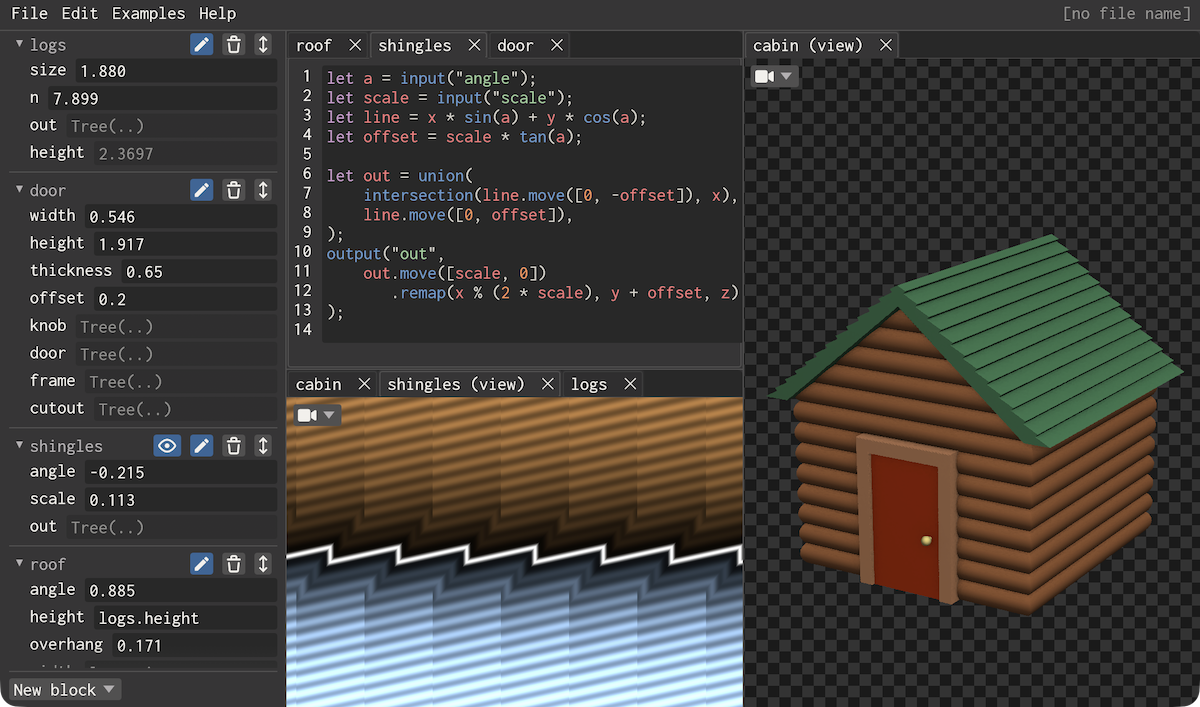
Halfspace is an experimental IDE for
solid modeling with distance fields.
(The demo is best experienced on a computer; mobile Safari has some WebGPU
issues, and pan / tilt / zoom interactions are not yet designed for multitouch)
Halfspace is a showcase app for the Fidget kernel, which is used
for rasterization and meshing. Within the GUI, images are rasterized in
real(ish)-time; models can be exported as either images or triangle meshes:
Since it's 2026, let me note at the outset that this is not vibe-coded.
I've been working on it since
April 2025
and am writing the code using my human brain, for
various reasons
(and Fidget dates back to
2022).
Now, the rest of this writeup assumes some knowledge of implicit surfaces;
please see many previous
writeups for details for more
background info (or just keep reading, you'll be fine).
I've spent a bunch of time writing implicit kernels, slightly less time writing
GUIs on those kernels, and even less time actually modeling with those tools.
In practice, I don't actually need to do much solid modeling in my daily life,
so most of the stuff that I create is a demo or an example of how to use a
particular kernel.
Still, I've noticed a particular tension when working with implicit surfaces.
Working with low-level implicit surfaces is a bit like writing assembly: it's
low-level, powerful, and annoying. If all you're given is x, y, z
variables – and it's your responsibility to combine them into all the shapes of
your dreams – that can be a painful experience.
When faced with the pain of writing assembly, most people build abstractions on
top of it: high-level languages and libraries that compile down to a low-level
representation. The equivalent here is a standard library of shapes and
transformations: sphere, box, translate, scale, etc.
There's also a less common approach to the pain of assembly: making assembly
itself less painful to write.