// NATURE NEWS — SPAZIO & SCIENZA
Harmful tau spreads like self-propagating prion proteins
Kayleigh Mason-Chalmers is in the Department of Chemistry and Biochemistry, the UCLA-DOE Institute for Genomics and Proteomics, and the STROBE NSF Science and Technology Center, University of California, Los Angeles (UCLA), Los Angeles, California 90095, USA.
Search author on:
PubMed
Google Scholar
Jose A. Rodriguez is in the Department of Chemistry and Biochemistry, the UCLA-DOE Institute for Genomics and Proteomics, and the STROBE NSF Science and Technology Center, University of California, Los Angeles (UCLA), Los Angeles, California 90095, USA.
Search author on:
PubMed
Google Scholar
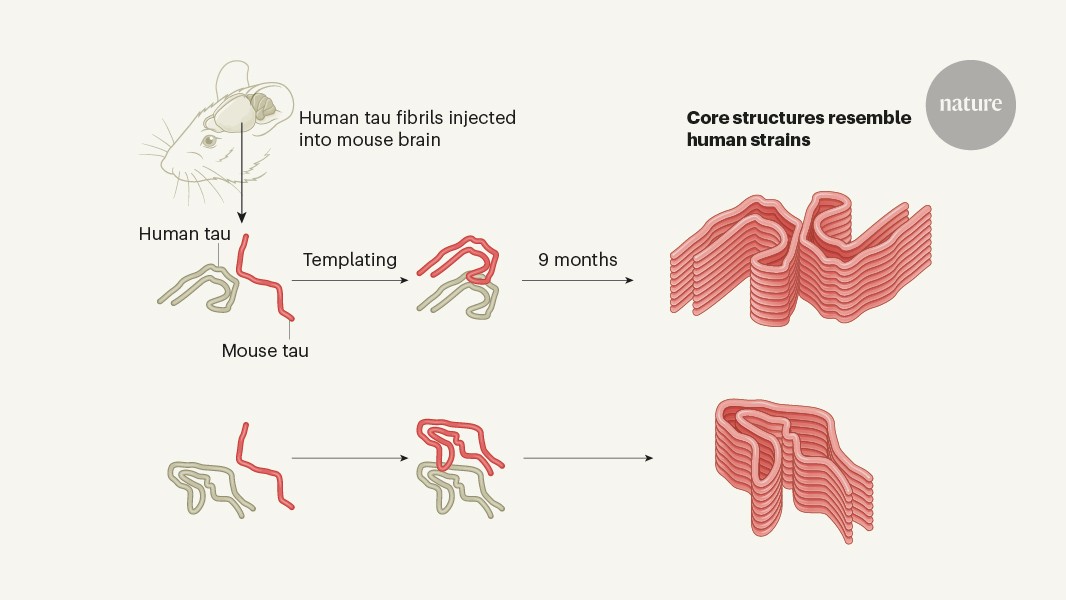
Prions are shape-shifting, self-assembling proteins that transform from a physiologically harmless version into one that is misfolded, prone to aggregation and infectious. What makes prions and prion-like proteins capable of causing disease is their ability to act as templates, forcing normal functional proteins into a toxic form. Several proteins that are associated with neurodegenerative diseases, such as amyloid-β, α-synuclein and tau, are thought to spread in a prion-like manner1,2, but experimental support for some aspects of this hypothesis and its atomic basis have been lacking. In their paper in Nature, Lövestam et al.3 show that injecting human tau fibrils into mice causes mouse tau to take on the form of the injected structures, bolstering the theory that tau propagates similarly to prions.
Access Nature and 54 other Nature Portfolio journals
Get Nature+, our best-value online-access subscription
Prices may be subject to local taxes which are calculated during checkout
Article
PubMed
Google Scholar
Weingarten, M. D., Lockwood, A. H., Hwo, S. Y. & Kirschner, M. W. Proc. Natl Acad. Sci. USA 72, 1858–1862 (1975).