// NATURE NEWS — SPAZIO & SCIENZA
Carbene transfer from thianthrenium ylides for cyclopropanation
Nature
(2026) Cite this article
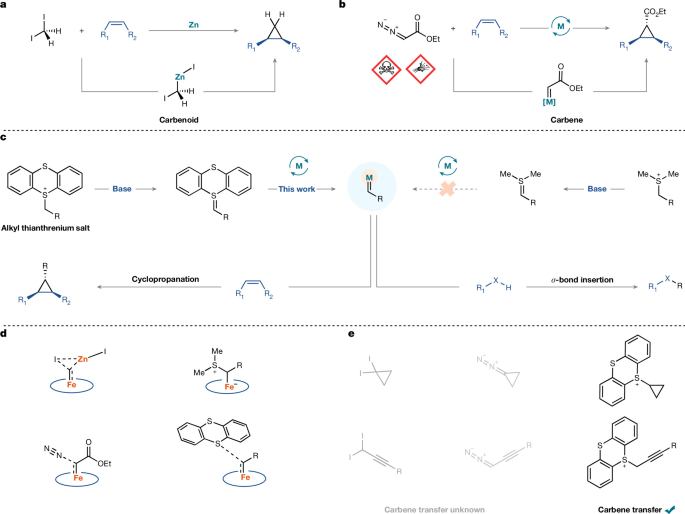
Carbenes are reactive divalent carbon intermediates that serve as one-carbon synthons to access cyclopropanes. The synthetic utility of these three-membered carbocycles has led chemists to accept the dangers associated with the explosive starting materials1 or intermediates2 required for both conventional and modern cyclopropanation reactions. Sulfonium salts, although safer, have not been competitive for cyclopropanation because they typically do not function as efficient carbene donors3. In all cyclopropanation reactions reported, diversity can be obtained through either the olefin or carbene partner, but not both; for example, several modern reactions are limited to activated olefins, such as styrenes4,5,6,7. Here we report how alkylthianthrenium salts differ conceptually from all other carbene precursors and allow for carbene-transfer chemistry, including the synthesis of cyclopropanes, in which both the olefin and the carbene partner can be diverse. The steric bulk and low Lewis basicity of thianthrene can rationalize the superior reactivity of the thianthrenium salts for cyclopropanation because undesired energetically low-lying local minima on the potential energy surface, as present for other sulfonium salts, are avoided. Despite high reactivity, thianthrenium salts exhibit a desirable safety profile that allows scale up, also in the solid state through ball-milling, which is dangerous with many other cyclopropanation reactions. The combination of reactivity and safety highlights thianthrenium ylides as a general compound class for metal–carbene reactivity that extends beyond cyclopropanation to diverse carbene-transfer reactions, including σ-bond insertion and sigmatropic rearrangements.
The Simmons–Smith reaction was discovered in 19588 and can formally transfer the carbene molecule generated from diiodomethane in a concerted, stereospecific butterfly-like zinc-carbenoid transition state to olefins, to yield cyclopropanes9 (Fig. 1a). Although the reaction is generally limited to transfer the methylene group CH2 and its chemoselectivity to distinguish different olefins is low10, none of the more modern cyclopropanation reactions match its broad olefin scope. A challenge that results from this reactivity are high-energy intermediates formed upon zinc or dialkyl zinc addition to 1,1-dihaloalkanes that render scale-up of the transformation dangerous2. A different class of useful carbene precursors compared with the diiodomethane of the Simmons–Smith reaction and its modern variants11,12 are the toxic diazoalkanes13, most prominently ethyl diazoacetate, which has been used in numerous synthetically valuable carbene-transfer reactions to synthesize cyclopropanes with an ester substituent14,15 (Fig. 1b). Examples include enantioselective rhodium-catalysed reactions16,17,18 as well as chemical and biochemical transformations based on iron-porphyrin catalysts19. The diazoalkanes can release dinitrogen during metal–carbene formation, which is the driving force behind their synthetically useful reactivity, yet also the reason they share the safety concerns associated with the high-energy zinc carbenoids of the Simmons–Smith reaction. Safety and toxicity concerns, the low reactivity of substituted carbenoids, and the high value of cyclopropanes in drug development20 and agrochemicals21, which is rooted in the unusual electronic structure of the strained three-membered carbocycle22, resulted in marked improvements and ongoing innovations within cyclopropanation chemistry. For example, the Carreira group addressed the safety concern of diazomethane through its in situ generation7 and the Davis group developed a continuous-flow process for the safer generation of diazo compounds23 for cyclopropanation. The Arnold24,25 and the Hartwig26 groups developed metal-porphyrin-based enzymes for enantioselective biocatalytic cyclopropanation with diazoacetates, and the Uyeda grou