// NATURE NEWS — SPAZIO & SCIENZA
Transcription pause and elongation regulators mediate somatic hypermutation
Nature
(2026) Cite this article
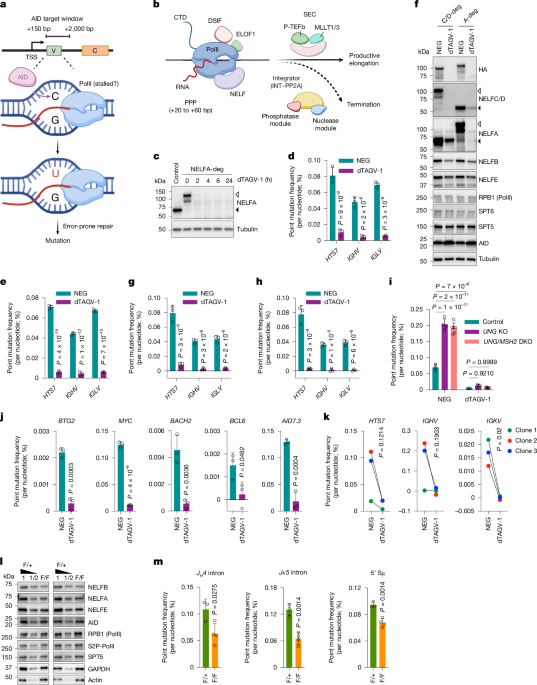
Somatic hypermutation (SHM) creates point mutations in the variable regions of immunoglobulin genes in activated B cells to support antibody affinity maturation1. SHM is initiated by activation-induced deaminase (AID), and the single-stranded DNA substrate of this cytosine deaminase is thought to arise during RNA polymerase II (PolII) transcription, perhaps in the context of PolII stalling2,3. The factors and mechanisms that mediate AID chromatin recruitment and generate its putative stalled PolII substrate during SHM are unknown. Negative elongation factor (NELF) stabilizes PolII in a paused state near the transcription start site. Release of NELF from PolII and the PolII elongation-versus-termination decision are regulated by opposing super elongation complex (SEC) kinase and integrator–protein phosphatase 2A (INT–PP2A) activities4. Here we demonstrate that NELF, the SEC components MLLT1 and MLLT3 and the INT–PP2A phosphatase module are required for SHM. We show that NELF can associate with PolII in the AID target window in the gene body and that, in the absence of NELF, AID fails to deaminate its targets despite efficient recruitment to chromatin and transcription by PolII. MLLT1 and MLLT3 interact with AID through their histone-binding YEATS domain and are required for AID enrichment at its target sites. We propose a physiological function for the NELF–PolII association in gene bodies in creating the stalled PolII substrate for AID action during SHM.
The mechanisms that coordinate the action of AID with PolII transcription have not been established. Nor have the factors that restrict SHM to a target window from about 150 bp to 2 kb downstream of the transcription start site (TSS)5,6 and mediate AID recruitment to its physiological immunoglobulin locus targets and non-immunoglobulin off-target loci (Fig. 1a). After initiation, PolII tends to pause 20–60 bp downstream of the TSS (the promoter-proximal pause (PPP)) stabilized by NELF and DRB-sensitivity-inducing factor (DSIF; composed of SPT4 and SPT5)4,7 (Fig. 1b). NELF, composed of subunits A, B, C/D (isoforms produced from the same gene) and E, is a dedicated PolII pause factor found primarily at TSSs in association with PolII8,9,10,11,12. In the paused NELF–DSIF–PolII complex, NELF promotes PolII pausing by stabilizing an elongation-incompetent configuration of the DNA–RNA hybrid in the PolII active site and inhibiting binding of PolII to the transcription elongation factors TFIIS, SPT6 and the PAF1 complex (PAF1c)13,14.
a, Simplified model of SHM. C, constant region; V, variable region. b, Schematic of the two known fates for PolII at the PPP. c, Blot of the time course of NELFA degradation. Control, RASH-1C extract. Open triangle, degron fused protein; filled triangle, endogenous protein. n = 1. d,e, Point mutation frequencies in NELFA degron (d) and NELFC/D degron (e) RASH-1C cells treated with dTAGV-1 or dTAGV-1 NEG for 4 h and 2 days of doxycycline (as for other degron experiments here unless indicated otherwise). For all plots of mutation frequency, data are presented with the no-doxycycline background subtracted; raw, unsubtracted data are tabulated in the Source data. n = 3. Analysis of variance (ANOVA) in d: F1,12 = 498.0, P < 0.0001. ANOVA in e: F1,12 = 6227, P < 0.0001. f, Western blots of NELFC/D degron (C/D-deg) and NELFA degron (A-deg) RASH-1C cells. Open triangle, degron fused protein; filled triangle, endogenous protein. n = 1. g,h, Point mutation frequencies in G1-arrested NELFA degron (g) and NELFC/D degron (h) RASH-1C cells. n = 3. ANOVA in g: F1,12 = 416.2, P < 0.0001. ANOVA in h: F1,12 = 365.8, P < 0.0001. i, Point mutation frequencies in IGHV in NELFA degron cells with UNG knockout (KO) or UNG and MSH2 double KO (UNG/MSH2 DKO). n = 3 in control, n = 4 in UNG KO and n = 6 in UNG/MSH2 DKO. ANOVA: F2,20 = 83.27, P < 0.0001. j, Point mutation frequencies at AID off-target loci in UNG KO, BCL